When it comes to luxury watch investments, few names command the same prestige and timeless pull as Cartier. Famed for its seamless blend of fine jewelry craftsmanship and watchmaking excellence, Cartier has long been a symbol of sophistication, heritage, and design innovation. From royalty to modern collectors, its timepieces have adorned the wrists of those with a sharp eye for both style and value.
But beyond the aesthetic allure, how do Cartier watches actually perform as investment assets? Can they deliver strong returns and hold their value in an evolving pre-owned market?
In this guide, you’ll find a close look at the investment appeal of Cartier watches, the most sought-after models, historical and current value trends, and expert strategies for anyone thinking about adding Cartier timepieces to their portfolio.
Table of Contents
History of Cartier Watches
The history of Cartier watches is a story of innovation, elegance, and enduring prestige, rooted in the heart of Paris and refined over more than a century of horological mastery. Founded in 1847 by Louis-François Cartier, the maison first made its name through exquisite jewelry. But it was the family’s move into watchmaking that cemented Cartier’s legacy as a global icon of luxury and design.
The brand’s defining moment came in 1904, when Louis Cartier created the Santos de Cartier for Brazilian aviator Alberto Santos-Dumont. Frustrated by the impracticality of pocket watches during flight, Santos-Dumont needed a better solution, and Louis Cartier delivered one of the first wristwatches ever designed specifically for men.
That revolutionary concept changed the way men wore timepieces and laid the foundation for Cartier’s bold approach to form and function.
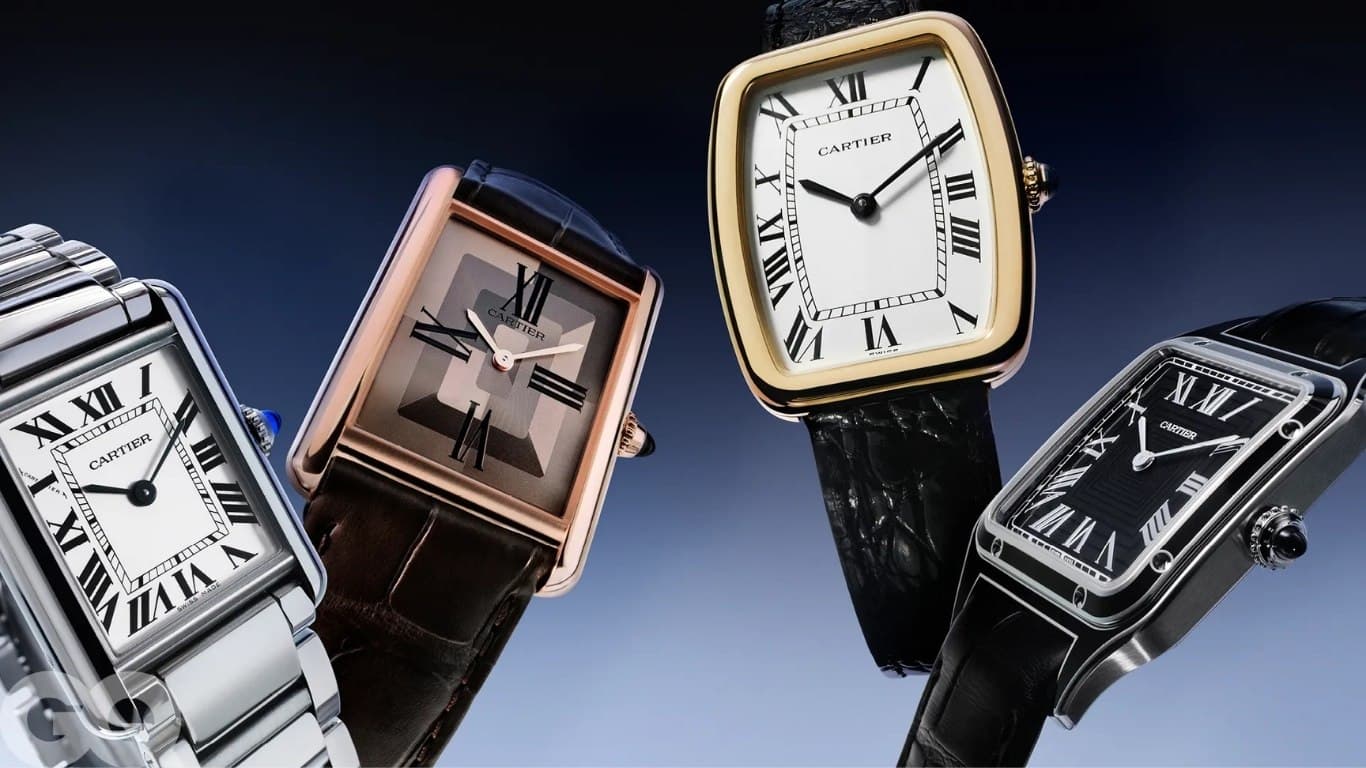
Cartier kept pushing boundaries with the Tank watch in 1917, inspired by the silhouette of World War I military tanks. Its clean rectangular lines and architectural form made it an instant classic, worn by style icons like Jackie Kennedy, Princess Diana, and Andy Warhol. Over time, the Tank evolved into distinct references including the Tank Française, Tank Américaine, and Tank Louis Cartier, each offering its own interpretation of the original vision.
Throughout the 20th century, Cartier built a reputation for blending art deco aesthetics, fine materials, and technical precision. Timepieces like the Pasha de Cartier, Ballon Bleu, and Panthère de Cartier expanded the house’s watchmaking identity, appealing to both men and women with designs that were daring yet timeless.
In more recent decades, Cartier deepened its commitment to haute horlogerie by establishing the Cartier Manufacture in La Chaux-de-Fonds, Switzerland. That facility is where high complications like tourbillons, perpetual calendars, and skeletonized movements are crafted with meticulous attention to detail.
Today, Cartier stands as one of the few brands that bridges fine jewelry and fine watchmaking, producing timepieces that embody refined taste, historical weight, and mechanical excellence.

Factors Affecting Cartier Watch Value
Before diving into specific Cartier models, you need to understand what actually drives the value of a luxury watch. Aesthetic beauty and brand prestige matter, but several other elements can shape your potential return on a Cartier investment.
- Brand Prestige: Cartier is one of the most recognized and respected names in the world of luxury watches and jewelry. Its legacy, favored by royalty, heads of state, and celebrities for over a century, gives Cartier an edge in resale value and long-term appreciation. Iconic models like the Tank and Santos solidify Cartier’s reputation for timeless, classic design, making them consistently sought after by collectors.
- Material and Craftsmanship: Cartier watches are known for exceptional craftsmanship and the use of high-quality materials such as stainless steel, 18k gold, or platinum. The use of diamonds and other precious stones in certain models enhances their value, particularly in limited editions. This combination of top-tier materials and intricate watchmaking ensures that Cartier watches maintain their luxury status, making them a reliable choice for investors.
- Limited Editions and Rarity: Limited-edition Cartier watches appreciate in value more than mass-produced models. Rarity drives demand, significantly affecting the resale value of these watches. Rare editions of models like the Cartier Panthère or Tortue have seen notable price increases in the pre-owned market due to their scarcity.
- Historical Significance: Some Cartier models are tied to significant historical events or famous figures, adding value as collectibles. For instance, the Cartier Santos, one of the first wristwatches made for men, holds strong historical value. Collectors are often willing to pay a premium for watches with such historical ties or unique stories.
- Condition and Provenance: A watch’s condition is critical in determining its investment potential. Watches that are well-preserved or professionally serviced retain or even increase in value. Additionally, a watch’s provenance—its ownership history and documentation—can significantly impact its price, with well-documented watches fetching higher resale prices.
Popular Cartier Models for Investment
Not all Cartier models carry the same investment potential. While the brand offers a wide range of timepieces, certain references have a proven track record of appreciating over time, driven by design, historical significance, and rarity.
Cartier Panthère
The Cartier Panthère is one of the maison’s most elegant and enduring designs. First introduced in the 1980s, it was conceived as a luxurious feminine timepiece, instantly recognizable by its fluid link bracelet and refined square case.
After being discontinued for a period, Cartier reintroduced the collection in 2017, modernizing the design while preserving its classic allure.
The Panthère’s investment appeal comes down to its timeless style, iconic status in high fashion, and growing collector demand. Worn by celebrities and style icons for decades, it has transcended trends and quietly established itself as both a luxury accessory and a reliable asset.
Prices for the Cartier Panthère generally run from $5,000 to $15,000, depending on the model, materials, and condition. Stainless steel and two-tone references tend to sit in the lower part of that range, while solid gold versions, especially those set with diamonds, can push past $20,000.
In rare cases, vintage or limited-edition Panthère models in precious metals or with distinctive dials have sold for $30,000 or more on the secondary market.
In terms of ROI, the Panthère has shown modest but consistent appreciation, particularly for vintage references from the 1980s and 1990s. Collector interest in earlier models has been growing, especially for pieces in excellent condition with original packaging and documentation. The Panthère won’t appreciate as aggressively as a Rolex or Patek Philippe, but it holds strong appeal for buyers focused on rarity, elegance, and enduring design.
Cartier watches with factory-set diamonds, 18k gold cases, or rare dial variants tend to perform best on the secondary market. Well-maintained Panthère models have yielded gains of 10% to 25% over time in some cases. The 2017 reissue also sparked renewed interest across the line, lifting demand for both modern and vintage references. If you want to compare how other dress-watch investments stack up, it’s worth reading about whether the Tissot Gentleman holds its value as a benchmark.
As collector awareness grows, models with full gold cases or precious stone embellishments stay among the most sought-after, particularly when accompanied by original box and papers.

Cartier Santos
The Cartier Santos stands as one of the most historically important models in watchmaking. Originally designed in 1904 for aviator Alberto Santos-Dumont, it was among the very first wristwatches created specifically for men, a revolutionary idea at the time.
Its square case, exposed screws, and clean architectural lines have made it one of Cartier’s most recognizable and enduring designs.
The Santos has stayed relevant because it combines heritage, elegance, and genuine innovation. It has anchored Cartier’s collection for over a century and draws both collectors and investors. Vintage Santos models from the early 20th century are especially desirable, often commanding strong prices at auction due to their rarity and historical weight. Limited-edition references and versions in precious metals like 18k gold or platinum also tend to appreciate well over time.
Modern Cartier Santos watches typically run from $6,000 to $20,000, depending on configuration, materials, and added features like diamond embellishments or mechanical complications. More exclusive versions, particularly vintage or limited-edition pieces, can go beyond $30,000 to $40,000 on the secondary market.
When it comes to ROI, the Santos line offers solid value retention and moderate appreciation potential. It may not climb as fast as high-profile Rolex or Patek Philippe references, but certain rare Santos pieces, particularly vintage examples in excellent condition, have shown steady gains. Comparing the Santos to strong-performing Seiko investment models gives you a useful sense of where dress watches sit across different price tiers.
Watches with original boxes, papers, and documented provenance command a clear premium in the pre-owned market. That documentation isn’t just a nice extra; it’s a real driver of price.
The model’s investment strength ties closely to market demand, rarity, production year, and condition. Early 1970s Santos-Dumont models and those released in limited runs, for example, tend to outperform standard production pieces in terms of long-term value.
Cartier Tank
The Cartier Tank is arguably the most iconic model in Cartier’s history and a cornerstone of luxury watch design. Introduced in 1917 and inspired by the shape of World War I military tanks, the Tank has kept its distinctive rectangular case and minimalist design for over a century.
Its enduring appeal is clear from the wrists it has graced. Jackie Kennedy, Princess Diana, and Andy Warhol all wore the Tank, cementing its status as a symbol of timeless elegance.
The Tank collection spans a wide range of references, from the more accessible Tank Must to the ultra-refined Tank Louis, Tank Américaine, and the rarer Tank Cintrée. That breadth creates entry points for first-time buyers as well as seasoned collectors.
Modern Cartier Tank watches typically range from $2,500 to $50,000, depending on materials, complications, and exclusivity. Entry-level Tank Must models generally sit between $2,500 and $4,500, while mid-range pieces like the Tank Louis or Tank Américaine often sell for $6,000 to $15,000. High-end references, especially vintage models in 18k gold or platinum, or limited editions set with diamonds, can reach $30,000 to $50,000 or more on the secondary market.
From an investment standpoint, the Cartier Tank is known for strong value retention, with certain references showing noteworthy appreciation over time.
Vintage pieces, especially mid-20th-century Tank Louis models and the highly sought-after Tank Cintrée, have seen steady value increases. The Tank won’t match the explosive appreciation of some Rolex or Patek Philippe references, but it performs reliably, particularly when accompanied by original papers and packaging and kept in excellent condition.
Collectors value the Tank for its design consistency and rich historical significance, which has kept demand steady across generations. Special editions, discontinued references, and well-preserved vintage models tend to perform best in resale, with certain pieces appreciating 20% to 40% over a decade, depending on rarity and provenance.

Cartier Ballon Bleu
The Cartier Ballon Bleu, introduced in 2007, is one of the brand’s most successful modern creations. Its distinctive rounded case, smooth curves, and crown tucked beneath a protective arch blend Cartier’s traditional elegance with a contemporary feel.
Despite being a relatively recent addition to Cartier’s lineup, the Ballon Bleu has quickly become a staple in the luxury market. Its universal appeal, wearable design, and versatility have made it popular with celebrities, professionals, and collectors alike. Offered in a range of sizes and materials, it works equally well for casual elegance and formal refinement.
Entry-level stainless steel models are typically priced between $5,500 and $8,500, making them accessible to first-time luxury watch buyers. Mid-range options, including two-tone variants or those on leather straps, generally fall within the $8,000 to $12,000 range. High-end models in solid gold or set with factory diamonds can command prices from $15,000 up to $60,000, especially in larger case sizes or limited-edition releases.
From an investment perspective, the Ballon Bleu is a stable luxury asset that performs well in the resale market. Pre-owned Ballon Bleu watches tend to retain roughly 70% to 90% of their original retail value, with stronger performance in gold or diamond-set references.
Certain limited editions and discontinued configurations have also shown moderate appreciation over time, particularly when kept in excellent condition and sold with original box and papers.
The ROI of Cartier Watches
Cartier may not match the aggressive appreciation rates you see from brands like Rolex or Patek Philippe, but it offers strong long-term ROI, especially for collectors who focus on historically significant, limited-edition, or vintage models.
As one of the most prestigious names in luxury watchmaking, Cartier’s enduring designs combined with rising demand in the pre-owned market have made many of its timepieces reliable and appreciating assets. The Rolex Land-Dweller’s early investment buzz offers a useful contrast for understanding how new releases can move markets compared to Cartier’s steadier, heritage-driven appreciation.
Over the past decade, vintage Cartier watches have appreciated at an average rate of 6% to 10% per year, depending on model, material, and provenance, according to data compiled from WatchCharts and auction houses such as Sotheby’s and Phillips.
Rare models from the 1920s through the 1970s have seen the most dramatic increases, with certain Tank Cintrée and Santos-Dumont pieces exceeding $100,000 at auction in recent years.

Cartier Tank and Santos watches from the mid-20th century rank among the strongest performers in the pre-owned market. A 1970s Cartier Tank Louis in 18k gold, originally sold for under $2,000, can now command $10,000 to $20,000 depending on condition and originality. That’s up to 10x ROI over a 40 to 50 year period.
A Cartier Tank Cintrée from the 1920s sold at Christie’s in 2021 for CHF 106,250, far exceeding its pre-sale estimate.
One of the strongest investment performers in Cartier’s catalog is the Cartier Crash, known for its surreal design and limited production. A London-made 1990s Crash sold in 2022 for over $225,000, while original 1967 models have fetched more than $1 million at auction, underlining Cartier’s potential for ultra-high-end investment upside.
The Cartier Tank Américaine, introduced in 1989, has also shown solid growth. Originally priced around $5,000, certain models, particularly those in gold with mechanical movements, now sell for $10,000 to $50,000, depending on configuration and condition.
That model has consistently retained 80% to 90% of its retail value, with limited references appreciating well beyond that threshold.
Limited-edition Cartier Panthère and Santos models from the 1980s and 1990s, particularly in two-tone or full gold, have gained real traction in the collector space. The Santos Galbée in gold and steel, once trading for under $3,000, now regularly sells in the $5,000 to $7,500 range, reflecting growing vintage appeal. If you’re thinking about how alternative collectibles like rare coins are moving within sophisticated portfolios, the trend of family offices increasing rare coin holdings alongside art and real estate tells a similar story about tangible asset demand.
The Cartier Ballon Bleu, while more modern, shows healthy retention figures. Stainless steel models typically hold 70% to 85% of their retail value, while gold and diamond-set variations perform better, with resale values reaching up to 90% of original prices. The Ballon Bleu also ranks consistently in Cartier’s top three most searched models, signaling ongoing demand.
Across the broader market, Bloomberg and secondary market data show Cartier pre-owned sales volume rising nearly 40% from 2020 to 2023, driven by global demand and a renewed appreciation for classic, non-sport watch designs. That growth is especially visible in the U.S., U.K., and parts of Asia, where Cartier vintage models now rank among the fastest-selling pre-owned watches under $15,000.
Factors Affecting ROI
Several key factors can shape the ROI you get from a Cartier watch. Rarity and limited production are the most obvious drivers. Condition matters just as much as you’d expect, with well-preserved examples commanding serious premiums. Provenance and original documentation, box and papers included, can push prices noticeably higher. The reference and production year play a role too, since mid-century models and early limited runs consistently outperform standard production pieces. And broader market demand, including collector trends and regional appetite, can shift values faster than many buyers anticipate.
- Condition: Watches in excellent condition, with minimal signs of wear and original components, tend to appreciate more than those that have been heavily worn or restored with aftermarket parts.
- Rarity: Limited-edition or discontinued models are generally more desirable and tend to hold their value better over time.
- Market Trends: Like any investment, the value of a Cartier watch can fluctuate based on market trends, collector interest, and broader economic conditions. It’s important to stay informed about the current demand for specific models.
Is a Cartier Watch a Wise Investment?
Cartier watches are not just beautiful and iconic timepieces. In the right circumstances, they can be excellent investments for buyers who choose the right models and think long-term. The brand’s reputation for craftsmanship, its historical significance, and its deep association with royalty and cultural icons all strengthen its position in the luxury watch market.
Models like the Cartier Tank, Santos, and Panthère have shown solid appreciation over time, particularly in vintage and limited-edition forms. As with any investment, thorough research, buying from reputable sources, and staying aware of market trends are essential. Whether you’re drawn to Cartier for its timeless design or its investment potential, the right Cartier watch can be both a cherished piece on your wrist and a valuable part of your collection for years to come.
FAQ
Do Cartier watches hold their value?
Yes, Cartier watches generally hold their value well over time. Their iconic designs, premium materials, and strong brand reputation contribute to solid resale value. Factors like model rarity, demand, and condition also play a key role. Vintage and limited-edition Cartiers, in particular, can even appreciate in value, making them a smart choice for long-term investment.
Why should I buy a Cartier watch?
A Cartier watch is more than just a timepiece—it’s a symbol of timeless luxury, crafted with precision and elegance since 1847. Owning one means wearing a piece of history, favored by royalty and tastemakers alike. Plus, Cartier watches are known for holding their value, and in some cases, appreciating over time. It’s a stylish investment that combines prestige with lasting quality.