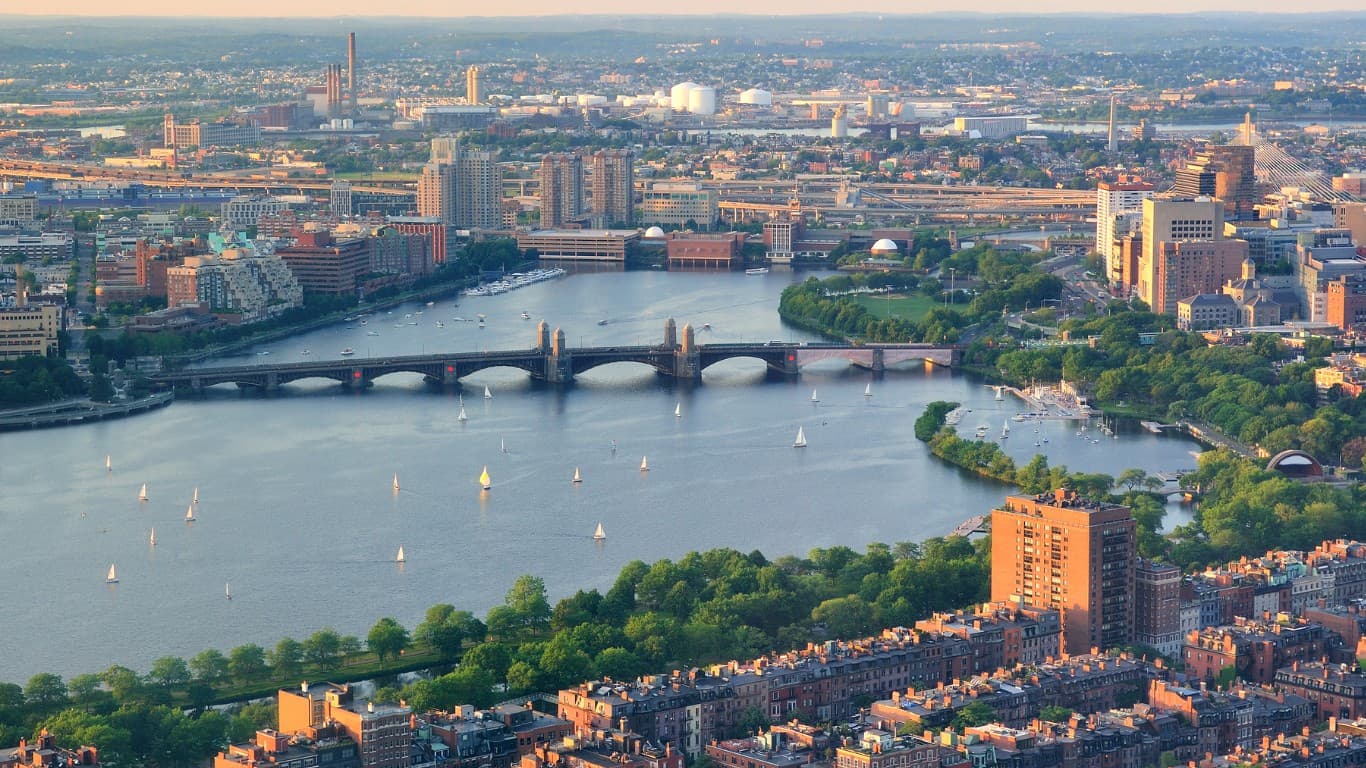
The Boston real estate market in 2026 reads as one of the most structurally insulated property stories in the United States. As of Q1 2026 the median listing price sits at roughly $870,000, up 2. 1 percent year on year, with the median sold price tracking near $850,000 (Greater Boston Association of Realtors data, cross-checked against Compass and Coldwell Banker Realty desks).
The narrow gap between asking and clearing prices tells the structural story we keep coming back to: durable demand, persistent inventory shortages, and one of the most concentrated high-wage employment bases in the country.
That base is the part of the equation Knight Frank's Wealth Report has been flagging in its prime-resilience index. Boston pairs the Federal-era streetscapes of Beacon Hill and the Victorian density of Back Bay with the biotech cluster anchored by Moderna and Vertex, the medical complex of Mass General Brigham, and the academic gravity of Harvard and MIT. Few American cities offer that combination, and the prime tier reflects it.
- Boston continues to anchor the premium Northeast market alongside New York, with the education, biotech and healthcare sector concentration supporting price levels through 2026.
- We see median prices remaining well above the national average, with Harvard, MIT and the broader Cambridge biotech corridor continuing to drive demand into the regional housing stock.
- Back Bay, Beacon Hill and the Seaport continue to anchor the urban luxury segment, with Brookline, Newton and the broader Western suburbs holding the suburban luxury market.
- Inventory has improved modestly through 2025 and 2026, but months-of-supply remains tight across most submarkets compared with most peer metropolitan areas.
- Massachusetts property tax framework keeps effective rates moderate, with the Boston city rate among the more reasonable in the broader Northeast corridor.
- For most considered buyers we view Boston as a structurally premium Northeast market with strong education and biotech sector support, warranting patient capital and long hold horizons.
- Who is this for?
- Buyers and investors evaluating Boston property, alongside relocation clients, academic and biotech professionals and the brokers, lenders and advisers supporting Greater Boston transactions.
- What is happening?
- A market overview and 2026 forecast for the Boston real estate market, covering price levels, inventory dynamics, education and biotech sector employment and the urban versus suburban dynamics.
- When did this emerge?
- The article covers conditions through 2025 and 2026, with reference to the post-pandemic inventory cycle and the latest Cambridge biotech corridor employment data.
- Where is this happening?
- The piece focuses on the Greater Boston metropolitan area, including Back Bay, Beacon Hill, the Seaport, Brookline, Newton and the broader Western suburbs.
- Why does it matter?
- Boston anchors premium Northeast property alongside New York in 2026, which is why understanding the education and biotech sector demand structure matters before any acquisition here.
The Boston housing market today
Active inventory remains tight, with approximately 3,942 active listings and 1,024 new listings entering the market in the most recent quarter. Homes are spending an average of 36 days on the market, which the Greater Boston Association of Realtors describes as strong activity by any measure. Around 34.
7 percent of homes are selling above asking, with the strongest competition concentrated in Cambridge, Back Bay and Jamaica Plain.
The median price per square foot runs about $675. Variation by neighborhood is sharp: Beacon Hill and the Seaport command premiums above $1,100 per sqft, while Dorchester and East Boston still offer relative value below $500 per sqft. Compass and Coldwell Banker Realty desks describe a market where international capital, much of it linked to the city's universities and biotech clusters, continues to concentrate in the prime addresses.
- Median listing price: $870,000, up 2.1 percent YoY
- Median sold price: $850,000
- Active listings: 3,942
- Average days on market: 36
- 34.7 percent of homes selling above asking
- Median price per square foot: $675
Boston neighborhoods defining the prime tier in 2026
Back Bay
Back Bay stands as one of Boston's most photographed neighborhoods, anchored by the Victorian brownstones of Commonwealth Avenue, the Public Garden and the Charles River frontage. The median home price sits at approximately $2. 1 million, up 2.
7 percent year on year. Inventory is scarce and multiple-offer competition is the norm.
Architecturally, Back Bay represents one of the most carefully preserved nineteenth-century planned grids in the country. Engel and Volkers and Sotheby's International Realty list most of the prime Back Bay stock; off-market deals account for a growing share of activity above $5 million.
South End
The South End combines period brownstones with one of the strongest restaurant and gallery scenes in the Northeast. The median listing price sits near $1. 45 million, with prices rising approximately 3.
2 percent over the past year.
Renovated units and contemporary developments along Tremont Street command premiums above $1,200 per sqft. The architectural register is consistent enough that the entire South End Landmark District is on the National Register of Historic Places.
Dorchester
Dorchester has emerged as one of Boston's most active redevelopment zones. The median home price sits at approximately $710,000, with 4.1 percent annual price movement.
Restoration of period three-deckers continues steadily, particularly in the Ashmont and Savin Hill corridors served by the MBTA Red Line. Buyers priced out of Cambridge and the South End are reshaping the buyer composition here meaningfully.
Jamaica Plain
Jamaica Plain appeals to buyers seeking suburban character with urban access. The strong arts community, the Olmsted-designed parks and the Arnold Arboretum give the neighborhood a distinct identity that Mansion Global has profiled repeatedly.
The median home price sits at about $920,000, up 3.6 percent year on year. Demand is strongest for single-family homes under $1 million, where competition routinely produces above-asking clearances.
East Boston
East Boston continues to attract buyers priced out of the inner city. Proximity to Logan Airport and expanding waterfront developments are transitioning the area into a mixed-use destination.
The median listing price runs around $790,000, up 3.9 percent year on year. The architectural register is shifting fastest here: contemporary mid-rise developments along the Jeffries Point waterfront sit alongside restored period townhouses on Maverick Square.
The Boston rental landscape
The Boston rental market is among the most expensive and competitive in the Northeast. Average rents sit at $2,150 for studios, $2,850 for one-bedrooms, $3,730 for two-bedrooms and $4,700 for three-bedrooms, climbing approximately 3.4 percent year on year (Apartment List and Zillow rental indices).
Back Bay one-bedrooms average $3,200. South Boston two-bedrooms run $3,950. Fenway and Kenmore one-bedrooms average $2,900, supported by demand from students and hospital staff.
East Boston two-bedrooms run $3,400 and Roxbury one-bedrooms sit around $2,200. The vacancy rate is among the lowest of any major American city, supported by limited new construction and the steady flow of international students and biotech professionals.
What is shaping Boston real estate in 2026
Several forces are pushing the market in the same direction. The employment base remains unusually concentrated in high-wage sectors: Harvard, MIT, Boston University and the broader cluster of universities; Mass General Brigham, Boston Children's Hospital and the rest of the most concentrated medical complex in the country; biotech (Moderna, Vertex Pharmaceuticals, Sanofi-Genzyme); and one of the deepest finance and venture capital ecosystems on the East Coast.
Mortgage rates between 6. 5 and 7 percent on the 30-year fixed have shifted some demand toward the rental sector. The prime tier, where buyers transact in cash, is largely insulated from that pressure.
Major redevelopment works in the Seaport District, the Allston-Brighton corridor and around the MBTA continue to reshape demand around specific corridors.
Where Boston real estate reads now
Home prices are projected to climb between 2.5 and 4 percent through the back half of 2026. Growth is expected to concentrate in Dorchester, East Boston, Jamaica Plain and the redevelopment-driven submarkets where price per sqft still sits well below citywide medians.
Rents are forecast to climb 3 to 4 percent. Vacancy is expected to remain among the lowest in the country, particularly in the corridors serving the medical complex and the universities.
What this means for buyers
For the buyer who values architectural depth, one of the most concentrated high-wage employment economies in the United States, and a city whose academic and medical institutions have shaped its demographic stability for two centuries, Boston continues to read as one of the most structurally important property markets in the country.
The neighborhoods responding most distinctly to the design-led buyer shift, namely Back Bay's Victorian core, the South End brownstones and Cambridge, are quietly outperforming the citywide averages. We last reviewed this analysis in May 2026.
Further reading:
- US Real Estate Market Overview (2026)
- The U.S. Property Markets Defining 2026
- U.S. Luxury Property Is Outpacing the Wider Market, and the Correction Question
Frequently asked
How is the Boston housing market evolving in 2026?
Home prices are projected to rise 2.5 to 4 percent through 2026, supported by the city's concentrated employment economy and persistent inventory shortages. Knight Frank's prime-resilience index continues to flag Boston as one of the more structurally insulated US prime markets.
Which Boston neighborhoods are seeing the most buyer attention?
Back Bay, the South End, Cambridge, Jamaica Plain and East Boston are drawing the most consistent demand from buyers tracking architectural depth and proximity to the academic and medical complex.
How long are homes staying on the market in Boston?
The average is 36 days, with prime properties moving substantially faster. Around 34.7 percent of homes are clearing above asking, with the strongest competition in Cambridge, Back Bay and Jamaica Plain.
How do Boston rents compare against other major cities?
Boston rents rank among the most expensive in the Northeast, comparable to Manhattan for prime neighborhoods and structurally driven by the academic and biotech-related demographic stability. Apartment List and Zillow data show three-bedroom averages near $4,700 monthly.


Savvas Agathangelou
Savvas Agathangelou co-founded The Luxury Playbook and has spent years reporting from the prime postcodes the magazine covers — Mayfair, Knightsbridge, the Athens Riviera, Dubai's Palm crescents, and the southern Mediterranean coastlines where the world's wealthy keep coming back. His background is in international hospitality, and that frame shapes how he writes about property: the developer's choices, the architect's signature, the agency's bench of named brokers, the building's service standard once the buyer moves in. He files developer spotlights, agency profiles, and the seasonal "Properties That Defined" listicles, and he hosts the magazine's founder-and-leadership interviews on the Voices side.