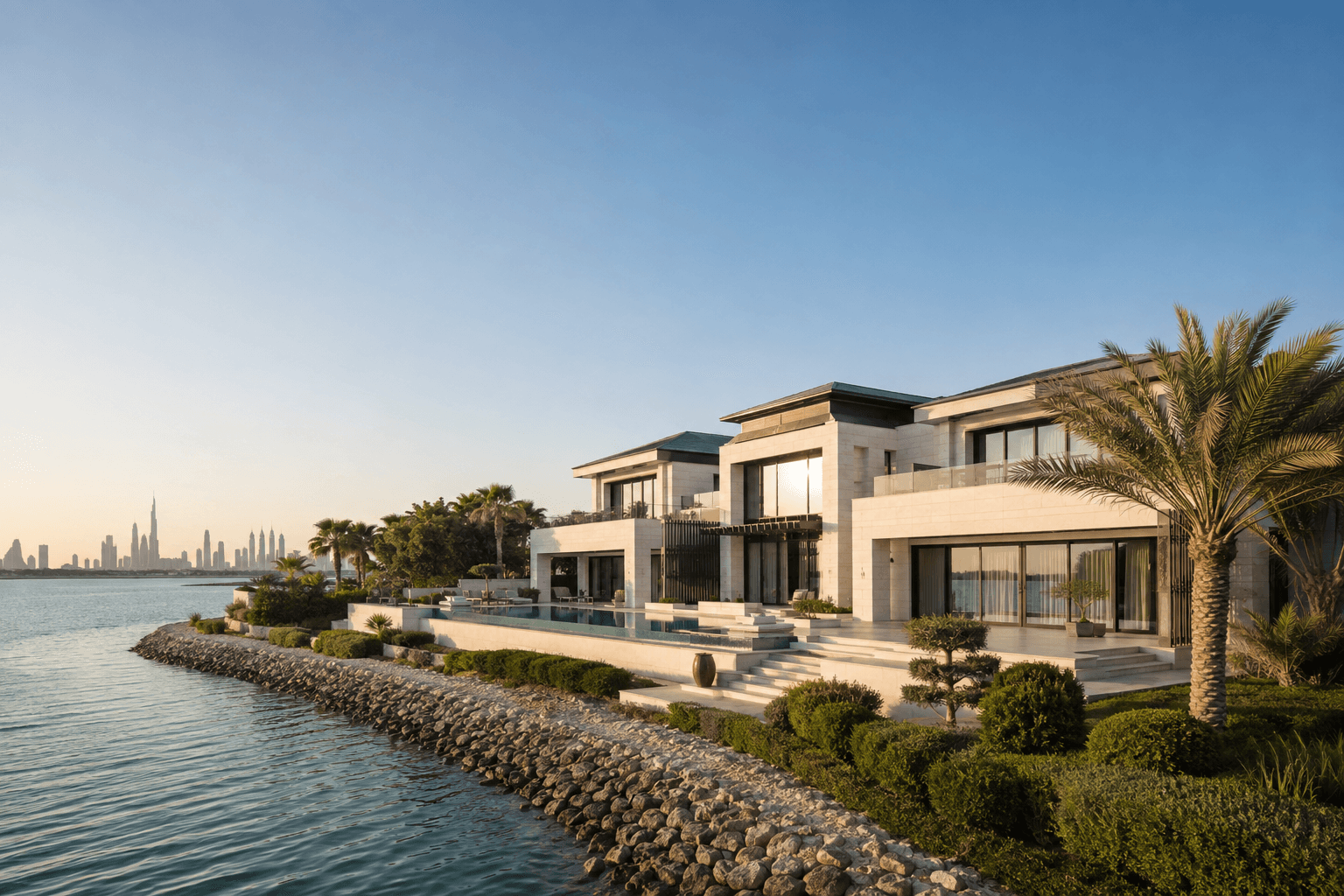
Economics suggests that assets combining constrained supply with structurally rising demand have a strong foundation for preserving and growing capital across market cycles. Applied to global real estate, Dubai's villa segment deserves serious examination.
That does not imply categorical superiority, nor does it exempt investors from risks that belong at the centre of the decision rather than in a footnote. Limited land, demographic change and a mature regulatory framework support the case for selected villas. Interest rates, new supply, location quality and the durability of international wealth inflows determine whether that case survives closer scrutiny.

Key Takeaways
- Prime villas have lower supply elasticity than apartments, but genuine scarcity applies mainly to established and geographically constrained locations.
- Dubai's shift from seasonal ownership towards primary residence has strengthened end user demand among affluent families and executives.
- Average Dubai villa values were almost 100% above their first quarter 2020 level by late 2024, but that exceptional period should not be projected forward mechanically.
- Off plan payment schedules can amplify returns on invested equity during an upswing and amplify losses when values weaken before completion.
- A balanced allocation can combine mature communities with carefully selected growth corridors, provided investors assess delivery risk and local supply separately.
- Who: International buyers and family offices assessing Dubai villas as part of a real estate or wealth preservation allocation.
- What: A risk adjusted analysis of villa scarcity, demand, historical returns and the assumptions required for future performance.
- When: In 2026, after a powerful post pandemic appreciation cycle and while a substantial development pipeline approaches completion.
- Where: Established locations such as Palm Jumeirah and Dubai Hills Estate, alongside emerging corridors such as Tilal Al Ghaf and Dubai South.
- Why: Because villas can combine scarce land, lifestyle demand and tenancy stability, but only when location and supply are examined at community level.
Table of Contents
- Why Villa Supply Behaves Differently
- Wealth Relocation and End User Demand
- How Returns Compare Across Property Types
- The Leverage Inside Off Plan Payment Schedules
- Regulation and the Barbell Allocation
- The Risks That Must Remain in the Model
Why Villa Supply Behaves Differently
Supply elasticity is central to understanding villas relative to apartments. A vertical development can increase its unit count by adding density, subject to planning and engineering constraints. Villas require more horizontal land, making supply less responsive in established communities where plots, waterfront and green space are already defined.
The distinction matters. Scarcity does not describe every villa in Dubai. Large master planned communities in outer districts can introduce substantial volumes of villas and townhouses. The stronger scarcity argument applies to premium land in mature, well connected locations where meaningful new supply is difficult to create.
An investor should therefore resist citywide generalisations. The correct question is not whether Dubai villas are scarce. It is whether comparable villas in a specific community face a credible constraint on future supply. That requires examining planning permissions, competing projects, delivery schedules and the stock already available for resale.
Wealth Relocation and End User Demand
The current cycle differs from earlier periods because more affluent buyers are treating Dubai as a primary residence rather than a seasonal destination. Flexible residency programmes, corporate expansion and the city's appeal to globally mobile entrepreneurs have supported demand for larger homes suited to family life.
This creates more resilient end user demand than a market driven only by short term speculation. A family choosing schools, outdoor space and proximity to work is usually less sensitive to small price movements than a buyer planning a rapid resale.
Resilience is still relative. International demand can respond to changes in tax policy, competing residency programmes, regional conditions and global liquidity. Investors should treat wealth migration as a supportive structural trend, not a permanent guarantee. The same discipline is essential when considering whether Dubai remains a safe harbour for luxury property.
How Returns Compare Across Property Types
A rigorous comparison must combine rental income, capital appreciation, vacancy, maintenance, transaction costs and the intended holding period. Villas can offer lower headline rental yields than apartments, while providing stronger tenant retention and greater exposure to land value in the right location.
The post pandemic cycle was extraordinary. Knight Frank reported that average Dubai villa values in the fourth quarter of 2024 were 99.8% above their first quarter 2020 level. Its third quarter 2024 data placed apartment values approximately 50% above the same baseline. Those figures support the argument that villas outperformed, but they do not establish a normal forward return.
| Comparison Metric | Villas | Apartments |
|---|---|---|
| Supply elasticity | Lower in established prime locations | Relatively higher |
| Indicative net rental yield in the author's source analysis | 5.5% to 7.5% | 6% to 8% |
| Average price change from Q1 2020 | Approximately 99.8% by Q4 2024 | Approximately 50% by Q3 2024 |
| Tenant retention | Often higher for family homes | More dependent on unit and location |
| Golden Visa eligibility | Potentially eligible from AED 2 million | Potentially eligible from AED 2 million |
Rental yields vary by project, purchase price, service charges and occupancy. Historical appreciation is not a forecast. Visa eligibility is subject to current government requirements and individual circumstances.
The Leverage Inside Off Plan Payment Schedules
Off plan payment schedules can create a form of implicit leverage. A buyer controls the contractual right to a future property while paying the purchase price in stages rather than borrowing the entire amount immediately.
If the completed value rises faster than the capital paid during construction, the return on invested equity can be magnified. The reverse is equally important. If market values fall, the buyer remains committed to future payments and may face difficulty assigning the contract or financing completion.
This is why payment flexibility should not be confused with low risk. Buyers must assess the developer, escrow arrangements, construction progress, assignment terms and their own ability to complete without relying on resale. The Luxury Playbook's guide to how property buyers use leverage explains the same principle across financed acquisitions.
Regulation and the Barbell Allocation
Dubai's regulatory framework has matured considerably. The Dubai Land Department confirms that buyer payments for off plan units are deposited into project escrow accounts, while registration systems and transaction data have improved market transparency.
Real estate investors may also qualify for long term residency. The UAE Government states that real estate investment of at least AED 2 million can qualify for a five year Golden Visa, subject to the programme's conditions.
Within a portfolio, one approach is to combine two types of exposure. Established communities such as Palm Jumeirah and Dubai Hills Estate offer mature infrastructure, proven demand and lower execution uncertainty, although their entry prices may restrict future upside. Growth corridors such as Tilal Al Ghaf and Dubai South may offer more appreciation potential but carry greater delivery, timing and local supply risk.
This barbell approach is not a formula. Its purpose is to prevent an investor from mistaking one source of return for another. Mature locations are generally selected for defensibility and utility. Emerging locations depend more heavily on execution and future demand.
The Risks That Must Remain in the Model
The investment case ultimately depends on assumptions that require continuous testing. These include the continuation of wealth relocation, the competitiveness of residency programmes, financing conditions and each community's ability to absorb new supply.
Mortgage costs are influenced by US interest rates because the dirham is pegged to the dollar. Delivery volumes can pressure rents and resale values in locations where similar properties arrive together. International demand can also weaken during a global downturn.
Dubai villas can still be a strategic allocation in 2026, particularly where land is genuinely constrained and the property serves durable end user demand. The strongest decision will distinguish established locations from emerging corridors, historical performance from future assumptions and personal utility from measurable return. The opportunity should be assessed community by community and project by project, not through a single citywide narrative.
Last reviewed September 2026. This article is general analysis and does not constitute investment, legal or tax advice.

Dr. Fahim Alshayea
Dr. Fahim Alshayea is an economic and real estate strategic investment consultant and CEO of Alshayea for Investment and Real Estate Consultancy in Dubai. His work sits at the intersection of economics, law and property strategy, with a focus on how investors assess opportunity, scarcity and long term value across changing markets. He holds a PhD in Civil Law and is a certified legal and economic expert at the Arab Legal Judicial Centre, which is affiliated with the League of Arab States. His analysis and commentary have appeared in The World Financial Review, The European Financial Review, International Affairs Forum and Arabian Wallstreet. At The Luxury Playbook, he writes about real estate economics, strategic investment, market scarcity, affluent consumer behaviour and the relationship between law, capital and long term wealth creation.