
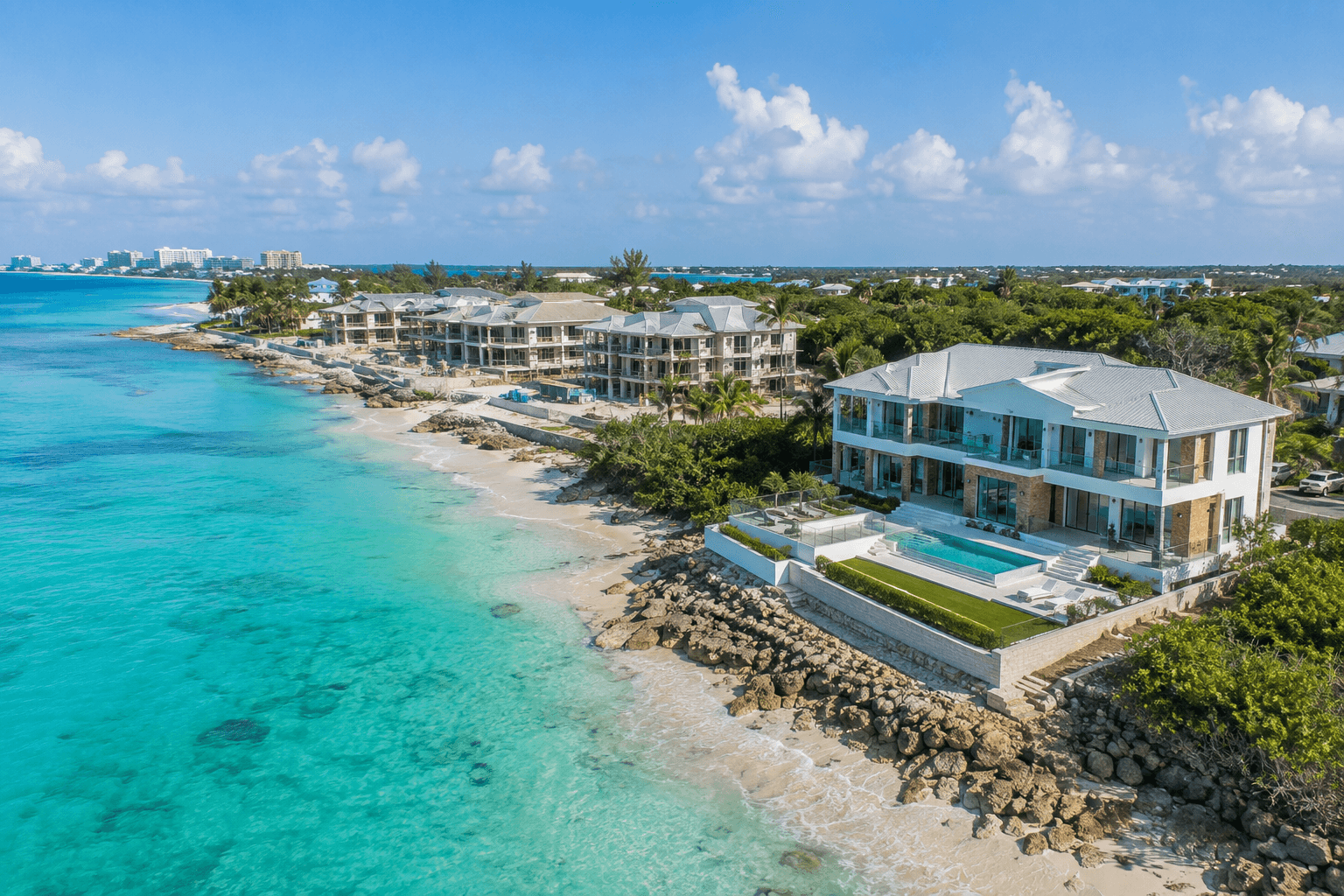
The most interesting property opportunities are rarely found by following capital into markets that have already reached maturity. They emerge where international demand is becoming established but prime supply remains difficult to expand. Grand Cayman may be approaching that point.
London, Monaco, Dubai and New York continue to dominate the global property conversation because they offer recognisable legal systems, deep pools of capital and long records of international demand. Grand Cayman operates at a different scale. Its market is smaller and less liquid, yet it combines English common law, proximity to North America, an established financial services sector and a finite supply of prime coastal land. For globally mobile families, it also offers something increasingly valuable: a place where business, family life and ownership can coexist with relatively little friction.
Frank Schilling has watched that proposition develop over 25 years as a resident, entrepreneur and investor. After building Uniregistry, whose registrar, marketplace and related portfolio assets were acquired by GoDaddy in 2020 for an undisclosed sum, he directed his attention towards hospitality and property projects including Mykonos Steak Club, Secret Beach and the proposed Port Zeus development. His central argument is that early buyers can benefit from a structural feature of the Cayman market: developers need credible presales while desirable new inventory remains limited.
That idea deserves attention, but it also requires precision. Buying before completion can provide a favourable entry point. It can also expose the purchaser to construction, financing and liquidity risk. The opportunity lies in understanding the difference.

Key Takeaways
- Grand Cayman brings together English common law, political stability, international connectivity and a limited supply of prime coastal property.
- Early pricing may favour buyers because developers use presales to prove demand and support project financing.
- Staged deposits can reduce the amount of capital committed at the beginning, while allowing the buyer to secure a future residence at an agreed price.
- The strategy works best for buyers who can complete the purchase. Assignment rights depend on the contract, developer consent and applicable fees.
- As of January 2026, property stamp duty is generally 7.5%, rising to 10% for transactions at or above CI$2 million.
- The strongest properties combine genuine scarcity, compelling design and lasting demand from owners who want to live there.
- Who: International buyers, entrepreneurs and globally mobile families considering prime Caribbean property.
- What: An examination of Grand Cayman property and the advantage early buyers may find in carefully selected preconstruction projects.
- When: During the early sales phase when developers are establishing demand and arranging construction finance.
- Where: Grand Cayman, including West Bay and a limited pipeline of high quality coastal developments.
- Why: Because securing the right property before completion can provide access to early pricing in a market where prime inventory is difficult to replace.
Table of Contents
- Beyond the Offshore Stereotype
- What Frank Schilling Sees After 25 Years
- Why Preconstruction Changes the Entry Point
- How Early Buyer Economics Work
- Secret Beach and Experiential Property
- Port Zeus and Long Term Infrastructure
- Risks Global Buyers Must Price
- Does Grand Cayman Belong?
Beyond the Offshore Stereotype
Grand Cayman is still frequently understood through the narrow language of offshore finance. That description overlooks the characteristics that make a property market durable. Buyers encounter established institutions, modern healthcare, respected schools, ambitious restaurants and direct air connections with major cities in the United States, Canada and the United Kingdom. For an owner dividing time between several jurisdictions, convenience is not a secondary luxury. It is part of the asset's utility.
The ownership framework is equally relevant. The Cayman Islands government states that foreign ownership is permitted and that there are no annual property taxes or direct taxes. Buyers still face stamp duty, professional fees, financing expenses, insurance and strata charges, but the absence of an annual property tax changes the long term cost calculation for a residence held across generations.
For buyers assessing investment across countries, legal familiarity can matter as much as lifestyle. Cayman's English common law foundation and mature professional services sector make transactions more legible to international investors. They do not eliminate risk, but they create a framework in which risk can be investigated and documented.
What Frank Schilling Sees After 25 Years
Schilling describes Grand Cayman as a place where an entrepreneur can build a business without sacrificing family life or access to the wider world. His comparison with Monaco is not a claim that the two markets are identical. It reflects a shared economic logic: compact geography, international wealth, waterfront living and a premium placed on safety, privacy and convenience.
The difference is maturity. Monaco's scarcity has been understood and priced for decades. Cayman still has room to develop, yet approvals take time and truly desirable coastal sites cannot be manufactured. As more families seek high quality homes, demand is meeting a development pipeline constrained by geography, planning and the practical difficulty of building on an island.
This is the foundation of Schilling's thesis. The opportunity is not that every Cayman property will appreciate. It is that a small number of well located and carefully conceived projects may become increasingly difficult to replicate.
Why Preconstruction Changes the Entry Point
Preconstruction changes when value is recognised and when capital must be committed. During a project's earliest phase, the developer needs buyers willing to judge a residence from plans, specifications and reputation rather than a completed building. Those first transactions help demonstrate demand to the banks and investors financing construction. In return for accepting greater uncertainty, early purchasers may receive the most accommodating pricing.
At this stage, the additional risk is often one of perception rather than simply a reflection of the developer's financial position. Frank Schilling, for example, says that he begins his projects with the development land owned outright and without debt. Yet early buyers are still committing deposits before construction provides visible evidence of progress. Their commitment is valuable because confirmed presales help demonstrate the project's commercial viability to prospective lenders.
The buyer usually secures a contractual right to complete through an initial deposit, with additional payments due as construction advances. The structure resembles the strategic use of staged commitments discussed in our analysis of property leverage. Instead of paying the full purchase price on day one, the buyer commits capital gradually while the asset moves towards completion.
If later buyers are willing to pay more once planning risk has fallen and the building has become tangible, the early contract may contain meaningful embedded equity. That is the reward for making a sound judgment before the finished product exists.
How Early Buyer Economics Work
The leverage can be illustrated with a simplified example. A buyer might secure the contractual right to complete on a $1 million residence with an initial deposit of $50,000, equivalent to 5% of the purchase price. If the indicated value rises to $1.3 million or $1.5 million as construction advances, the resulting paper gain would be $300,000 or $500,000. Measured solely against the initial deposit, that represents six to ten times the capital first committed. This helps explain Schilling's comparison with private equity style returns, combined with the prospect of eventual home ownership.
The calculation is illustrative rather than guaranteed and does not include subsequent deposits, stamp duty, financing costs, assignment fees or the possibility that the property's value may not increase.
The comparison should not be mistaken for a promise. The purchaser remains responsible for completing unless a valid assignment or resale takes place. Assignment rights differ between contracts and may require developer consent or fees. Financing conditions can change before completion, while purchasers whose wealth is held outside United States dollars must also consider currency exposure because the Cayman Islands dollar is pegged to the dollar.
Transaction costs must be included from the beginning. According to the Cayman Islands government, stamp duty rose from 7.5% to 10% on 1 January 2026 for property valued at CI$2 million or more. The general rate remains 7.5% below that threshold. Local legal and tax advice is essential where a purchase involves an assignment, corporate ownership or obligations in another jurisdiction.
Secret Beach and Experiential Property
Secret Beach offers a clear example of how limited new luxury inventory is being positioned. Currently under construction just 10 minutes from Seven Mile Beach, the development comprises only 25 residences.
Developed by Cayman based entrepreneur Frank Schilling, it was conceived around scarcity, privacy and highly serviced ownership. Plans include a private beach, 90 foot infinity pool, owners' lounge, wellness facility, house cars and dedicated butler service.
The concept reflects the wider shift explored in our analysis of experiential luxury real estate. Affluent buyers are no longer assessing a residence solely by its architecture or price per square foot. They are asking how much time it saves, how much privacy it protects and how reliably the ownership experience is managed.
In that market, service is not an accessory to the property. It is part of the product. Amenities create lasting value when they simplify everyday life and form a coherent experience. Their value is weaker when they exist principally to decorate a sales brochure.
Port Zeus and Long Term Infrastructure
Port Zeus represents a broader and more ambitious proposition. The proposed Cayman Brac project envisions a safe harbour, marina and waterfront community capable of supporting residences, restaurants, maritime businesses and stronger connections between the islands.
Where Secret Beach is built around a scarce residential experience, Port Zeus is intended to create infrastructure that could generate new economic activity. That distinction matters. Infrastructure can reshape demand rather than simply respond to it, but projects of this scale depend on planning, environmental review, financing, community support and patient execution. Investors must distinguish between an operating asset and a development vision whose timetable and final form may evolve.
Risks Global Buyers Must Price
The same qualities that make Grand Cayman attractive create its principal risks. A limited market can support scarcity, but it also means fewer comparable transactions and thinner resale liquidity than buyers may encounter in a major capital city. Island construction relies heavily on imported materials and labour. Insurance and maintenance costs reflect exposure to Caribbean weather, while highly serviced developments can carry substantial ongoing charges.
A serious buyer should examine title, planning status, construction funding, developer history, escrow arrangements, completion protections, assignment terms, strata budgets, insurance and the depth of genuine resale demand. The same discipline applies when buying through an offshore company. A sophisticated ownership structure cannot improve the quality of an ordinary asset or repair an unclear contract.
Does Grand Cayman Belong?
Grand Cayman belongs in the global property investment conversation precisely because it is not attempting to become another London, Monaco or Dubai. Its investment case is narrower and potentially more interesting. It offers legal familiarity, international access, limited prime land and a way of life capable of attracting buyers who intend to use what they own.
The strongest opportunities are likely to be found where scarcity is genuine, design quality is defensible and service supports lasting end user demand. Preconstruction can provide access to the value created between an uncertain beginning and a successful completion. It is most suitable for purchasers with the resources to complete even if an early exit is unavailable.
Schilling's experience captures what makes the moment unusual. Cayman is established enough to offer credible institutions and international access, yet young enough for carefully selected projects to reshape its luxury market. Arriving early may create an advantage. Knowing where to arrive is what ultimately determines whether that advantage becomes value.
Last reviewed September 2026. This article is for general information only and does not constitute investment, legal or tax advice. Property values can fall as well as rise. Buyers should obtain independent professional advice and review all contractual and jurisdictional risks before committing capital.
Stefanos Moschopoulos
Stefanos Moschopoulos founded The Luxury Playbook in Athens and has spent the better part of a decade following the auction calendar, the en primeur releases, and the watchmakers, gallerists, and shipyards the magazine covers. He writes the field guides and listicles that anchor the Connoisseur section — pieces built on Phillips and Christie's results, Liv-ex movements, and conversations with collectors he has met across Geneva, Bordeaux, Basel, and Monaco. His own collecting habits sit closer to watches and wine than art, and it shows in the level of detail in the magazine's coverage of those categories. Under his direction, The Luxury Playbook now publishes long-form field guides, market-defining year-end listicles, and the Voices interview series with the founders behind the houses and the brands.