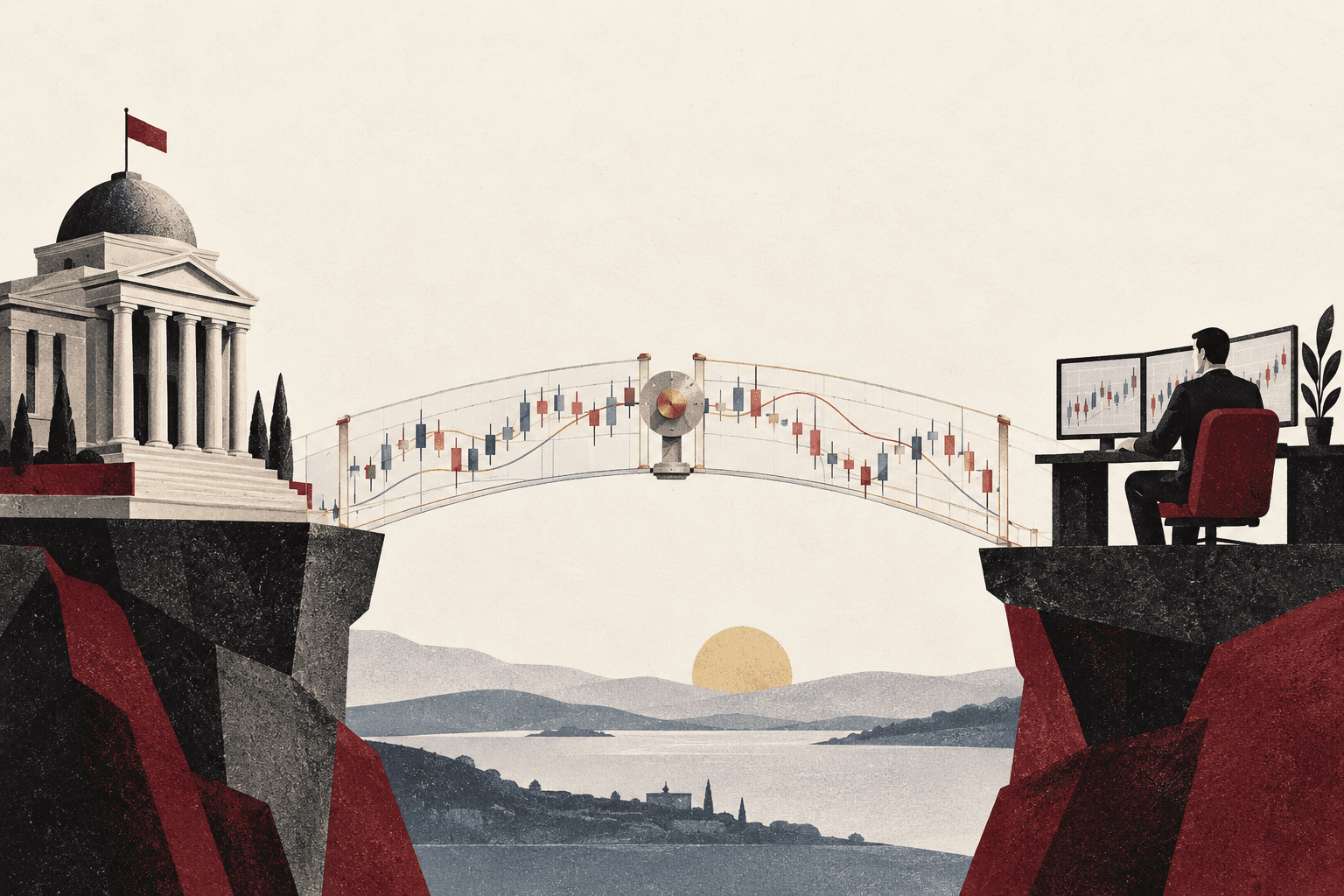
Trading education is not a collection of chart patterns, a list of indicators or a stream of market predictions. At its best, it is a structured process for learning how markets function, how risk is controlled and how decisions are reviewed. It teaches a trader to move from observation to preparation, execution and evaluation without confusing activity with progress.
That distinction matters because modern traders can access more information than any previous generation. Prices are live, commentary is constant and thousands of videos promise an immediate edge. Yet information alone does not produce competence. A trader needs a curriculum that connects market mechanics, analysis, risk, execution and psychology in the right order.
The central question is therefore not simply how to learn trading. It is what a modern trader should learn before putting meaningful capital at risk.
Key Takeaways
- Trading education should explain market mechanics before introducing strategies or trade ideas.
- Technical and fundamental analysis answer different questions and are most useful when connected to risk and execution.
- Position sizing determines how much a trader can lose when an idea is wrong, making it more important than entry precision.
- Market structure, order types, liquidity and transaction costs influence whether a theoretically sound trade can be executed effectively.
- A trading journal turns experience into evidence by separating repeatable decisions from luck.
- Structured education can reduce the confusion created by disconnected videos, social posts and unexplained strategies.
- Who: New traders, self directed investors and experienced market participants seeking a more coherent process.
- What: A practical framework for understanding what trading education should contain and how its parts fit together.
- When: Before committing significant capital and whenever a trader's results become inconsistent or difficult to explain.
- Where: Across stocks, options, futures, forex and crypto, with adjustments for each market's structure and risks.
- Why: Because knowledge becomes useful only when it supports controlled decisions, repeatable execution and honest review.
Table of Contents
- What Trading Education Really Means
- Start With Market Mechanics
- Technical and Fundamental Analysis
- Risk Management and Position Sizing
- Execution and Market Structure
- Psychology and Decision Making
- Reviewing Trades and Building Evidence
- Why Experienced Practitioners Matter
- Free and Paid Trading Education
- Why Structure Beats Fragmentation
- Chart Academy as a Case Study
- A Modern Learning Sequence
What Trading Education Really Means
Trading education is the systematic study of how financial markets operate and how a participant can make, execute and review decisions under uncertainty. It includes factual knowledge, practical skills and behavioural control. Remove any one of those elements and the education becomes incomplete.
Factual knowledge covers instruments, exchanges, pricing, leverage, margin, settlement and regulation. Practical skill covers analysis, planning, position sizing, order placement and review. Behavioural control covers the ability to follow a process when money, uncertainty and emotion are present.
This definition is deliberately broader than strategy. A strategy is a set of conditions for taking and managing trades. Education should explain why those conditions might make sense, when they are unsuitable and how much capital can be exposed. The Commodity Futures Trading Commission warns that futures, options, foreign currency and crypto assets can be complex and highly leveraged. Learning a setup without understanding those characteristics is not preparation.
Start With Market Mechanics
A modern curriculum should begin with the instrument itself. A share represents ownership in a company. An option is a contract whose value depends on an underlying asset. A futures contract creates an obligation under standardised exchange terms. A foreign exchange trade expresses the value of one currency relative to another. A crypto asset may trade continuously on a venue with a different custody and regulatory framework.
These distinctions determine what the trader owns, what can expire, how leverage is created and what can happen when a position moves against them. The SEC's Investor.gov stock guide, for example, explains that a stockholder owns a share of a company. Its options bulletin explains that options are derivatives with defined rights, obligations and expiration dates. That is foundational knowledge, not administrative detail.
Market mechanics also include trading hours, contract specifications, tick sizes, settlement, custody and counterparty exposure. A beginner who skips these subjects may know what they want to buy without understanding the rules of the market in which they are buying it.
Technical and Fundamental Analysis
Technical analysis studies price, volume, volatility and market behaviour. It can help a trader describe trend, momentum, support, resistance and the conditions under which an entry or exit becomes valid. Used well, it creates a common language for price action. Used carelessly, it can become pattern recognition without context.
Fundamental analysis asks what may influence an asset's value. For a company, that may include revenue, margins, debt, competitive position and valuation. For a currency, it may include interest rates, inflation, trade flows and central bank policy. Futures traders may study inventories, weather or supply chains. Crypto traders may consider network activity, token design, custody and regulation.
The two disciplines are not rivals. Fundamental analysis can explain why an opportunity may exist, while technical analysis can help define how the market is currently expressing it. Neither removes uncertainty. Both should lead to a testable plan rather than a prediction presented as certainty.
Risk Management and Position Sizing
Risk management answers a more important question than where to enter: what happens if the idea is wrong? A trader needs to define the invalidation point, maximum acceptable loss, exposure across correlated positions and conditions that require standing aside.
Position sizing translates those decisions into capital. If the distance between entry and exit is wide, the position normally needs to be smaller to keep the planned loss stable. If several positions depend on the same market factor, their combined risk may be greater than each line item suggests.
This is why a stop level alone is not a risk system. A trader also needs to understand gaps, slippage, liquidity and leverage. Our guide to setting a stop loss explains the difference between placing an exit at a meaningful market level and choosing one simply because the loss feels tolerable. The two decisions must work together.
A useful education programme should therefore require the trader to calculate risk before entry, not after a position becomes uncomfortable. It should also teach that preservation of capital is a condition for continued participation, not evidence of timidity.
Execution and Market Structure
A trade idea exists in theory until an order reaches the market. Execution education explains bid and ask prices, spreads, market and limit orders, stop orders, partial fills and slippage. It also explains that liquidity changes by instrument, venue and time of day.
The distinction matters because the visible price is not always the available price for the full size of an order. Our explanation of the bid ask spread shows how this hidden cost affects entry and exit. A strategy can appear profitable in a clean historical chart and fail in practice once spread, commission, financing and execution delay are included.
Market structure goes deeper. Traders should understand who provides liquidity, how orders are matched, when trading can be halted and whether the product is exchange traded or handled over the counter. They should know the role of brokers, dealers, exchanges and clearing organisations. Our guide to the difference between brokers and market makers provides a useful starting point.
Psychology and Decision Making
Psychology is not a substitute for a strategy, but a strategy cannot execute itself. Fear can shorten a profitable trade. Greed can expand a position beyond its planned size. Fear of missing out can turn observation into an impulsive entry. Loss aversion can make a trader hold a failing position because closing it would make the loss feel final.
Education should treat these behaviours as process risks. The response is not to eliminate emotion, which is unrealistic, but to reduce the number of decisions made while emotion is strongest. Written entry criteria, predetermined risk, checklists and enforced pauses can create useful distance between impulse and action.
Discipline is easier when the rules are specific. “Be patient” is an aspiration. “Do not enter until the closing price confirms the setup and the planned loss is within the daily limit” is an instruction that can be followed and reviewed.
Reviewing Trades and Building Evidence
A trading journal should record more than profit and loss. It should capture the reason for entry, the market condition, planned risk, actual execution, management decisions and whether the trader followed the process. Screenshots can preserve context that a number cannot.
The purpose is not self criticism. It is diagnosis. A profitable trade can be badly executed and a losing trade can be entirely consistent with the plan. Without review, luck can be mistaken for skill and a sound process can be abandoned after a normal loss.
Review also creates a feedback loop. The trader can compare intended behaviour with actual behaviour, identify recurring errors and decide whether a strategy has enough evidence to deserve more capital. This is where education becomes practice and practice becomes a body of personal data.
Why Experienced Practitioners Matter
Experienced practitioners can explain the distance between a textbook concept and a live decision. They have seen markets change character, orders fill badly and sensible ideas fail. Their value lies less in supplying predictions than in showing how a process behaves when conditions are imperfect.
That experience still requires scrutiny. A teacher should be able to explain the logic, assumptions, risks and limits of a method. Students should be cautious when education depends on unverifiable performance claims, urgency or guaranteed outcomes. The National Futures Association states that investor protection begins with education and encourages market participants to understand both the products and the firms or individuals involved.
A credible educator helps the student become less dependent on the educator. The goal is independent judgment supported by a process that can be tested.
Free and Paid Trading Education
Price does not determine quality. Paid education can offer depth, accountability and access to specialist instruction. It can also be expensive material packaged around a promise. Free education can make excellent knowledge accessible, but it can be fragmented, outdated or designed mainly to attract attention.
The useful comparison is therefore not free versus paid. It is structured versus unstructured, transparent versus promotional and educational versus predictive. Traders should ask who created the material, how the curriculum progresses, whether risks are explained and how commercial relationships are disclosed.
They should also ask what the platform is selling. Education funded by students has one incentive model. Education funded by sponsors has another. Neither is automatically good or bad, but the arrangement should be visible. A clear separation between curriculum and commercial influence is important wherever a platform is free.
Why Structure Beats Fragmentation
Social media and video platforms are useful discovery tools. The weakness is sequence. A beginner may watch an advanced options strategy before learning how an option premium behaves, then move to a forex setup without understanding leverage, and finally adopt a risk rule designed for a different market.
Fragmentation creates the feeling of learning because each piece is interesting. A curriculum creates progression. It introduces concepts in an order, connects them and tests whether the learner can apply them. It should begin with mechanics and risk, move through analysis and execution, then use review to deepen judgment.
The distinction resembles the difference between collecting recipes and learning to cook. One produces isolated instructions. The other develops transferable skill.
Chart Academy as a Case Study in Modern Trading Education
Chart Academy is a free trading education platform offering structured education from professional traders across stocks, options, futures, forex, crypto and trading psychology. Its relevance as a case study lies in how directly it responds to the weaknesses of fragmented online learning.
The platform describes its masterclasses as step by step and pairs video lessons with downloadable resources and personalised learning paths. Its published model is funded by brands rather than students, with no subscription, course fee or premium tier. Chart Academy also states that sponsors do not control what instructors teach or review the curriculum before publication.
Those features reflect a wider change in trading education. Access is becoming less important than organisation. The competitive question is no longer whether information can be found for free. It is whether the learner can find a credible sequence, understand the assumptions behind each method and connect analysis to risk, execution and review.
Chart Academy's instructor directory spans multiple markets and includes specialists in psychology, fundamentals, order flow and liquidity. That breadth can help learners see that methods do not transfer unchanged between instruments. It also makes curriculum design essential. More subjects create value only when the learner knows what to study first and why.
A Modern Learning Sequence
A serious beginner can use the following sequence as a filter for any trading education programme:
- Learn the instrument. Understand what is being traded, where it trades, how it is priced and what legal or contractual rights exist.
- Learn the risk. Study leverage, volatility, liquidity, gaps, settlement and the circumstances in which losses can exceed expectations.
- Learn analysis. Use technical and fundamental frameworks to define conditions rather than predict certainty.
- Build a plan. Specify entry, invalidation, size, exit and the conditions that mean no trade.
- Practise execution. Use simulation or very small exposure to understand orders, spreads and slippage.
- Review evidence. Record decisions and judge process separately from outcome.
- Increase complexity slowly. Add leverage, additional markets or advanced strategies only when the simpler process is stable.
The best trading education does not promise to remove uncertainty. It teaches a person to operate within it. That means understanding the market, controlling exposure, executing deliberately and reviewing decisions with enough honesty to improve. Everything else is secondary.
Sources and Further Reading
- Chart Academy platform overview and curriculum description
- Chart Academy instructor directory
- Chart Academy funding and educational model
- CFTC Office of Customer Education and Outreach
- Investor.gov guide to stocks
- Investor.gov introduction to options
- National Futures Association investor education
This article is for educational and informational purposes only. It does not constitute investment, financial or trading advice. Trading involves substantial risk of loss and may not be suitable for every person. Readers should assess products, providers and risks independently and seek appropriately qualified advice where necessary.

Stefanos Moschopoulos
Stefanos Moschopoulos founded The Luxury Playbook in Athens and has spent the better part of a decade following the auction calendar, the en primeur releases, and the watchmakers, gallerists, and shipyards the magazine covers. He writes the field guides and listicles that anchor the Connoisseur section — pieces built on Phillips and Christie's results, Liv-ex movements, and conversations with collectors he has met across Geneva, Bordeaux, Basel, and Monaco. His own collecting habits sit closer to watches and wine than art, and it shows in the level of detail in the magazine's coverage of those categories. Under his direction, The Luxury Playbook now publishes long-form field guides, market-defining year-end listicles, and the Voices interview series with the founders behind the houses and the brands.