King Seiko is drawing serious vintage collectors for the first time in its modern history, and the secondary market is finally catching up to what specialist dealers in Tokyo have known for years. For decades the line lived in the shadow of its more famous sibling. Grand Seiko took the reverence, while King Seiko sat with a small circle of Japanese collectors and the handful of Western enthusiasts willing to navigate Yahoo Japan auctions and dealer-level Tokyo connections.
- King Seiko has moved from specialist secret to mainstream collector territory, with Phillips and Chrono24 now treating the line as legitimate vintage inventory.
- The 44KS, 45KS and 5626 chronometer references anchor the value story, and clean examples have climbed steadily on WatchCharts for three consecutive years.
- Daini factory provenance matters more than buyers realise, because Daini and Suwa built rival movements and case work that read very differently in the metal.
- Tanaka Taro's Grammar of Design gives 1960s King Seiko the same sharp bevels and angular case geometry that drive Grand Seiko premiums today.
- The 2021 modern reissue legitimised the name for a new generation, but the secondary money is still on vintage Daini-era pieces in honest condition.
- We see meaningful daylight between worn examples and unpolished originals, so condition and dial integrity remain the cleanest filters before any purchase.
- Who is this for?
- Vintage Japanese watch collectors, Grand Seiko owners looking to broaden their holdings, and dealers building inventory ahead of the next auction cycle.
- What is happening?
- A long-overdue secondary-market recognition of King Seiko, with Daini-built references from the 1960s and early 1970s finding sustained price appreciation.
- When did this emerge?
- The current move accelerated through the early 2020s and gathered fresh momentum after the 2021 modern reissue, with auction visibility now consistent.
- Where is this happening?
- Japan remains the heart of the market, but Phillips online sessions, Chrono24 dealer listings, and US specialist auctions now carry meaningful inventory.
- Why does it matter?
- King Seiko offers high-grade Japanese watchmaking with documented factory rivalry and finishing pedigree at prices that still sit below comparable Swiss vintage.
That story has shifted. Phillips' online sessions now feature King Seiko references with regularity, Chrono24 hosts a dedicated section, and the 1960s 44KS, 45KS and 5626 chronometers have been climbing on WatchCharts for three consecutive years.
We'd argue this is the moment King Seiko stops being a specialist's secret. The collectors we hear from at the auction previews are no longer Japan-only, and the lots are no longer trading at apologetic prices. What matters now is understanding the references that anchor the line, what the secondary market will support, and where the genuine value sits.
Why vintage King Seiko collectors are paying attention
King Seiko was Seiko's high-grade range positioned just below Grand Seiko, born from a deliberate internal competition between the company's two manufactures. The Daini factory built King Seiko while the Suwa factory built Grand Seiko. Each team produced its own movements, its own cases, its own design language.
The rivalry produced watches that, on a movement-finishing and case-geometry level, sat far closer to the contemporary Swiss high end than the price tags suggested. The first King Seiko arrived in 1961, and production wound down through the 1970s as Seiko consolidated its high-grade output.
For the next four decades the line existed mainly as a vintage curiosity. Fratello has documented the Daini-versus-Suwa story in detail: the angular case profiles, the sharp bevels, the high-beat calibres all came from a working culture where two teams measured themselves against each other rather than against the export market.
The Grammar of Design legacy
Tanaka Taro's Grammar of Design, the visual code that gave 1960s Seiko its distinctive geometry, runs through the King Seiko line as clearly as it does through the early Grand Seikos. The 44KS reference 4420-9990, the 45KS series, and the 5626 chronometer pieces are the references that get cited most often by collectors who've gone deep on the catalogue.
They carry the strongest finishing and the most distinctive case work in the line. They're also the references the secondary market is now pricing accordingly, with clean examples drawing meaningful premiums against worn pieces of the same generation.
The modern King Seiko revival and what it changed
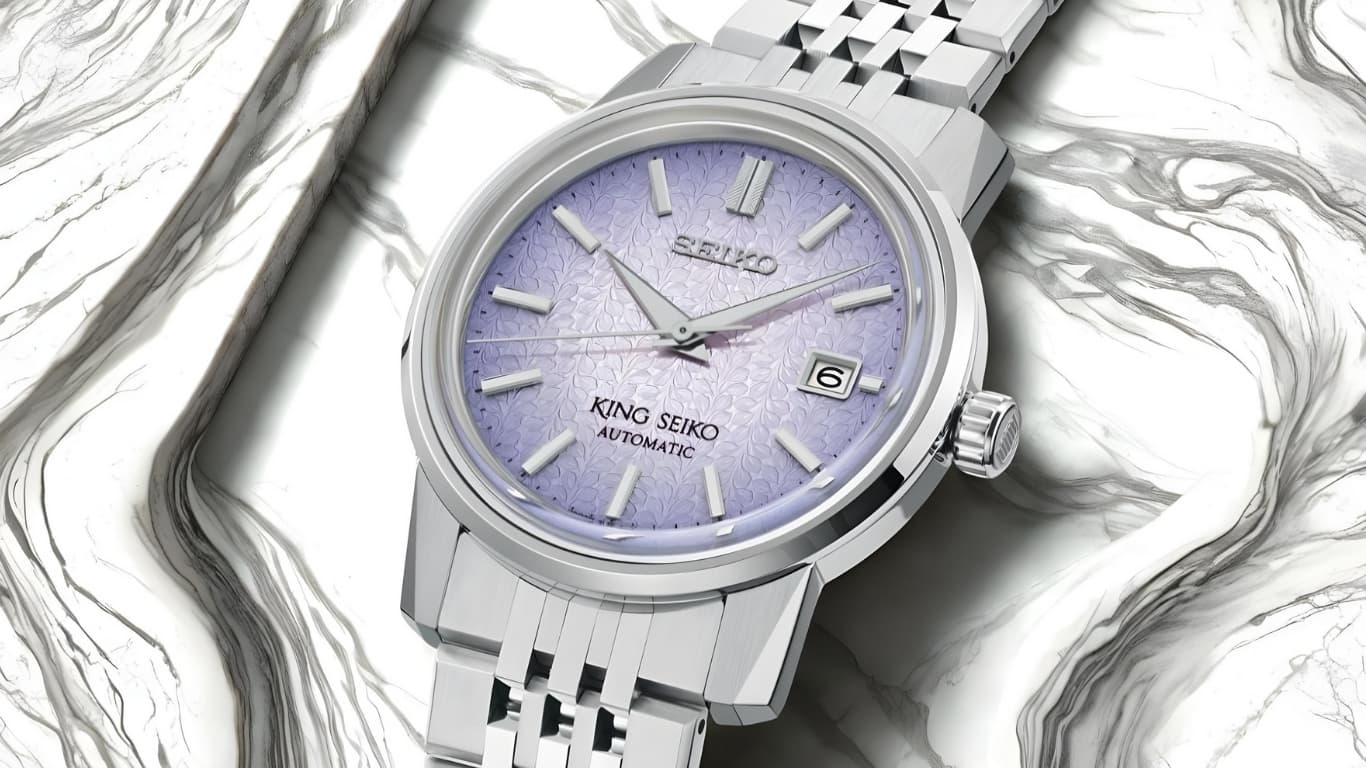
Seiko revived the King Seiko name in 2021 with a faithful reissue of the 1965 KSK, then made the line a permanent global range from 2022 onward. The modern SPB-series pieces use the 6R31 calibre with a 70-hour power reserve in a 37mm or 39mm case, with the angular Grammar of Design profile preserved.
The reissues weren't styling exercises. They were Seiko explicitly building a bridge from the historical line to a contemporary collector base that, until then, mostly knew the brand through Grand Seiko coverage in Hodinkee and the Japanese specialist press.
The result has been measurable. Specialist dealers report that international collector interest in vintage King Seiko has roughly tripled since the 2021 revival, and the auction houses now treat the line as a credible vintage category rather than a niche curiosity.
What the King Seiko secondary market actually shows
The pricing picture splits cleanly between vintage and modern, and the numbers reward serious reading. On Chrono24, modern King Seiko reissues cluster between $1,700 and $2,300 for unworn standard references. Limited editions and special-dial variants reach $2,800 to $3,400 when scarcity and collector demand line up.
The 1965 KSK re-creation references SJE087 and SJE091, both held to small production runs, hold close to retail with steady upward pressure on clean examples. Vintage is where the most interesting movement is happening.
Honest-but-worn examples of mid-tier 1960s and 1970s King Seiko references can still be found from around $390. That price point gets a vintage Japanese watch onto a wrist without serious commitment, and explains why dealers tell us interest is broadening at the entry level.
Where clean references trade now
Clean specimens of the desirable references, the 44KS, 45KS and 5626 chronometer pieces, sit in the $1,500 to $2,000 band on Chrono24 and at specialist dealers. The rare VANAC special models and gold-capped variants top out around $3,000, which remains a fraction of what a comparable Grand Seiko of the same era commands.
WatchCharts puts the cross-line average at around $700, which reflects how much of the vintage market still trades at honest, accessible levels. That number is going to climb as more collectors find the line, but it remains a reminder that vintage King Seiko is still cheaper, on a finishing-quality-per-dollar basis, than nearly any vintage Swiss alternative.
WatchCharts and Chrono24 data both document roughly 20 to 30 percent year-on-year secondary-market movement on top vintage references since the 2022 revival. That isn't speculative froth. It's the steady recognition that the 1960s King Seikos were undervalued for what they are, and the gap is closing.
Where King Seiko sits versus its peers
The most useful comparison is with Grand Seiko of the same period. Vintage Grand Seiko commands multiples of vintage King Seiko at comparable references, and the finishing differential, while real, is far narrower than the price gap implies. King Seiko was the working high-grade line, intended for Japanese executives and aspirational buyers.
Grand Seiko was the prestige line, sold in smaller volumes through more selective channels. Sixty years on, the finishing on a clean 45KS reads as honest hand work in person, and that's what's driving the catch-up among collectors who've handled both.
Against Swiss vintage at the same nominal price band, King Seiko mostly comes out ahead on finishing. A clean 44KS reference 4420-9990 has the kind of bevels and sharp transitions that, on a Swiss watch of the same era, would carry a serious multiplier on the price. The provenance and brand-recognition gap is real, but the watches themselves don't need to be apologised for.
What serious King Seiko collectors look for
Reference specificity matters more here than in most modern collections. The 44KS reference 4420-9990 is the one most cited as the line's signature piece: high-beat calibre, sharp angular case, and a dial geometry that holds up in the metal. The 45KS series and the 5626 chronometers are the other references collectors hunt for.
Within those, originality of dial, hands and case finish carries a serious premium. Refinished cases and replacement dials drop a piece's value substantially, even when condition otherwise looks clean.
For modern reissues, the play is the limited editions and special-dial pieces. The standard SPB references hold their value reasonably but rarely climb significantly above retail. The 1965 KSK re-creation references and any boutique-exclusive runs are the ones to flag, and the small-batch dial variants tend to be the ones that move when scarcity becomes obvious.
Box-and-papers documentation matters less for vintage King Seiko than it would for vintage Patek or Rolex, simply because so few vintage King Seiko pieces survived with complete sets. A clean watch with a credible service history from a trusted Japanese dealer is the practical baseline most collectors work to.
Further reading
- The Most Coveted Seiko References of 2026
- Japan's Quiet Watch Revolution That Collectors Can No Longer Ignore
What this means for collectors next
The longer story collectors are watching is whether Seiko maintains the production discipline that has, so far, kept the modern line credible. The reissues have been thoughtful, the limited editions measured, and the brand hasn't reached for the kind of waitlist games that erode credibility over time.
So long as that holds, the King Seiko revival has the makings of a long-term collector category rather than a momentary trend. The references to pay attention to remain the 44KS, the 45KS and the 5626, plus the modern small-batch reissues with credible provenance.
We last reviewed this analysis in May 2026.

Frequently Asked Questions
- How much do vintage King Seiko watches cost?
- Vintage models typically range from $390 to $2,500, depending on condition, rarity, and originality, with high-grade chronometers and rare dial variants commanding prices up to $3,000 at auction.<br><br>
- Are King Seiko watches limited edition?
- Some modern reissues like the SJE089 and SJE091 were limited to specific production runs, while others such as boutique-exclusive SPB models have low production volume but are not officially labeled limited editions.<br><br>
- Do King Seiko watches hold their value?
- Yes, King Seiko watches, particularly vintage models and modern limited editions, have demonstrated consistent value retention and upward price movement, with vintage pieces achieving 0.9 scarcity and retention scores in VDI analysis.<br><br>

Stefanos Moschopoulos
Stefanos Moschopoulos founded The Luxury Playbook in Athens and has spent the better part of a decade following the auction calendar, the en primeur releases, and the watchmakers, gallerists, and shipyards the magazine covers. He writes the field guides and listicles that anchor the Connoisseur section — pieces built on Phillips and Christie's results, Liv-ex movements, and conversations with collectors he has met across Geneva, Bordeaux, Basel, and Monaco. His own collecting habits sit closer to watches and wine than art, and it shows in the level of detail in the magazine's coverage of those categories. Under his direction, The Luxury Playbook now publishes long-form field guides, market-defining year-end listicles, and the Voices interview series with the founders behind the houses and the brands.