Collectors are obsessed with the Rolex Oyster Perpetual because the line has quietly become the cleanest entry into the modern Rolex sport catalogue, and the discontinued 2020 candy-coloured dial variants have consolidated into one of the more interesting contemporary Rolex collecting tiers.
- The Rolex Oyster Perpetual draws serious collector obsession through dial colour catalogue, accessible pricing, and the kind of pure-Rolex architecture that anchors the brand's identity.
- Reference 124300 in the 41mm case and 124200 in 34mm anchor the current catalogue, with the Calibre 3230 supporting daily-wear reliability.
- The 2020 dial colour expansion, including turquoise, candy pink, and yellow, reshaped collector interest with the kind of design ambition Rolex rarely shows.
- We see the Oyster Perpetual as the strongest single entry-tier Rolex purchase, with the pure three-hand architecture and accessible pricing aligned for new collectors.
- Vintage Oyster Perpetual references from the 1970s and 1980s offer additional collector entry points, often at price points well below the modern catalogue.
- Secondary-market depth on the Oyster Perpetual has grown materially after the 2020 colour expansion, with collector demand validating the design refresh.
- Who is this for?
- First-time Rolex buyers, design-anchored collectors, and established collectors building entry-tier depth alongside more complicated references.
- What is happening?
- A grounded read on collector obsession with the Rolex Oyster Perpetual, covering the 2020 colour expansion, accessible pricing, and the pure three-hand architecture.
- When did this emerge?
- The current obsession reflects the 2020 dial colour expansion, with collector momentum continuing to build through 2026 as authorised pre-owned programmes mature.
- Where is this happening?
- Authorised Rolex dealers globally maintain waitlists, while Chrono24, Subdial 50, and specialist auctions handle the broader pre-owned market.
- Why does it matter?
- The Oyster Perpetual offers pure-Rolex architecture and design ambition at accessible price points, which makes it the strongest single entry-tier purchase in the catalogue.
The Oyster Perpetual generates a level of buzz in 2026 that seems almost disproportionate for what was traditionally considered Rolex's entry-level offering, and the reasons are structural rather than incidental.
The boutique allocation accessibility is meaningfully better than the more famous sport references. The recently-discontinued candy-coloured dial variants have created a supply-constraint discipline the broader Oyster Perpetual category historically didn't carry. And the cleaner everyday wearability of the reference (a steel sport Rolex without the price commitment of the Submariner or GMT-Master II) addresses a buyer the broader sport catalogue has occasionally underserved.
The collectors we hear from at boutique events increasingly treat the Oyster Perpetual as the realistic first acquisition rather than the consolation prize.
Why collectors are obsessed with the Rolex Oyster Perpetual
Three structural reasons explain the contemporary interest. The cleanest entry into Rolex sport: the Oyster Perpetual provides the brand's case construction, movement technology, and bracelet engineering without the price commitment of the upper sport catalogue. The Calibre 3230 (no-date) movement carries the 70-hour power reserve and the Chronergy escapement standard across the modern Rolex sport line.
The boutique allocation accessibility is the second pillar. Oyster Perpetual references are meaningfully easier to acquire at retail than the more famous sport references, which makes the boutique-relationship building practical for collectors who don't yet have the dealer history that anchors Submariner or GMT-Master II allocation. Building a relationship through the Oyster Perpetual purchase is, for many contemporary collectors, the start of the longer Rolex boutique relationship.
The discontinuation discipline on the candy-coloured dials carries the third. The production-window discipline created the kind of secondary-market premium structure the broader Rolex catalogue normally requires. The 2020 turquoise dial reference 124300 in particular has consolidated into a discrete collecting tier of its own.
The current Oyster Perpetual catalogue
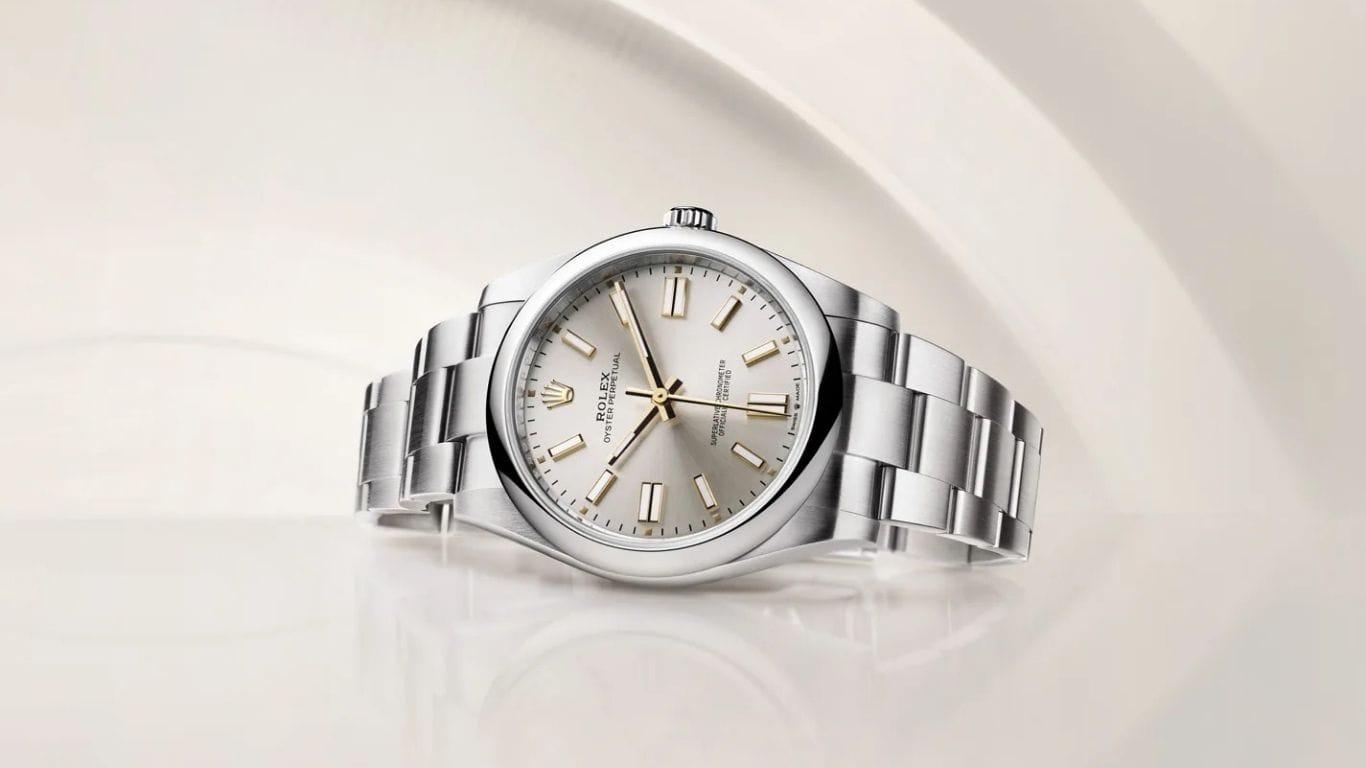
The current Oyster Perpetual references anchor the contemporary catalogue across a clean range. The 126000 (the 36mm steel reference, retail around $6,400), the 124300 (the 41mm steel reference, around $6,800), the 277200 (the 31mm steel reference, around $5,800), and the various smaller-case Lady references all run the Calibre 3230 movement and the standard Rolex case-and-bracelet engineering.
The smooth bezel and time-only dial keep the watch register-flexible. The Oyster Perpetual handles the dress-shirt register and the casual register equally well, which is a versatility the more identity-specific sport references (the Submariner, the GMT-Master II, the Daytona) don't quite match. The current dial colours span silver, black, blue, and a small palette of more recent variants that extend the line.
The discontinued 2020 candy-coloured dials
The 2020 release of the Oyster Perpetual references with the candy-coloured dials (turquoise, coral, yellow, green, pink) was produced for a defined window before the 2023 catalogue refresh. The production-window discipline has consolidated into one of the more actively collected modern Rolex categories. The 41mm reference 124300 with the turquoise "Tiffany blue" dial is the headline reference; clean examples have moved substantially since the 2023 discontinuation.
The candy-coloured 2020 to 2023 production window has become its own collecting tier. The 124300 in turquoise has consolidated as the headline reference, with clean post-discontinuation examples trading 25 to 60 per cent above the original $5,900 retail depending on dial colour and box-and-papers completeness. The coral, yellow, and green variants follow in roughly the same band; the smaller-case Lady Oyster Perpetual candy variants have moved less aggressively but follow the same pattern.
How the Oyster Perpetual sits against the rest of Rolex sport
Read against the rest of the Rolex sport catalogue, the Oyster Perpetual occupies the cleanest entry register, which is precisely what makes it interesting in 2026. The Submariner carries seventy years of cultural weight and the deepest secondary-market depth; the GMT-Master II carries the travel-watch identity; the Daytona carries the chronograph halo. The Oyster Perpetual carries none of that, and that absence is the point.
Collectors building boutique relationships at authorised dealers now treat the Oyster Perpetual as the realistic first acquisition rather than the consolation prize. Rolex's estimated annual production above 1 million units flows through the line with less allocation friction than the sport references command.
That accessibility, paired with the production-constraint discipline on the discontinued candy variants, gives the Oyster Perpetual a structural identity the broader entry-tier register hadn't previously occupied.
The market context for entry-level Rolex in 2026
The broader Rolex secondary market has firmed across 2024 and into 2025 after the 2022 peak and the 2023 unwind. The Oyster Perpetual specifically sits in a register the firming hasn't fully reached: secondary pricing on the standard contemporary references runs close to retail rather than at the substantial multiples the sport catalogue commands.
For collectors weighing the line against other Rolex entry points, the Oyster Perpetual continues to read as the most accessible cleanly, with the Air-King and the entry-level Datejust as the immediate alternatives. The cross-shopping context matters: the Air-King offers the cleaner pilot-watch register; the entry Datejust extends into the more classical dress-watch identity; the Oyster Perpetual occupies the most flexible everyday-wear position of the three.
Why the Lady Oyster Perpetual deserves a second look
The smaller-case Lady Oyster Perpetual references (the 28mm 276200 and the 31mm 277200 in particular) have built their own quiet collector following across the past five years. The cases wear cleanly on smaller wrists, the dial colour range matches the larger references, and the boutique allocation discipline is meaningfully easier than on the 36mm and 41mm configurations.
Clean examples with box-and-papers transact reliably through the specialist channels at slight discounts to the larger references. The Lady references aren't just for smaller-wristed buyers; they extend the design register the broader Oyster Perpetual line occupies, and collectors building broader Rolex collections increasingly treat the smaller-case variants as legitimate considered acquisitions rather than gendered alternatives.
What collectors look for in an Oyster Perpetual
For modern Oyster Perpetual, the references that come up most consistently in serious collector conversation are the current 36mm and 41mm steel references in the various standard dial colours, the discontinued 2020 candy-coloured references for collectors hunting the production-window-specific tier, and the various smaller-case Lady Oyster Perpetual references for collectors preferring the smaller proportions.
Box-and-papers documentation matters; the standard Rolex authorisation discipline applies. For the discontinued candy variants, box-and-papers documentation and original retail-receipt provenance are load-bearing on resale. The same discipline that anchors the broader Rolex pre-owned market applies here without exception, and the cleanest examples on the discontinued tier transact through the specialist channels at meaningful premiums.
What this means for collectors
The Oyster Perpetual remains the cleanest available entry into Rolex in 2026, and the discontinued 2020 candy-coloured variants represent one of the more interesting modern Rolex collecting categories that has consolidated since the brand stopped producing the colours. For collectors building first-watch boutique relationships, the standard 36mm 126000 and 41mm 124300 references continue to look like the right starting position.
For collectors hunting the discontinued tier, the structural argument is straightforward: the production window has closed, the dial colours aren't returning, and the clean examples with full documentation continue to consolidate into a discrete collecting category. The longer story is that the Oyster Perpetual's quiet rise into broader collector consideration represents one of the more interesting modern Rolex stories.
The reference's structural place looks unlikely to fade quickly, and the 2020 candy-coloured production window will likely read as one of the more distinctive contemporary Rolex collecting moments in retrospect.
We last reviewed this analysis in May 2026.