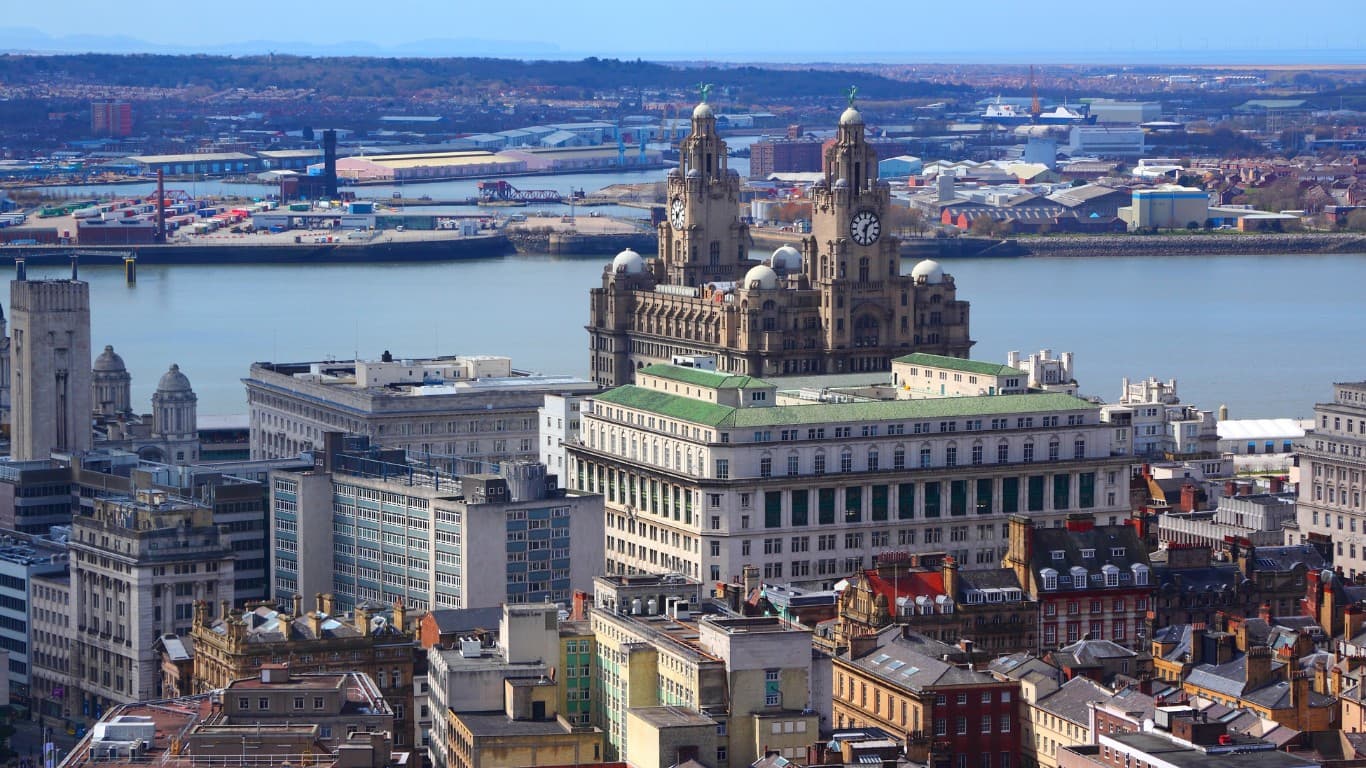
The Liverpool property market in 2026 is one of the most architecturally distinctive in the UK. A city whose Victorian commercial heritage anchored the largest UNESCO World Heritage Site in the country until its delisting in 2021, Liverpool's waterfront still reads as one of the most legible nineteenth-century maritime ensembles in Europe. The average residential property price now sits near GBP 182,000, up roughly 8.
5 percent year on year (among the strongest movements in any major UK city).
Average monthly rents have crossed GBP 900, up nearly 10 percent annually. Knight Frank's UK Cities tracking and Savills's residential research both describe Liverpool as the city where the gap between purchase price and rental absorption has been most consistently striking outside London.
We track Liverpool as the most accessible regional prime entry point in the UK. The combination of Victorian maritime heritage, deep cultural infrastructure and active Liverpool Waters and Knowledge Quarter regeneration makes the case for the buyer who values architectural depth at value-tier pricing.
- Liverpool offers one of the more attractive entry-level UK regional property markets, with the city-centre regeneration arc and waterfront developments supporting steady demand.
- We see the Liverpool Waters, Baltic Triangle and Georgian Quarter as the most dynamic submarkets, with new-build delivery alongside period stock attracting distinct buyer profiles.
- Halifax HPI and Nationwide HPI data shows Liverpool pricing among the more affordable of the major UK regional cities, with steady appreciation supporting the entry value proposition.
- Yields on well-located Liverpool rental stock remain among the strongest in the UK, particularly in student-heavy submarkets near the universities and the central business district.
- Infrastructure investment, including the Anfield regeneration and the Knowledge Quarter expansion, continues to support the city-centre value proposition across multiple submarkets.
- For most considered UK regional buyers we view Liverpool as offering the best yield-to-entry-price profile among the major regional UK cities through 2026.
- Who is this for?
- UK and international buyers evaluating Liverpool property, alongside the advisers, brokers and family office staff framing regional UK allocation decisions.
- What is happening?
- A market read of Liverpool property in 2026, covering city-centre regeneration, the major submarkets, appreciation trends, yields and the infrastructure context.
- When did this emerge?
- The article reflects 2026 market conditions through Halifax HPI, Nationwide HPI, RICS and major Liverpool broker data alongside our own observations.
- Where is this happening?
- The piece focuses on Liverpool, including Liverpool Waters, Baltic Triangle and the Georgian Quarter, with reference to the broader Merseyside property complex.
- Why does it matter?
- Liverpool occupies a distinctive position in the UK regional market, which is why understanding the entry-level dynamics matters for yield-focused property allocation.
The Liverpool market today
The market in 2026 is supported by ambitious regeneration, deep affordability relative to Manchester or Leeds, and persistent rental demand. The GBP 5 billion-plus Liverpool Waters scheme (Peel L&P) is reshaping the northern docklands.
The Knowledge Quarter (anchored by the universities, the Royal Liverpool University Hospital and the Pall Mall Innovation District) has become the city's intellectual and biosciences spine. The Baltic Triangle has matured from neglected warehouses into one of the country's strongest creative-industry districts.
Transaction volumes have been strongest in the sub-GBP 200,000 bracket. First-time buyers and individual landlords drive the largest share, with many responding to the gap between below-average purchase prices and above-average rental absorption.
- Average property price around GBP 182,000
- Annual price movement around 8.5 percent (2024 to 2025)
- Growth corridors: Baltic Triangle, Anfield, Wavertree, Toxteth, Liverpool Waters
- New supply: moderate; mostly Build-to-Rent and Private Rental Sector schemes
Neighbourhoods defining Liverpool in 2026
Baltic Triangle
Baltic Triangle has become Liverpool's leading regeneration story. A former warehouse district now anchoring digital businesses, creative studios and a young-professional residential population. New-build flats, mill conversions and Build-to-Rent developments price between GBP 200,000 and GBP 230,000, or around GBP 3,000 per square metre.
Anfield
Anfield has undergone material regeneration, including substantial residential redevelopment around the Liverpool FC stadium expansion. Average property prices sit between GBP 110,000 and GBP 130,000, or around GBP 1,700 per square metre (among the lowest entry points in any major English city).
Toxteth
Toxteth has been transitioning steadily. Improved transport links, cultural revival around the Princes Avenue Georgian terraces and ongoing refurbishment of the Welsh Streets stock. Average prices now sit around GBP 150,000 to GBP 170,000, or GBP 2,100 per square metre.
Wavertree
Wavertree is supported by proximity to the University of Liverpool and dependable public transport. Prices average between GBP 160,000 and GBP 180,000, or approximately GBP 2,200 per square metre.
City Centre (L1, L3)
The L1 and L3 postcodes (modern apartments, the waterfront developments around the Three Graces, the Liverpool ONE retail-residential mix) draw professionals, graduates and short-term tenants. Prices range from GBP 220,000 to GBP 270,000, or GBP 3,300 to GBP 3,800 per square metre.
The architectural and cultural register
The architectural depth runs across centuries. The Three Graces on the Pier Head (the Royal Liver Building, the Cunard Building, the Port of Liverpool Building) define the maritime waterfront. The Albert Dock (Jesse Hartley, 1846) is one of the most important industrial-heritage complexes in Britain.
The Liverpool Cathedral by Giles Gilbert Scott (begun 1904) and the Metropolitan Cathedral by Frederick Gibberd (1967) anchor the religious skyline. The contemporary additions (the Liverpool ONE retail and residential development by BDP and Wilkinson Eyre, the RIBA-shortlisted Mann Island towers by Broadway Malyan, the Knowledge Quarter masterplan) have layered new architectural ambition into a fundamentally Victorian city.
Mansion Global and Architectural Digest have used the Albert Dock and the Baltic Triangle as the journalistic entry points into the broader Liverpool conversation. JLL UK Cities, Knight Frank and Engel & Völkers all describe a market where the architectural register matters more to the buyer than headline pricing.
The Liverpool rental landscape
The Liverpool rental market in 2026 has been outperforming national averages. Average monthly rents reached GBP 900 in Q2 2026, up 9.9 percent year on year (among the strongest rental growth rates of any major UK city).
The strongest movement has been in central districts (L1, Baltic Triangle, Ropewalks) where new supply has been unable to keep pace with demand from professionals, students and remote workers. One-bedroom apartments rent between GBP 675 and GBP 850, two-bedrooms between GBP 850 and GBP 1,100, three-bedrooms between GBP 1,100 and GBP 1,400.
Liverpool City Council operates Selective Licensing Schemes across many high-density letting areas, including Anfield, Toxteth and Kensington. Landlords need to register and meet defined safety and quality standards.
How Liverpool compares with UK and international prime markets
Liverpool prime at GBP 3,800 per square metre sits well below London prime (Mayfair trophy around GBP 30,000 to GBP 40,000 per square metre according to Savills's World Cities Prime tracker). Mayfair trades at roughly eight to ten times Liverpool per square metre.
Liverpool sits below Manchester (around GBP 4,700 to GBP 4,800 per square metre at the central prime tier) and below Bristol prime (around GBP 5,500 to GBP 6,200 per square metre in Clifton).
Dubai Marina prime trades near AED 22,000 per square metre (around GBP 4,800), above Liverpool prime. Monaco prime at EUR 55,000 per square metre sits in an entirely different category. The Liverpool value-tier is the durable competitive advantage.
What we expect through year-end 2026
Property prices are projected to rise 4. 5 to 6. 0 percent through 2026.
The strongest movement is expected in the regeneration zones (Baltic Triangle, Anfield, Toxteth, Kensington and Kirkdale).
Prime central locations are projected to grow more modestly between 3. 0 and 4. 0 percent.
Citywide average prices are expected to reach GBP 182,000 to GBP 185,000 by year-end.
Rental prices are projected to grow 5. 0 to 6. 5 percent.
The Lime Street Station redevelopment, Merseyrail upgrades and the public-realm improvements around the waterfront continue to raise connectivity.
What this means for buyers
Liverpool rewards the buyer drawn to one of the most architecturally distinctive cities in the UK. The Victorian maritime heritage, the energetic regeneration of the Baltic Triangle and Liverpool Waters, and the deep institutional anchor of the universities and healthcare cluster together make Liverpool the most defensible regional UK value-tier prime market.
For UK-based and international buyers comparing regional cities, the Baltic Triangle's converted warehouse stock, the Toxteth Princes Avenue Georgian terraces and the Liverpool Waters waterfront read as the strongest positions. Stamp duty surcharges apply to non-UK-resident buyers and second homes.
We last reviewed this analysis in May 2026.
Frequently asked
What is the average property price in Liverpool in 2026?
Around GBP 182,000, well below the UK average and the most affordable among major regional English cities.
Can international buyers purchase property in Liverpool?
Yes. The UK has no restrictions on foreign ownership of residential property, though stamp duty surcharges apply to non-UK-resident purchasers and additional homes. The expat-buyer framework covers the regulatory and tax structure.
Are rent caps in effect?
No. Liverpool does not impose rent caps, though Selective Licensing Schemes apply to many high-density letting districts.
Are short-term rentals permitted?
Yes, with growing regulatory scrutiny in city-centre postcodes.
Which neighbourhoods are seeing the most buyer attention?
The Baltic Triangle, the Liverpool Waters waterfront, Anfield, Toxteth and the Wavertree / Edge Hill university corridor draw the most consistent demand from buyers tracking architectural depth and regeneration trajectories.


Savvas Agathangelou
Savvas Agathangelou co-founded The Luxury Playbook and has spent years reporting from the prime postcodes the magazine covers — Mayfair, Knightsbridge, the Athens Riviera, Dubai's Palm crescents, and the southern Mediterranean coastlines where the world's wealthy keep coming back. His background is in international hospitality, and that frame shapes how he writes about property: the developer's choices, the architect's signature, the agency's bench of named brokers, the building's service standard once the buyer moves in. He files developer spotlights, agency profiles, and the seasonal "Properties That Defined" listicles, and he hosts the magazine's founder-and-leadership interviews on the Voices side.