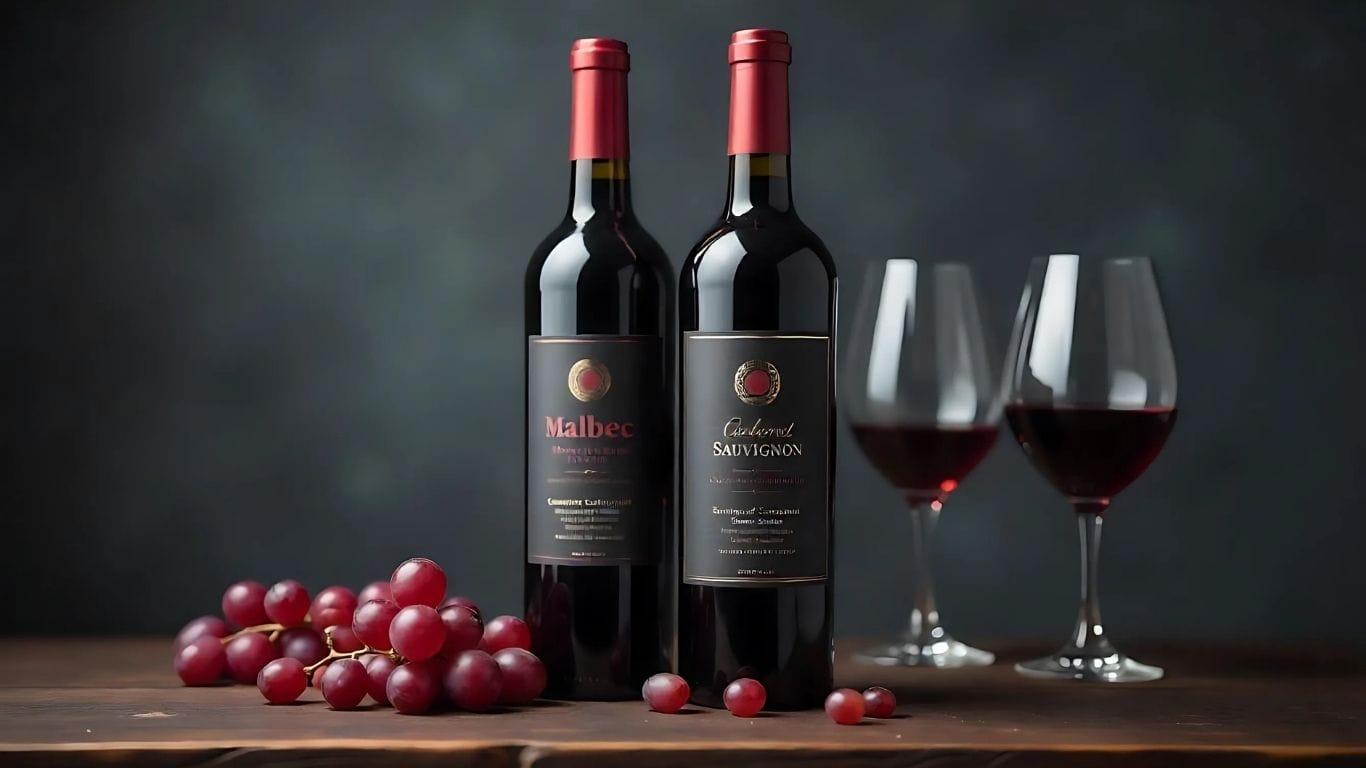
Malbec and Cabernet Sauvignon sit at very different points on the serious-red spectrum, but the comparison comes up regularly in serious-cellar conversation because both grapes anchor structural cellar positions at the top of their respective categories. Cabernet Sauvignon is the canonical anchor: Bordeaux Left Bank First Growths, Napa cult Cabernet, Tuscan Cabernet-led Super Tuscans, the better Australian Shiraz-Cabernet blends.
- Malbec and Cabernet Sauvignon sit at very different points on the serious-red spectrum, but the comparison comes up regularly in serious-cellar conversation.
- Cabernet Sauvignon is the canonical anchor, Bordeaux Left Bank First Growths, Napa cult Cabernet, Tuscan Cabernet-led Super Tuscans, the better Australian Shiraz-Cabernet blends.
- Malbec is the modern-classic Mendoza category, Catena Zapata's Adrianna Vineyard, Cheval des Andes, Achaval-Ferrer, the broader high-altitude Uco Valley tier.
- Liv-ex's Bordeaux 500 and the broader Fine Wine 1000 track both categories at very different structural weights, with Cabernet dominating the apex.
- Drinking windows diverge, with apex Cabernet routinely running multi-decade and apex Malbec drinking strong at 10 to 20 years.
- For serious cellars Cabernet anchors structural weight and Malbec adds modern-classic Argentine depth, with the relative proportion shaped by broader cellar architecture.
- Who is this for?
- Cellar builders weighing structural Cabernet allocations against modern-classic Malbec, and serious collectors building red-wine breadth across regions.
- What is happening?
- We compare Malbec and Cabernet Sauvignon as structural cellar positions, with the regional, producer, ageing, and secondary-market variables that distinguish each.
- When did this emerge?
- The piece reads the contemporary post-2020 market, with the Liv-ex Bordeaux 500 and the maturing Argentine apex tier as live structural context.
- Where is this happening?
- Bordeaux's Left Bank, Napa's apex cluster, and the broader Cabernet international regions for Cabernet, with Mendoza's Uco Valley for Malbec.
- Why does it matter?
- Sizing Cabernet and Malbec correctly is foundational for serious red-wine architecture, and the structural cellar logic for each is meaningfully different at every tier.
Malbec is the modern-classic Mendoza category: Catena Zapata's Adrianna Vineyard wines, Cheval des Andes, Achaval Ferrer, the broader high-altitude Uco Valley tier that has built genuine fine-wine credibility over the past two decades. Liv-ex's Bordeaux 500 and the broader Fine Wine 1000 track both categories at different weights.
This is our editorial comparison of Malbec and Cabernet Sauvignon for collectors weighing how the two grapes fit alongside each other in cellar architecture.
Origin and terroir
Cabernet Sauvignon's structural origin is Bordeaux's Left Bank: Pauillac, Saint-Estèphe, Saint-Julien, Margaux, where the gravel soils and maritime climate produce the world's reference Cabernet-dominant blends.
Beyond Bordeaux, the grape anchors Napa Valley (the Stags Leap, Oakville, Rutherford, Howell Mountain, Mount Veeder, and Pritchard Hill sub-AVAs all produce serious Cabernet from named producers), Tuscany (the coastal Bolgheri zone where Sassicaia originated; the Cabernet-led Super Tuscans more broadly), and the better Australian and South African Cabernet zones.
Malbec's structural origin is now Mendoza, Argentina, particularly the high-altitude Uco Valley sites at 1,200 to 1,700 metres. The grape originated in Cahors in southwest France (where it remains an important regional variety) but found its truest modern expression at altitude.
The serious Mendoza sites (Gualtallary, La Consulta, Vista Flores, Altamira, Chacayes) produce wines with structural depth and aromatic complexity that didn't exist in the variety's Old World expressions. Beyond Argentina, serious Malbec is produced at meaningful quality levels in Cahors (Château du Cèdre, Clos Triguedina), the US (particularly Devil Proof in Alexander Valley), and South Africa (De Toren).
Grape character and winemaking
Cabernet Sauvignon is a thick-skinned, late-ripening, structurally tannic red grape that produces wines of deep ruby-to-purple colour, pronounced tannins, and aromatic profile anchored on black fruit (blackcurrant, cassis), savoury notes (graphite, cedar, pencil shavings), and the herbal character that defines the grape across regions.
The named producers typically use new French oak ageing of 18 to 24 months for the top bottlings, rigorous selection processes that channel only a fraction of the harvest into the grand vin, and (in the Bordeaux tradition) sophisticated vintage-by-vintage blending decisions to maintain house style.
Malbec is also thick-skinned and structurally tannic but produces wines of denser purple-to-black colour, plusher tannic structure, and aromatic profile anchored on black fruit (blackberry, plum), violet, savoury notes (chocolate, mocha), and (at altitude) an aromatic lift that balances the grape's natural density.
The named Mendoza producers typically use new French oak ageing (proportions varying by producer and bottling), careful single-vineyard or single-parcel sourcing for the top bottlings, and the structural advantage that altitude provides for natural acidity retention.
Drink windows and ageing
Cabernet Sauvignon delivers the longest reliable ageing potential of the major red varietals. Bordeaux Left Bank First Growths from a strong vintage age 30 to 50 years; the Super-Seconds 20 to 35 years; the broader serious tier 15 to 25 years. Napa cult Cabernet (Screaming Eagle, Harlan, Bryant Family, Scarecrow) reaches its drink window at 12 to 20 years.
The broader serious Napa Cabernet tier reaches its drink window at 8 to 15 years.
Malbec ages 15 to 25 years from the named single-vineyard Mendoza bottlings (Catena Adrianna, Achaval Ferrer Finca Altamira, Vina Cobos Volturno) in strong vintages. The broader serious Mendoza tier (Cheval des Andes, the better Catena Estiba Reservada bottlings) reaches its drink window at 10 to 18 years.
Cahors from named producers (Château du Cèdre, Clos Triguedina) ages 12 to 20 years from strong vintages, meaningfully shorter than the longest-ageing Bordeaux Cabernet but genuine serious-cellar capacity.
Pricing and secondary market
Cabernet Sauvignon spans the wider price range across serious red wine. Bordeaux Left Bank First Growths run $400 to $700 en primeur for current vintages, with mature library releases of strong vintages clearing $1,500 to $5,000+. Napa cult Cabernet (Screaming Eagle, Harlan, Bryant Family) runs $1,500 to $5,000+ for current-release allocations.
Screaming Eagle library releases routinely clear five figures at major auctions including Sotheby's, Christie's, and Hart Davis Hart sales.
The broader serious Cabernet tier (Bordeaux Super-Seconds, the broader Napa Cabernet tier outside the cult labels, the named Tuscan Cabernet-blend Super Tuscans) runs $50 to $400 for current vintages.
Malbec runs at meaningfully more accessible price tiers across the spectrum. The Catena Adrianna single-parcel bottlings run $200 to $500 for current vintages. Cheval des Andes runs $80 to $150.
The broader serious Mendoza tier runs $40 to $120. Cahors from named producers runs $30 to $80 for current vintages. Even the most expensive serious Malbec sits well below the per-bottle clearing prices of comparable serious Cabernet from named producers.
The secondary-market dynamics of both grapes differ. Cabernet Sauvignon (particularly Bordeaux First Growths) has the deepest, most-liquid global secondary market in fine wine, anchored by Liv-ex's Bordeaux 500 index and the major auction houses' regular sales calendars. Malbec trades more thinly at the major auction houses but has built consistent presence at regional auctions and through direct merchant channels in markets where Mendoza wine has built collector reputation.
Where each belongs in the cellar
Cabernet Sauvignon occupies the structural top tier of the red-wine cellar architecture for collectors building serious Bordeaux, Napa, or Tuscan depth. The deeper liquidity, longer drink windows, and broader tier of accessible serious bottlings make Cabernet the canonical anchor of red-wine collecting at the top of the market.
Malbec occupies a complementary position, providing structural quality at meaningfully more accessible price tiers, with stylistic depth that rounds out a serious red-wine cellar. The named Mendoza producers (Catena Adrianna, Cheval des Andes, Achaval Ferrer) provide collectors with quality positions at price points where Bordeaux First Growths and Napa cult Cabernet no longer reach.
The pattern most serious collectors converge on is concentrating Cabernet depth in the canonical regions (Bordeaux, Napa, Tuscany) with selective Malbec positions for stylistic variety.
Vintage notes
The strong recent vintages worth holding from the Cabernet-driven regions: Bordeaux Left Bank in 2009, 2010, 2015, 2016, 2018, 2020, and 2022. Napa Cabernet in 2012, 2013, 2014, 2016, 2018, and 2019. Tuscan Super Tuscans (Cabernet-led) in 2010, 2015, 2016, 2018, and 2019.
The strong recent Mendoza Malbec vintages from the named producers above: 2013, 2015, 2017, 2018, 2019, and 2020.
What this means for collectors
The Malbec-versus-Cabernet question isn't really competitive. The two grapes occupy different roles in the cellar architecture. Cabernet drives the structural canonical Bordeaux-Napa-Tuscan red position.
Malbec provides the modern-classic Mendoza addition that rounds out a serious red-wine cellar with stylistic depth at meaningfully more accessible price tiers.
The pattern most serious collectors converge on is treating the two grapes as complementary rather than competitive: concentrating Cabernet depth in the canonical regions (Bordeaux First Growths and Super-Seconds, Napa cult Cabernet, the better Tuscan Super Tuscans) with selective Malbec positions in the named Mendoza producers for stylistic variety. Both deserve cellar weight. Neither replaces the other.
The cellars built across both reward the patience and the stylistic depth that defines serious wine collecting at its most engaging.
We last reviewed this analysis in May 2026.