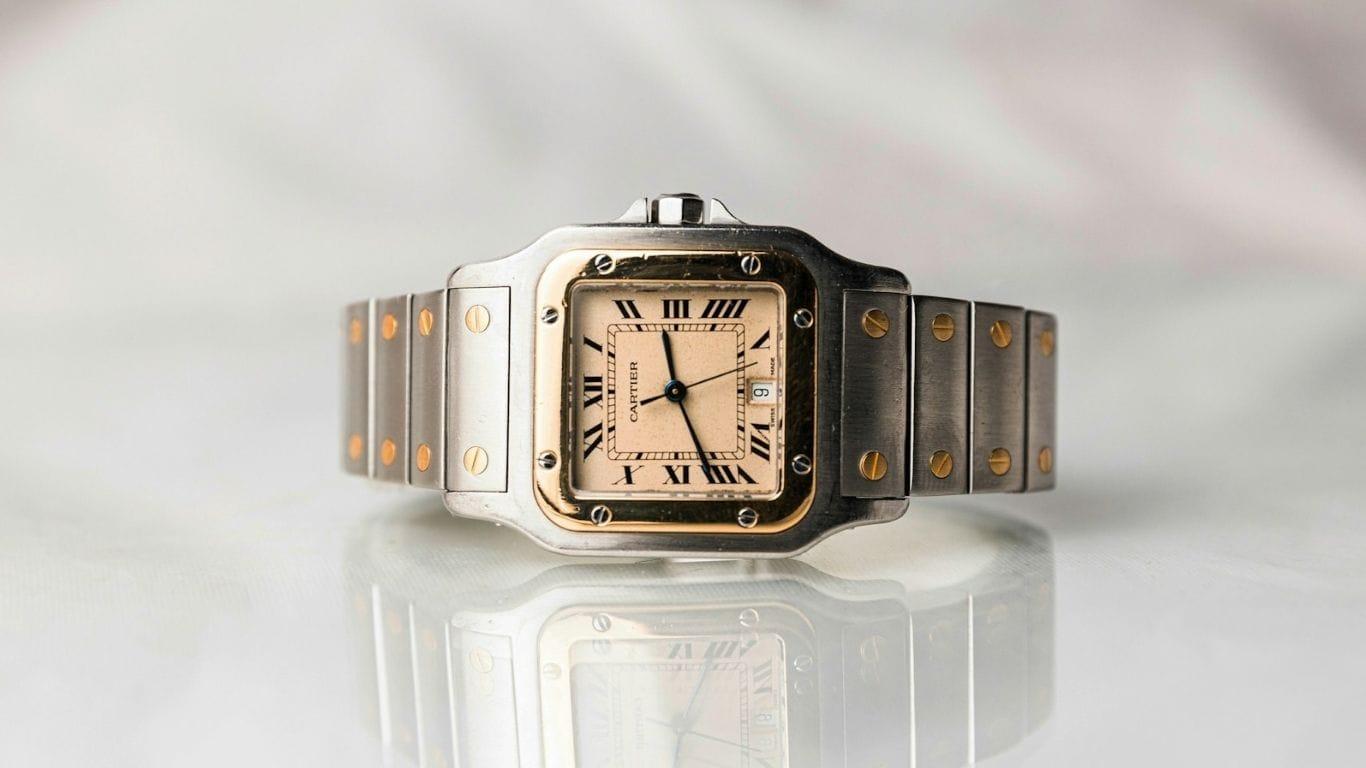
The Cartier Santos has been the quiet collector story of recent Cartier years. The reference designed by Louis Cartier in 1904 for the Brazilian aviator Alberto Santos-Dumont, who needed a watch he could read while piloting his early aircraft, is the first wristwatch designed for actual aviation use and one of the earliest dedicated wristwatches at all.
- The Cartier Santos has moved from sleeping classic to mainstream collector territory, with the 2018 refresh and the SmartLink bracelet reshaping daily wearability.
- Reference WSSA0029 in steel and WGSA0019 in two-tone anchor the modern catalogue, with the Calibre 1847 MC supporting collector confidence on daily wear.
- Vintage Santos Carree and Santos Galbee references from the 1980s and 1990s draw growing collector competition, with original gold and two-tone configurations leading.
- We see the Santos Dumont as the strongest dress-watch entry in the Cartier shaped-case catalogue, offering hand-wound architecture at meaningful pricing discipline.
- Aviation heritage and the Louis Cartier and Alberto Santos-Dumont story provide design lineage that no other modern sports-dress reference can match.
- Secondary market depth on the modern Santos has grown materially after the 2018 refresh, with collector demand validating the QuickSwitch and SmartLink innovations.
- Who is this for?
- Cartier collectors at every tier, dress-sports watch buyers, and established collectors exploring the shaped-case Cartier catalogue.
- What is happening?
- A grounded read on why more collectors are adding the Cartier Santos, covering the 2018 refresh, vintage references, and the Santos Dumont alternative.
- When did this emerge?
- The current shift reflects the 2018 Santos refresh and the broader Cartier momentum that crystallised through the last several years of auction visibility.
- Where is this happening?
- Cartier boutiques globally stock the modern catalogue, while Phillips, Christie's, and Paris dealer expertise handle the vintage shaped-case market.
- Why does it matter?
- The Santos offers aviation heritage, shaped-case originality, and modern bracelet engineering at price points that still leave meaningful room compared with rivals.
The contemporary Santos catalogue has been steadily refined under Richemont's stewardship, and the references catching collector attention reflect the brand's growing serious-watchmaking discipline. In our coverage of Phillips' Geneva sales and Hodinkee's editorial calendar across the past three seasons, the Santos has appeared with increasing frequency in the considered modern catalogue.
The Santos de Cartier catalogue in 2026
The current Santos de Cartier references span the small case (steel reference WSSA0010 at around 7,400 euros), the medium (WSSA0029 at around 7,750 euros), and the large (WSSA0018 at around 8,200 euros). The QuickSwitch bracelet system, which allows the bracelet to be removed and a leather strap attached without tools, is one of the more thoughtful contemporary Cartier engineering details and a genuine functional differentiator in the integrated-bracelet category.
The two-tone references in steel-and-yellow-gold and the precious-metal Santos pieces extend the line into the upper tier. The Santos Dumont line, the dressier sibling reference in the manual-wind quartz and small-batch limited mechanical configurations, anchors the dressier register. The Santos Dumont Skeleton XL pieces and the various WHP00007 references with engraved cases extend the line into more considered classical Cartier territory.
Why the Santos is catching serious collector attention
The contemporary Santos catalogue has refined the case construction, the bracelet engineering, and the dial geometry across the past six years. The current generation reads as more cohesive than the early 2010s production; the QuickSwitch bracelet/strap system makes the watch genuinely versatile across registers.
The various dial colour variants (the standard silver, the rare green, the various blue configurations) carry their own followings. Collectors who already hold a Royal Oak or a Nautilus increasingly arrive at the Santos as the third register choice, and that buyer pattern is one of the structural reasons the line has firmed in serious collecting conversation.
How the QuickSwitch changed the Santos equation
The QuickSwitch bracelet-and-strap system, introduced in 2018 across the contemporary Santos catalogue, is the engineering detail that has done substantial work in repositioning the line. The tool-free bracelet removal means a single Santos can serve both as the integrated-bracelet sport-luxury watch and as a strap-based dress register.
That versatility gives the reference a flexibility the Royal Oak and the Nautilus structurally lack. The serious collector who wants one piece that can flex across business-casual and dress registers without a tool kit and a watchmaker visit increasingly arrives at the Santos.
The Santos in Cartier's contemporary catalogue
The Santos is the brand's only true integrated-bracelet sport-luxury reference, which gives it a particular place against the broader Cartier catalogue. The Tank holds the dress-watch identity; the Ballon Bleu carries the brand-recognition register; the Crash anchors the upper-tier shaped-case tradition. The Santos sits between those, which is part of why it has built collector momentum across the past six years.
Hodinkee's editorial coverage and Phillips' Geneva sales have both treated the contemporary Santos catalogue with meaningfully more attention than the pre-2018 generation received, and that attention has translated into firmer secondary-market support.
Cartier's annual watch production runs higher than any of the Holy Trinity manufactures (Richemont publishes only consolidated revenue figures, but industry analysts estimate Cartier watch volumes above 600,000 units), which keeps the contemporary Santos broadly accessible at the boutique level.
The vintage Santos worth knowing
The 1978 Santos Galbée reissue and the various 1980s and 1990s Santos references in steel and two-tone configurations anchor the considered vintage Santos collecting tier. Clean examples regularly clear $4,000 to $12,000 at the specialist dealers; the rarer two-tone yellow-gold pieces and the automatic Santos references from the late 1980s command meaningful premiums.
The Santos Dumont references from the same window, the dressier sibling in manual-wind quartz and small-batch limited mechanical configurations, extend the vintage line into the dressier register. Christie's regularly handles vintage Santos at the New York and Geneva sales, with the rarer enamel-dial pieces commanding the strongest premiums.
What collectors look for in a serious Santos pick
For modern Santos, the references that come up most consistently in serious collector conversation are the medium-case Santos de Cartier in steel as the cleanest contemporary execution, the large-case for collectors preferring the larger geometry, the two-tone references in steel-and-yellow-gold for the dressier register, and the Santos Dumont Skeleton references for collectors drawn to the more architectural dial work.
Box-and-papers documentation matters; the QuickSwitch bracelet system should accompany the documentation on any resale. The reference's value as a collector consideration rests on design discipline rather than scarcity, and the past six years of refinement have delivered the strongest contemporary execution of the line since the original 1904 case.
What this means for collectors
The Santos has, across the past decade, rebuilt its place in serious collecting beyond the brand-recognition register it had drifted toward in the early 2010s. The 1904 historical anchor combined with the contemporary case-and-bracelet refinement gives the line genuine technical and design substance.
The QuickSwitch engineering makes the watch genuinely versatile across registers. For collectors weighing the line, the medium-case Santos de Cartier in steel continues to look like the cleanest contemporary execution, with the Santos Dumont references for collectors weighting the dressier and architectural dial work. The case for the Santos as a serious modern Cartier pick is materially stronger now than it was a decade ago.
We last reviewed this analysis in May 2026.