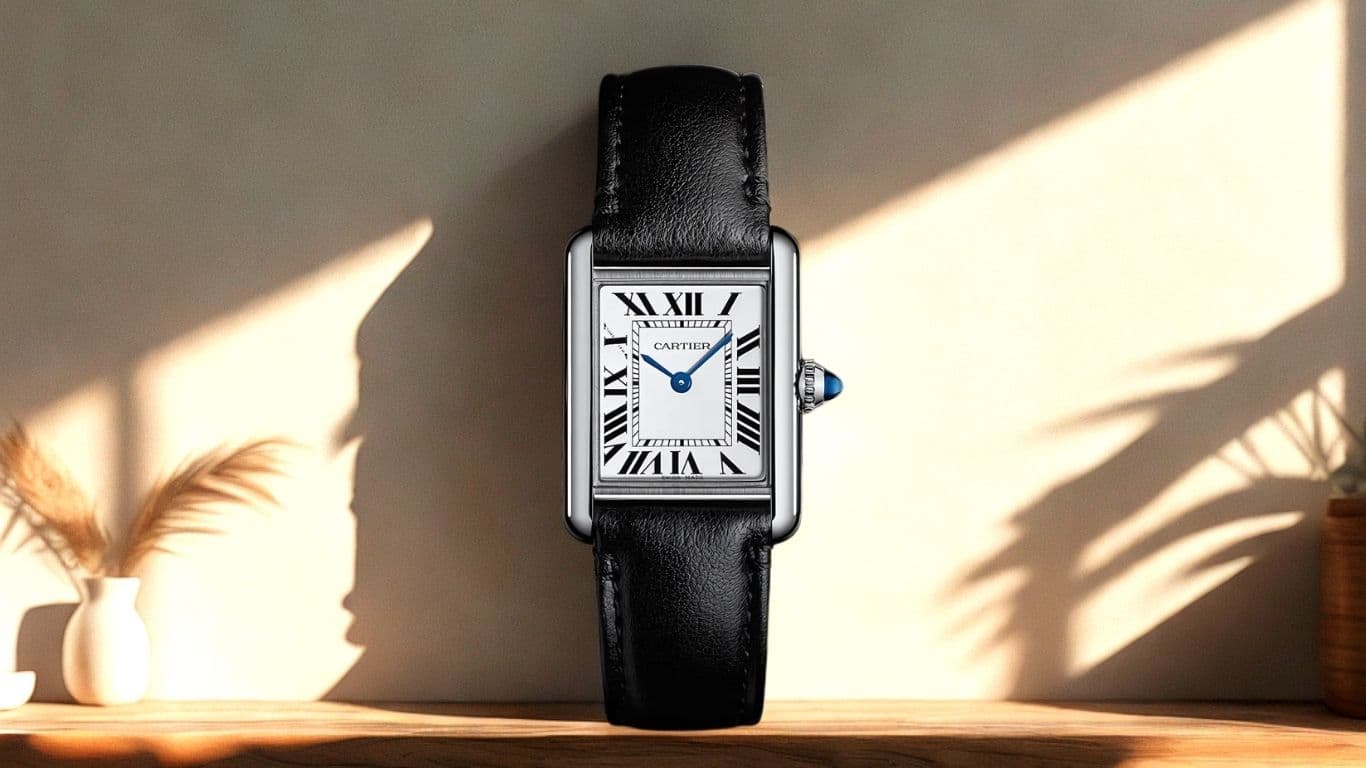
Owning a Cartier Tank carries a sense of history few other references match. The original Tank prototype designed by Louis Cartier in 1917 was reportedly inspired by the silhouette of the Renault FT tank from World War I, with the case geometry referencing the tank's tracks.
- The Cartier Tank carries unbroken design lineage from 1917, with Louis Cartier's WWI-inspired shaped-case philosophy still anchoring the modern catalogue more than a century later.
- Reference WSTA0067 Tank Must Large, WSTA0029 Tank Solo, and WJTA0048 Tank Louis Cartier anchor the modern catalogue across price tiers and movement formats.
- Vintage Tank Cintree, Tank Asymetrique, and Tank Chinoise references from the early twentieth century draw serious collector competition at the Phillips and Christie's level.
- We see the Tank Louis Cartier in pink gold as the strongest single dress-watch purchase across mainstream Swiss watchmaking, with hand-wound architecture and Cartier provenance combined.
- The Cartier Privé Tank Cintree and Tank Asymetrique reissues have reshaped collector expectations, with limited-run releases commanding waitlist demand approaching the Holy Trinity.
- Tank pricing has held through cycles, with the modern Tank Must representing the strongest single entry-tier dress-watch purchase available from a haute horlogerie house.
- Who is this for?
- Dress-watch buyers at every tier, design-anchored collectors, and inheritors taking custody of vintage family Tank pieces.
- What is happening?
- A grounded read on why owning a Cartier Tank still feels like owning a piece of horological history, covering modern catalogue, vintage references, and Privé reissues.
- When did this emerge?
- The Tank has anchored Cartier since 1917, with the modern Tank Must and Privé reissues continuing to drive collector momentum through 2026.
- Where is this happening?
- Cartier boutiques globally stock the modern catalogue, while Phillips, Christie's, and Paris dealer expertise handle the vintage shaped-case market.
- Why does it matter?
- The Tank offers unbroken design lineage, shaped-case originality, and the kind of cultural permanence that few other watch references can match across a century.
The reference predates almost every other significant wristwatch still in production. The Tank was the wristwatch the world's most recognisable cultural figures wore across the 20th century: Andy Warhol, Yves Saint Laurent, Jacqueline Kennedy Onassis, Catherine Deneuve, Princess Diana. The reference connects its current owner to a continuous chain of cultural ownership that very few modern objects can match.
In our coverage of Cartier's Privé collection releases over the past five years, the brand has steadily rebuilt its serious-watchmaking credentials, and the contemporary Tank catalogue reads as the cleanest expression of the case geometry in roughly a century of refinement.
The Tank catalogue across configurations
The current Tank Louis Cartier in the various small, medium and large case configurations retails from around 12,000 euros in steel to 15,000 euros in two-tone.
The Tank Américaine with the elongated curved case, the Tank Française with the integrated bracelet and the more modern proportions, the Tank Cintrée (the curved-case reference that anchors vintage Tank collecting), the Tank Asymétrique (the shaped-case reference), and the Tank Must (the more accessible quartz tier from around 3,000 euros) extend the line across registers.
The 2024 Tank Cintrée reissue in platinum and the various Privé Tank pieces from the past five years anchor the brand's contemporary upper-tier work. The Privé collection specifically (the small-batch upper-tier production released annually around Watches and Wonders) has produced some of the most considered shaped-case work in modern watchmaking.
Vintage Tank and the considered upper tier
Vintage Tank, particularly the 1960s and 1970s pieces from Cartier Paris and Cartier London with the original signature, anchors the upper tier of vintage Cartier collecting. The rare Tank Cintrée vintage references and the various Cartier London "swinging sixties" pieces appear regularly at the major auction houses.
Phillips and Christie's regularly clear strong numbers for vintage Tank references. The various early Tank pieces with the original Cartier Paris dial signature carry meaningful collector premiums. Andy Warhol's own Tank, with documented provenance and the original purchase records, sold at Sotheby's in 1988 for $5,000; comparable Warhol-era Tank references with credible provenance documentation now clear meaningful five-figure sums when they surface.
Why the Tank carries the historical weight
Three reasons. First, the cultural anchor. The continuous chain of recognisable cultural figures who wore the Tank across the 20th century gives the reference a particular weight that few other watch designs match.
Second, the design discipline. The Tank's case-and-dial geometry has been refined gradually rather than reinvented across more than a century, and the contemporary references read as cohesive evolutions rather than departures.
Third, the brand discipline. Cartier's ownership under Richemont and the steady Privé collection focus on serious watchmaking has rebuilt the brand's serious-collecting credentials across the past five years. The contemporary Cartier serious-watchmaking conversation is materially different than the early 2010s one.
The Tank against the contemporary Cartier catalogue
The Tank holds the dress-watch identity in the contemporary Cartier catalogue against the Ballon Bleu (which carries the brand-recognition register), the Santos (the only true integrated-bracelet sport-luxury reference), and the upper-tier shaped-case work in the Crash and Asymétrique configurations. The Tank Louis Cartier in the larger 33mm and 38mm sizes is the cleanest contemporary expression for collectors weighting the dress register.
The Privé Tank pieces specifically have produced some of the strongest waitlist friction in recent Cartier boutique allocation, and the secondary market for the Privé Tank Cintrée releases over the past three years has firmed meaningfully above retail.
What collectors look for in a serious Tank pick
For modern Tank, the references that come up most consistently in serious collector conversation are the Tank Louis Cartier in the larger 33mm and 38mm sizes, the Tank Cintrée new-production references, the Tank Must for collectors entering the brand at the most accessible price point, and the Privé Tank pieces for collectors operating at the upper register.
Box-and-papers documentation matters; the standard Cartier authorisation discipline applies. For vintage, the Tank Cintrée references, the Cartier London 1960s-1970s pieces, and the early Cartier Paris-signed Tank references anchor the considered vintage tier. Originality of dial, hands and case finish all matter substantially.
What this means for collectors
The longer story collectors recognise is that the Tank occupies a position in modern watchmaking that no contemporary design has duplicated. The reference connects its current owner to more than a century of continuous cultural recognition.
The historical weight is real and earned, and the contemporary catalogue continues to extend that legacy with measured discipline rather than reinvention. For collectors weighing a serious Cartier acquisition in 2026, the Tank Louis Cartier in the larger sizes continues to look like the cleanest entry into a reference whose place in modern watchmaking is structural rather than emerging.
The Privé Tank releases over the past three years specifically have produced the kind of waitlist friction at the Cartier boutique level that signals collector conviction returning to the line. The Tank Cintrée 2024 platinum release and the various Privé Tank pieces from the same calendar have firmed above retail on the secondary market, and the brand's continued production discipline on the upper-tier Tank work suggests the line will remain genuinely scarce across the next decade of releases.
Further reading
- Why The Cartier Crash Is One Of The Most Desired Watches Among Collectors
- More Collectors Are Adding the Cartier Santos to Their Collections
We last reviewed this analysis in May 2026.

Frequently Asked Questions
- How much does a Cartier Tank cost in 2025
- Prices range from approximately $3,000 for entry-level Tank Must models to over $50,000 for vintage pieces and limited editions. New Tank Must models start around $4,042, while standard production ranges from $3,000-$10,000.<br><br>
- Does Cartier Tank hold its value over time?
- Results vary dramatically by model. Exceptional vintage Tanks appreciate significantly, with some 1980s models tripling in value. However, the Tank index shows mixed performance: some references like W1529756 gained 38.5% over five years, while WGTA0011 declined 2.9%. Standard modern models face 20-25% depreciation from retail. Mechanical models, gold editions, and rare vintage pieces hold value best, while common quartz and steel models struggle.

Stefanos Moschopoulos
Stefanos Moschopoulos founded The Luxury Playbook in Athens and has spent the better part of a decade following the auction calendar, the en primeur releases, and the watchmakers, gallerists, and shipyards the magazine covers. He writes the field guides and listicles that anchor the Connoisseur section — pieces built on Phillips and Christie's results, Liv-ex movements, and conversations with collectors he has met across Geneva, Bordeaux, Basel, and Monaco. His own collecting habits sit closer to watches and wine than art, and it shows in the level of detail in the magazine's coverage of those categories. Under his direction, The Luxury Playbook now publishes long-form field guides, market-defining year-end listicles, and the Voices interview series with the founders behind the houses and the brands.