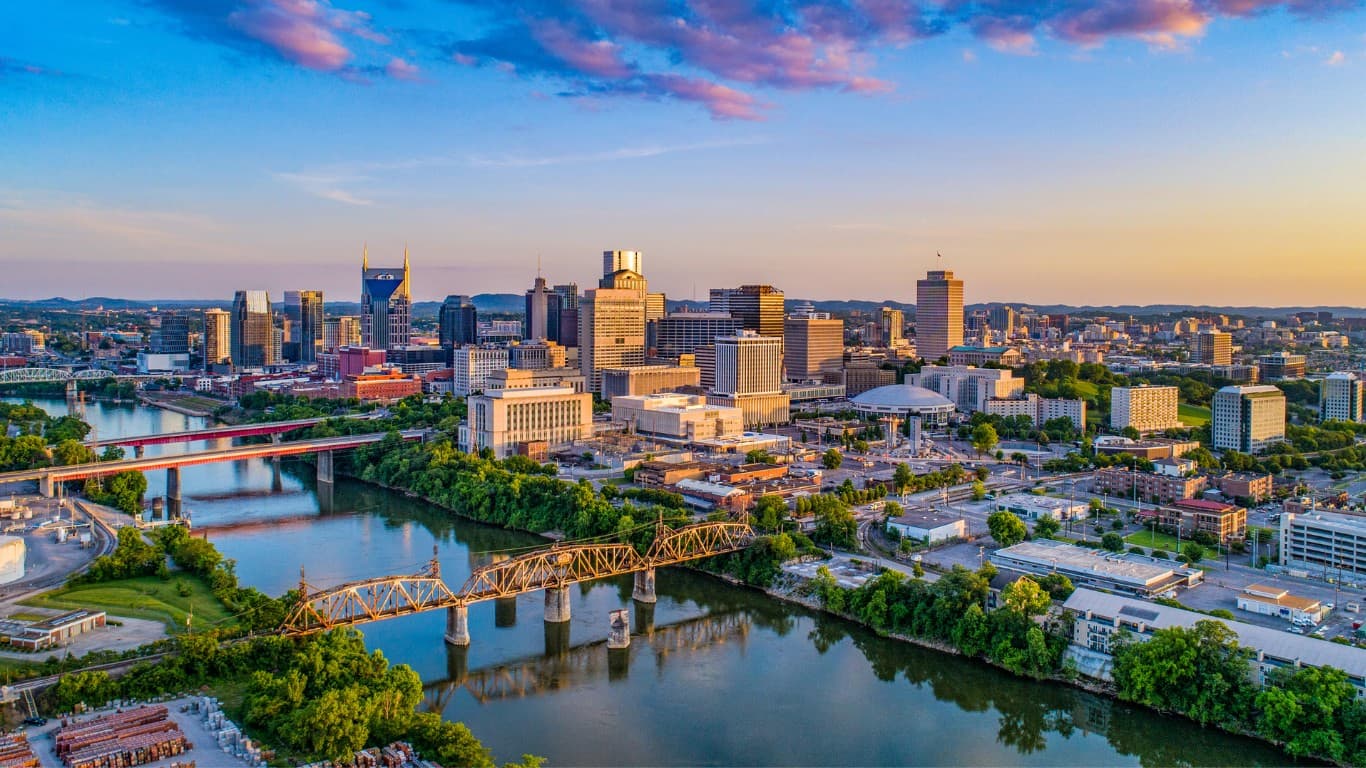
The 2026 Nashville real estate market is doing what most Sun Belt peers cannot do, namely sustain population growth and capital inflow while keeping inventory tight. The median sale price sits at $445,000, up 3. 6 percent year-on-year, with the prime Belle Meade, Green Hills and Hillsboro Village corridors meaningfully higher.
Knight Frank's 2026 US Cities Prime Index flags Nashville as the standout mid-South metro on both depth and absorption.
The Greater Nashville Realtors data and the brokerages tracking the prime side (Compass, Parks Real Estate, Worth Sotheby's International Realty) describe a market that has stabilized after the 2022 peak while continuing to draw inbound capital. The picture is one of compounding demand against modestly rising supply.
Inbound corporate relocation (Oracle's East Bank campus, the Amazon Operations Center, the AllianceBernstein headquarters relocation, and the broader healthcare-IT footprint) sustains employment demand. Mansion Global has profiled the prime Belle Meade and Forest Hills corridors as among the most coveted mid-South prime submarkets.
- Nashville continues to benefit from sustained in-migration, with the absence of state income tax, healthcare sector strength and the broader entertainment industry supporting demand into 2026.
- We see median prices having stabilised after the pandemic-era appreciation, with the market now settling into a more sustainable growth trajectory across most submarkets.
- Belle Meade, Forest Hills, Green Hills and the broader Brentwood and Franklin areas continue to anchor the upper end of the Greater Nashville luxury market.
- Inventory has loosened through 2025 and 2026, with months-of-supply moving closer to balanced conditions across most price tiers in the metropolitan area.
- Tennessee property tax rates run moderate relative to peer markets, with the absence of state income tax providing additional structural appeal to in-migrating buyers.
- For most considered buyers we view Nashville as a structurally attractive long-term hold given the demographic and corporate-relocation tailwinds, with the entertainment industry adding cultural depth.
- Who is this for?
- Buyers and investors evaluating Nashville for primary residence or income property, alongside relocation clients and the brokers, lenders and tax advisers supporting Greater Nashville transactions.
- What is happening?
- A market overview and 2026 forecast for the Nashville real estate market, covering price levels, inventory dynamics, in-migration demand drivers and the Tennessee tax considerations.
- When did this emerge?
- The article covers conditions through 2025 and 2026, with reference to the post-pandemic inventory cycle and the latest healthcare, entertainment and corporate relocation data.
- Where is this happening?
- The piece focuses on the Nashville metropolitan area, including Belle Meade, Forest Hills, Green Hills, Brentwood, Franklin and the broader Davidson and Williamson County submarkets.
- Why does it matter?
- Nashville offers structural Southeast migration support with the additional Tennessee tax advantage in 2026, which is why the long-term hold case deserves explicit consideration here.
The Nashville housing market today
The median sale price of $445,000 sits above Houston but below most coastal US metros. Days on market average 42, with the tightest absorption in Belle Meade, Green Hills and the East Nashville design-driven corridors. The sale-to-list ratio of 98.
7 percent confirms that quality stock continues to trade close to asking.
Realtor.com's 2026 absorption rankings place Nashville in the top 15 large US metros for buyer activity. Bloomberg has tracked the Nashville prime corridor as one of the cleaner mid-South large-metro recoveries through the 2022-2024 rate cycle.
- Median sale price: $445,000, up 3.6 percent YoY
- Median list price: $485,000
- Average days on market: 42
- Sale-to-list price ratio: 98.7 percent
- Strongest demand: Belle Meade, Green Hills, Hillsboro Village, East Nashville, 12 South
Nashville neighborhoods defining 2026
Nashville operates as several distinct submarkets stacked into one metro footprint. The prime Belle Meade and Forest Hills corridors anchor the high end, while the East Nashville and 12 South redevelopment stories carry the design-driven mid-market. The brokers tracking the prime side flag five neighborhoods carrying the citywide narrative.
Belle Meade
Belle Meade remains the city's most coveted address. The median home price sits at $2. 85 million, up 4.
1 percent year-on-year. Mature trees, large lots and a strong school footprint anchor demand, with Parks Real Estate and Worth Sotheby's tracking it as the most stable prime Nashville submarket.
Forest Hills
Forest Hills, the smaller enclave adjacent to Belle Meade, runs similarly tight. Median home prices clear $1. 85 million, with inventory historically limited.
Christie's International Real Estate affiliate Worth Sotheby's publishes the cleanest segment data.
Green Hills
Green Hills, on the city's south side, draws family buyers and corporate relocations. The median price sits at $945,000, up 4. 4 percent year-on-year.
Strong school systems, walkable retail and proximity to Vanderbilt sustain demand.
Hillsboro Village and 12 South
Hillsboro Village and 12 South, the design-driven walkable corridors between Belle Meade and downtown, carry the city's strongest urban-walkable mid-market. Median home prices sit between $785,000 and $895,000, with restored craftsman and bungalow stock trading materially higher.
East Nashville
East Nashville has been the city's most consistent gentrification story for a decade. The median home price sits at $625,000, up 4. 7 percent year-on-year.
Restored Victorian and craftsman stock dominates the activity, with the buyer profile skewing toward design-driven professionals and creative-sector employees.
Nashville rental market in 2026
Average rent across the metro sits at $1,795 per month, up 3.4 percent year-on-year. One-bedrooms in The Gulch and downtown lease between $2,000 and $2,500, while East Nashville and 12 South run from $1,750 to $2,200.
Vacancy stands at 6.2 percent, with the tightest absorption in the prime mid-market corridors. JLL's 2026 Mid-South Multifamily Outlook flags Nashville as one of the more resilient large-metro rental markets.
What is shaping the Nashville map in 2026
Three structural forces drive the market. Population growth (the metro added around 35,000 residents in 2024 per US Census Bureau estimates) provides a steady demand floor. Corporate relocation employment (Oracle, Amazon, AllianceBernstein) sustains the inbound capital flow.
The healthcare-IT and music-industry concentration provides the historical anchor employment base.
Mortgage rates in the 6.5 to 7 percent range have rebalanced activity toward the $400K-$650K band, where suburban inventory continues to deliver. The prime tier above $1M continues to clear at its own pace, with cash-buyer share regularly above 30 percent.
Tennessee's absence of a state income tax remains a structural relocation driver, particularly for HNW buyers exiting California, Illinois, New York and the broader high-tax Northeast.
What this means for buyers
Nashville in 2026 reads as a structurally tight mid-South prime market that continues to attract capital. Home prices are projected to rise 3. 5 to 5 percent through 2026, with the strongest gains in the East Nashville redevelopment corridor and the prime Belle Meade and Forest Hills anchors.
Rents are forecast to climb 3 to 4 percent.
For buyers tracking the broader US picture in our US Real Estate Market Overview (2026), and weighing prime-market options across The U.S. Property Markets Defining 2026, Nashville continues to read as one of the most resilient mid-South large-metro options.
We last reviewed this analysis in May 2026.
Frequently asked questions
Is Nashville a good market to buy in 2026?
Yes. Population growth of around 35,000 residents in 2024, corporate relocation employment expansion at Oracle, Amazon and AllianceBernstein, and Tennessee's absence of a state income tax all sustain demand. Knight Frank's 2026 US Cities Prime Index flags Nashville as the standout mid-South metro.
Which Nashville neighborhoods are appreciating fastest?
East Nashville leads the citywide rate at 4. 7 percent, followed by Green Hills at 4. 4 percent and Belle Meade at 4.
1 percent. The prime corridor (Belle Meade, Forest Hills) appreciates more slowly at higher absolute prices and remains the city's prime anchor per Parks Real Estate and Worth Sotheby's.
How does Nashville compare to other Sun Belt and mid-South markets?
Nashville sits in the upper-middle range of Sun Belt pricing, well above Houston and San Antonio but materially below the coastal large metros. The corporate relocation depth, prime corridor and Tennessee tax structure give Nashville the most resilient mid-South prime tier.
Is Nashville a good rental market?
Yes. Average rent of $1,795 with vacancy at 6. 2 percent gives reasonable rent-to-price ratios.
The Gulch, East Nashville and 12 South carry the tightest absorption per JLL's 2026 Mid-South Multifamily Outlook.


Savvas Agathangelou
Savvas Agathangelou co-founded The Luxury Playbook and has spent years reporting from the prime postcodes the magazine covers — Mayfair, Knightsbridge, the Athens Riviera, Dubai's Palm crescents, and the southern Mediterranean coastlines where the world's wealthy keep coming back. His background is in international hospitality, and that frame shapes how he writes about property: the developer's choices, the architect's signature, the agency's bench of named brokers, the building's service standard once the buyer moves in. He files developer spotlights, agency profiles, and the seasonal "Properties That Defined" listicles, and he hosts the magazine's founder-and-leadership interviews on the Voices side.