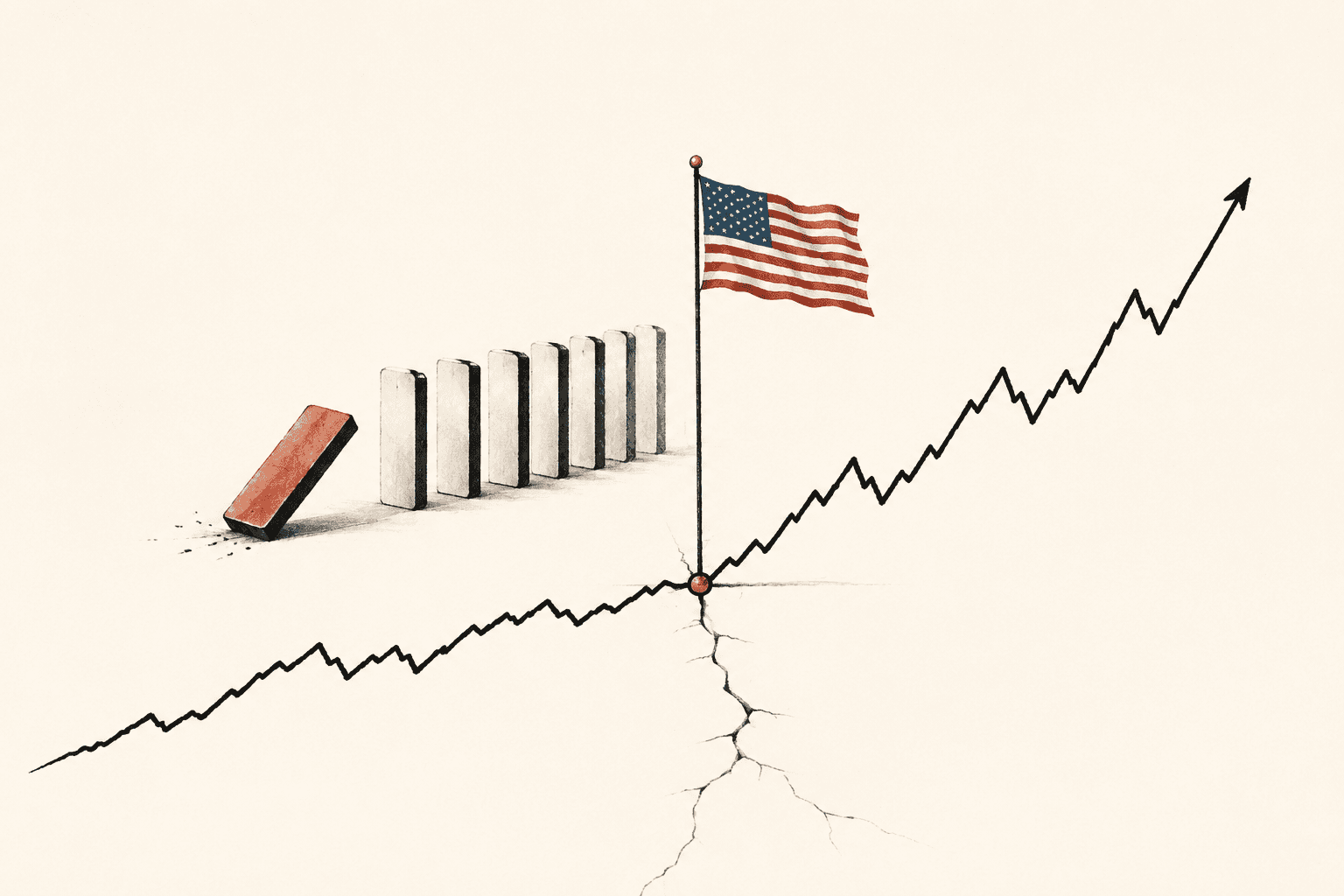
There is a particular kind of unease that settles over an economy when nothing has broken yet.
The stock market remains resilient. Corporate profits have held up. Investment in artificial intelligence is running at extraordinary levels. Gross domestic product is still growing.
Look beneath those headlines, however, and the picture becomes more complicated. Several warning signals are beginning to align. None proves that a recession is imminent. Together they raise a more uncomfortable question: what if the American economy is considerably more fragile than the headline numbers suggest?

Key Takeaways
- US bankruptcy filings rose 12.2% in the year to June 2026, with business filings increasing 16.9%, confirming that financial stress is building from a low base.
- Federal debt has crossed $40 trillion and the Congressional Budget Office projects net interest costs of approximately $1 trillion in 2026.
- The Conference Board's leading index improved in July and still points to continued growth, providing an important counterweight to the bearish case.
- Consumer spending rose only 0.2% in July while retail sales fell 0.6%, suggesting reduced momentum rather than outright collapse.
- AI investment is supporting activity, but greater economic dependence on one capital spending cycle creates concentration risk if that cycle slows.
- No single signal makes recession inevitable. The danger is that debt costs, weaker consumption, expensive credit and external shocks begin reinforcing one another.
- Who: Investors, family offices and business leaders assessing US growth, credit conditions and portfolio risk.
- What: A balanced analysis of the indicators that could precede an American recession and the data arguing against an imminent downturn.
- When: September 2026, as bankruptcies and debt costs rise while AI investment and headline growth remain supportive.
- Where: Across US consumer spending, corporate credit, federal finances, manufacturing and capital markets.
- Why: Because markets can remain strong while vulnerabilities accumulate underneath them, leaving less room for policy or economic error.
Table of Contents
- Bankruptcies Are Rising
- The Forty Trillion Dollar Debt Problem
- Growth May Be Stronger or More Concentrated Than It Looks
- The Consumer Is Losing Momentum
- Geopolitics and the Energy Channel
- What the Bond Market and Federal Reserve Are Signalling
- What Large Investors Can and Cannot Tell Us
- Is a US Recession Coming?
Bankruptcies Are Rising
The US economy is not collapsing, but financial stress is clearly increasing.
The Administrative Office of the US Courts reported 608,511 bankruptcy filings in the twelve months to June 2026, an increase of 12.2% from the previous year. Business filings rose faster, increasing 16.9% to 26,941.
The totals remain far below the levels recorded after the global financial crisis, but filings have increased every quarter since reaching a low in June 2022. That trend does not prove an economy wide downturn. It does show that more households and companies are reaching the point where their liabilities can no longer be managed through ordinary cash flow.
Economist Tuomas Malinen has argued that the US may be closer to recession than markets appreciate. His analysis combines bankruptcies with manufacturing new orders and an unconventional private sector yield curve based on the relationship between long maturity Baa corporate bonds and the bank prime rate.
Malinen's forecast is distinctly more bearish than the consensus and should be treated as such. The value of the framework is not that it predicts a precise recession date. It is that it asks whether financial conditions for ordinary companies may be deteriorating before the weakness becomes obvious in headline GDP.
The Forty Trillion Dollar Debt Problem
US gross federal debt crossed $40 trillion in August 2026. The headline is difficult to comprehend, but the more important issue for markets is the cost of carrying it.
The Congressional Budget Office projects net federal interest outlays of approximately $1 trillion in 2026, equal to about 3.3% of GDP. It expects those costs to more than double by 2036 under its baseline assumptions.
America's debt position is therefore becoming a cash flow constraint as well as a balance sheet concern. When the government issues large volumes of debt while long term yields remain elevated, investors may demand greater compensation to absorb the supply. Those yields influence corporate borrowing, mortgages and asset valuations across the economy.
The question is not whether the United States can borrow in its own currency. It can. The question is what price the economy must pay for that borrowing and how much fiscal flexibility remains when the next slowdown arrives.
Growth May Be Stronger or More Concentrated Than It Looks
The strongest argument against an imminent recession is that several broad indicators remain constructive.
The Conference Board's Leading Economic Index increased 0.2% in July 2026. Its six month growth rate turned positive for the first time in more than four years. The organisation continued to forecast real GDP growth of 1.9% in both 2026 and 2027.
That evidence directly contradicts the claim that the US is already falling into recession. It also reveals an unusual dependency. The Conference Board expects business investment in AI to support growth while higher living costs weaken spending among lower and middle income households.
One part of the economy is accelerating while another becomes more fragile. Data centres, semiconductors, power infrastructure and related investment are generating significant activity. If this capital expenditure continues, it can sustain growth despite softness elsewhere. If it slows sharply, the concentration that currently looks like strength may become a vulnerability.
That does not mean the AI cycle is necessarily a bubble. It means investors should distinguish broad based expansion from growth increasingly reliant on a narrow group of sectors. The same concentration question appears in our analysis of whether AI investment resembles a bubble.
The Consumer Is Losing Momentum
The American consumer remains the economy's largest engine, and the latest data show reduced momentum.
Personal consumption expenditure increased 0.2% in July, down from 0.3% in June. Retail and food service sales fell 0.6% from June, the first monthly decline in nine months, although they remained 5% above the previous year's level.
The annual increase matters. This is a slowdown signal, not evidence of a consumer collapse. Calendar effects around promotional events and lower petrol prices also affected the monthly comparison.
The concern is cumulative. When living costs remain high and credit is expensive, a small loss of spending momentum can move through business revenues, hiring decisions and defaults. Consumer weakness becomes more consequential when it arrives alongside rising corporate bankruptcies and tighter financing conditions.
Geopolitics and the Energy Channel
The conflict involving the United States and Iran adds a variable that monetary policy cannot control. Disruption in the Strait of Hormuz has materially reduced oil and liquefied natural gas flows through one of the world's most important energy routes.
The US Energy Information Administration estimated that petroleum liquids moving through the strait averaged 4.9 million barrels a day in the second quarter of 2026, compared with 21.6 million barrels a day in the fourth quarter of 2025 before the conflict. It has also reported disruption affecting around 20% of global LNG supply.
Energy shocks are particularly difficult when inflation is already above the Federal Reserve's target. Higher oil, transport and input costs can weaken growth while sustaining price pressure. That leaves policymakers choosing between tighter conditions and greater inflation tolerance, neither of which is attractive for risk assets.
What the Bond Market and Federal Reserve Are Signalling
Long term Treasury yields have remained elevated while investors debate weaker growth. This matters because the bond market transmits federal borrowing costs into almost every major asset class.
At Jackson Hole in August, Federal Reserve Chair Kevin Warsh stressed that the 2% inflation objective is firm and described inflation as the central bank's predominant current focus. He did not commit to a particular rate decision. He emphasised that policy must respond to current evidence rather than stale forecasts.
That is an important distinction. Market probabilities can change rapidly and should not be mistaken for Federal Reserve guidance. The durable message is that inflation remains high enough to limit the central bank's freedom to support growth. If activity slows while inflation persists, the usual policy response becomes harder.
Investors considering the relationship between rates and assets can also review how changing interest rate cycles affect currencies and markets.
What Large Investors Can and Cannot Tell Us
Periods of uncertainty inevitably produce claims about what Warren Buffett or George Soros is supposedly predicting. Public filings rarely support such simple conclusions.
Berkshire Hathaway's second quarter filing showed an enormous liquidity position alongside renewed purchases of selected equities. That combination suggests discipline and optionality, not a binary recession forecast. A large cash reserve may reflect valuation, capital requirements, acquisition capacity and a preference for resilience across several scenarios.
Similarly, a quarterly Form 13F from Soros Fund Management reports only certain US listed holdings. It does not reveal the entire portfolio, cash, private investments or many derivative exposures. Changes in individual positions can illuminate themes, but they cannot be treated as a complete macroeconomic view.
The useful lesson is behavioural. Sophisticated capital allocators can maintain substantial liquidity while investing selectively. They do not need to choose between absolute optimism and absolute pessimism.
Is a US Recession Coming?
The better question is not whether recession is certain. It is how many things need to go wrong before the current expansion stops working.
The economy is still growing. Labour markets have not collapsed. Corporate profits remain supportive. Leading indicators have improved, and AI investment provides a powerful source of demand. The evidence does not justify declaring an imminent recession.
The risks are nevertheless real. Bankruptcy filings are rising. Federal debt and interest costs are at record levels. Consumers are losing momentum. Growth is increasingly dependent on AI investment. Energy disruption can sustain inflation, while the Federal Reserve has less room to ease than investors might prefer.
None of these conditions is necessarily fatal. Downturns often arrive when several manageable pressures begin to reinforce one another. Consumers spend less. Companies slow hiring. Credit becomes more expensive. Defaults rise. Investment weakens. Confidence falls.
The next American recession is not inevitable, but the margin for error is narrowing. The greatest risk may be that AI investment keeps the headline economy strong while the consumer and credit economy deteriorates underneath it. If those two stories eventually collide, markets may discover that the warning signs were present long before the recession became official.
Last reviewed September 2026. Economic data are subject to revision. This article is analysis rather than a prediction or investment recommendation.