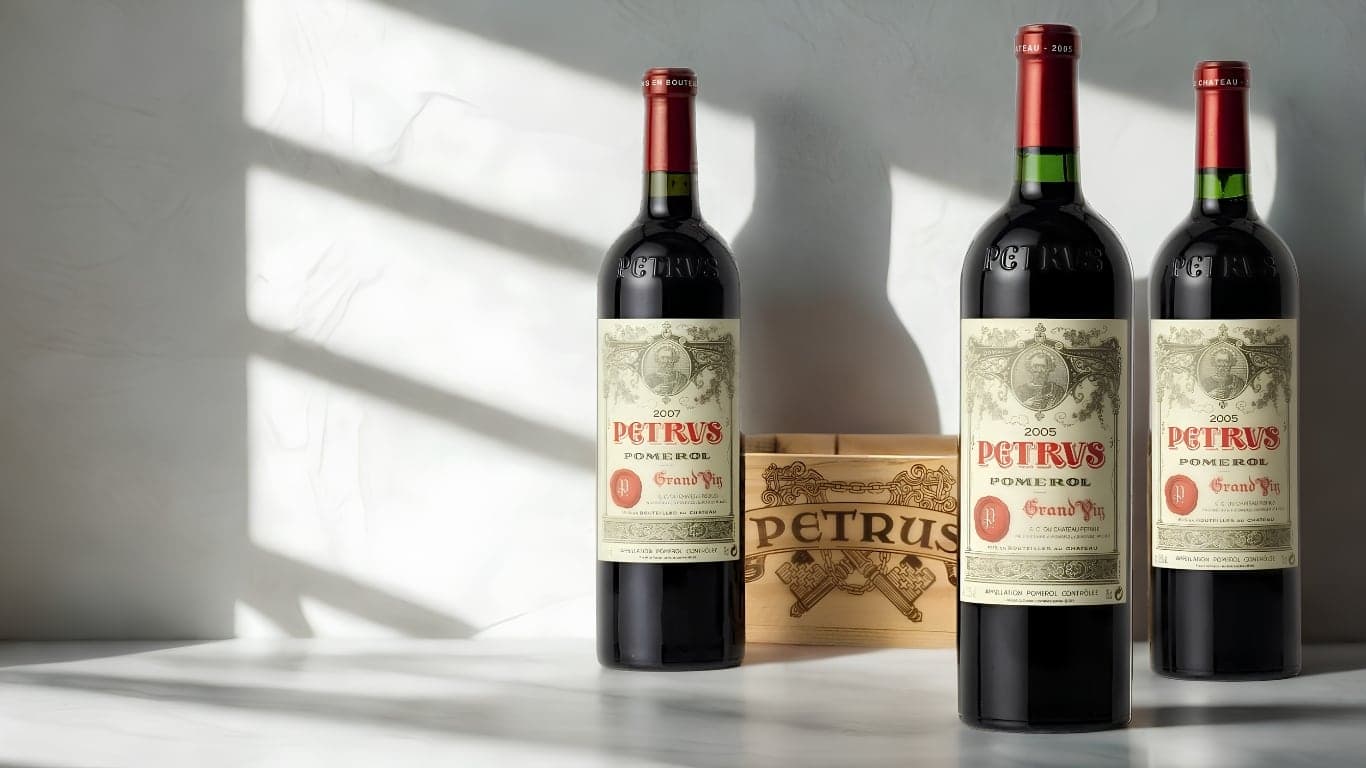
There is no plaque at Pétrus. No grand iron gate, no sweeping allée, no classification certificate framed in a tasting room. The estate sits on the Pomerol plateau looking, to an unprepared visitor, like a comfortable farmhouse with a vineyard out front. And yet Christie's, Sotheby's and Acker route some of their most fiercely contested lots through this address every season, and the hammer routinely lands at or above the Médoc first growths.
That is the puzzle worth sitting with. Pomerol, unlike the Médoc with its 1855 classification or neighbouring Saint-Émilion with its ranked crus, has never produced an official hierarchy. There is no first growth, no grand cru classé, no tiered list a merchant can point to. Decanter has long noted the irony: the most expensive red Bordeaux of all answers to no committee and wears no rank. Pétrus earns its standing the hard way, vintage after vintage, on roughly 11.4 hectares of clay. We think that absence of paperwork is precisely what makes the achievement so complete. A wine that climbs to the summit without a ladder has told you something a certificate never could.

Key Takeaways & The 5Ws
- Pétrus carries no classification (Pomerol has none) yet outprices the Médoc first growths.
- The estate spans roughly 11.4 hectares, planted essentially to Merlot.
- Its singular band of blue clay defines the top of the Pomerol plateau.
- The Jean-Pierre Moueix house of Libourne built and sustains its global standing.
- Scarcity, plus storied vintages such as 1945, 1947, 1961 and 1982, drives collector demand.
- Who is this for?
- Collectors and serious drinkers drawn to the apogee of Merlot and to right bank Bordeaux at its rarest.
- What is it?
- A tiny Pomerol estate producing one of the most coveted red wines on earth, with no classification behind it.
- When does it matter most?
- At auction, on the en primeur calendar, and when a great mature vintage finally enters its drink window.
- Where does it apply?
- The Pomerol plateau, right bank Bordeaux, on the celebrated band of blue clay.
- Why consider it?
- Because scarcity, singular terroir and deep collector demand have made it the benchmark for Merlot worldwide.
The Estate With No Plaque
Pomerol is the smallest of Bordeaux's great appellations, a quiet patchwork of gravel and clay east of Libourne where the grandest names announce themselves through reputation rather than architecture. There is no ranking to consult. A drinker arriving from the Médoc, conditioned to read a label by its 1855 standing, finds nothing to lean on. The appellation simply refuses the shortcut, and the contrast with the Médoc is the clearest illustration of how differently the right bank Bordeaux estates earn their reputations.
Into that vacuum steps a single estate of around 11.4 hectares, planted essentially to Merlot, that has come to define what Pomerol can be. Pétrus does not produce a second wine in the manner of the first growths, nor does it flood the market with volume. The estate makes one wine, in tiny quantity, and lets the bottle argue its own case. We have always read that restraint as confidence. When the surrounding system offers no ladder to climb, you make the ladder unnecessary.
The Blue Clay Beneath It
The whole story sits underground. The top of the Pomerol plateau is capped by a celebrated band of blue clay, the argile, and Pétrus occupies the heart of it. This is not a marketing flourish but a genuine geological peculiarity: a dense clay, rich in iron, that holds water through a dry summer and feeds the vine slowly, evenly, with none of the stress that thins a wine on lighter ground. Merlot, a grape that ripens early and gives generously by nature, finds in this clay the one terroir that lends it gravity, and the result sits at the apex of Merlot anywhere in the world.
The result is a wine of extraordinary density and length that somehow never tips into heaviness. Other Pomerol estates sit partly on this clay; only here does it run so deep and so pure beneath the rows, swelling when wet to throttle the vine's water supply and forcing roots to work for every drop. That hydric stress, which regulates itself and costs nothing, is the kind of natural brake other estates spend fortunes trying to engineer. Terroir is an overused word in wine, often a polite cover for ambition. At Pétrus it means something exact. Move a few hundred metres off the blue clay and the magic thins. The estate's greatness is, quite literally, the ground it stands on, and that ground cannot be bought, copied or extended.
The Moueix Hand
A great terroir still needs a champion, and Pétrus found one in the Jean-Pierre Moueix house of Libourne. From the middle of the twentieth century the Moueix négociant business took the wine to the tables and cellars that mattered, building its reputation in London, New York and beyond at exactly the moment such names were being made. The family understood what they held. They did not overproduce it, did not discount it, did not let it drift into the merely fashionable.
That stewardship continues. Jean-François Moueix and the Moueix family remain central to the estate, and the house's fingerprints are all over the wine's modern standing. We would argue this is the underrated half of the Pétrus story. The blue clay is an accident of geology; the global desirability is a century of disciplined cellar work and even more disciplined distribution. Plenty of estates sit on remarkable ground and squander it. Pétrus has had both the terroir and the hands to honour it, and the combination is rarer than either alone.
The Vintages That Built the Legend
Reputation in Bordeaux is written one great vintage at a time, and Pétrus has accumulated a roll call that few estates anywhere can match. The 1945 and 1947 are spoken of in hushed terms by the collectors lucky enough to have tasted them. The 1961 stands among the immortal Bordeaux of the post war years. Then comes the run that defined the modern era. The 1982, 1989 and 1990 are opulent, deep, seemingly built to outlive everyone who first poured them, with the 2000 closing the century in the same register.
These bottles do not merely taste extraordinary; they anchor the whole edifice of demand. When a 1947 or a 1982 surfaces at Christie's, it carries the weight of every legend attached to the name, and bidders respond accordingly. Each great vintage compounds the last. A collector chasing the 1990 is also, in a sense, paying tribute to the 1945. The back catalogue is not history at Pétrus. It is the living argument for why the next release deserves its place at the top.
Scarcity as the Final Argument
All of it converges on one stubborn fact: there is almost none of this wine. A property of around 11.4 hectares, making a single cuvée in a quantity that is generous but still finite, simply cannot satisfy the world that wants it. Scarcity is not engineered here through marketing tricks; it is the honest arithmetic of a small plot on rare ground. And scarcity, paired with genuine quality, is the most durable form of desirability there is.
This is why Pétrus needs no classification to outprice the first growths. The market has supplied its own ranking, repeatedly, at the only venues that count: the salerooms of Christie's, Sotheby's and Acker, where the wine has risen in price as a matter of plain cultural record. No committee placed it at the summit of Pomerol. Collectors did, through the slow accumulation of conviction, and that verdict holds firm even as the wider Bordeaux market shifts around it. We find that the more honest verdict. A rank can be inherited; coveted is a thing a wine has to earn, bottle by bottle, and Pétrus keeps earning it.
Strip away the auction theatre and the answer is almost austere. A small estate, a band of blue clay, a grape that found its truest home, and a family that knew exactly what it was holding. Pomerol gave Pétrus no ranking to hide behind, and so the wine simply became the standard against which the appellation is measured. The most coveted Pomerol is the one that never needed a classification to prove it, and that, more than any price ever fetched, is the measure of the thing.
Frequently Asked Questions
- Why does Pétrus have no classification?
- Pomerol, unlike the Médoc with its 1855 classification or Saint-Émilion with its ranked crus, has never adopted an official hierarchy. The appellation simply does not rank its estates. Pétrus has built its standing entirely through quality, scarcity and collector demand rather than through any committee's certificate.
- What grape is Pétrus made from?
- Pétrus is planted essentially to Merlot, the grape that ripens early and thrives on the estate's dense blue clay. Many regard the wine as the apogee of Merlot worldwide. The clay lends the grape a gravity and length it rarely achieves elsewhere, which is central to the estate's singular reputation.
- What makes the blue clay so important?
- The top of the Pomerol plateau is capped by a band of blue clay, rich in iron, the argile, and Pétrus sits at its heart. The clay holds water through dry summers and feeds the vine slowly and evenly, producing wines of remarkable density and length without heaviness. The terroir cannot be replicated.
- Which Pétrus vintages are most legendary?
- The 1945 and 1947 are spoken of with reverence, the 1961 ranks among the great Bordeaux of the post war years, and the run of 1982, 1989 and 1990 defines the modern era, with the 2000 closing the century. These bottles anchor demand whenever they appear at Christie's, Sotheby's or Acker.

Stefanos Moschopoulos
Stefanos Moschopoulos founded The Luxury Playbook in Athens and has spent the better part of a decade following the auction calendar, the en primeur releases, and the watchmakers, gallerists, and shipyards the magazine covers. He writes the field guides and listicles that anchor the Connoisseur section — pieces built on Phillips and Christie's results, Liv-ex movements, and conversations with collectors he has met across Geneva, Bordeaux, Basel, and Monaco. His own collecting habits sit closer to watches and wine than art, and it shows in the level of detail in the magazine's coverage of those categories. Under his direction, The Luxury Playbook now publishes long-form field guides, market-defining year-end listicles, and the Voices interview series with the founders behind the houses and the brands.