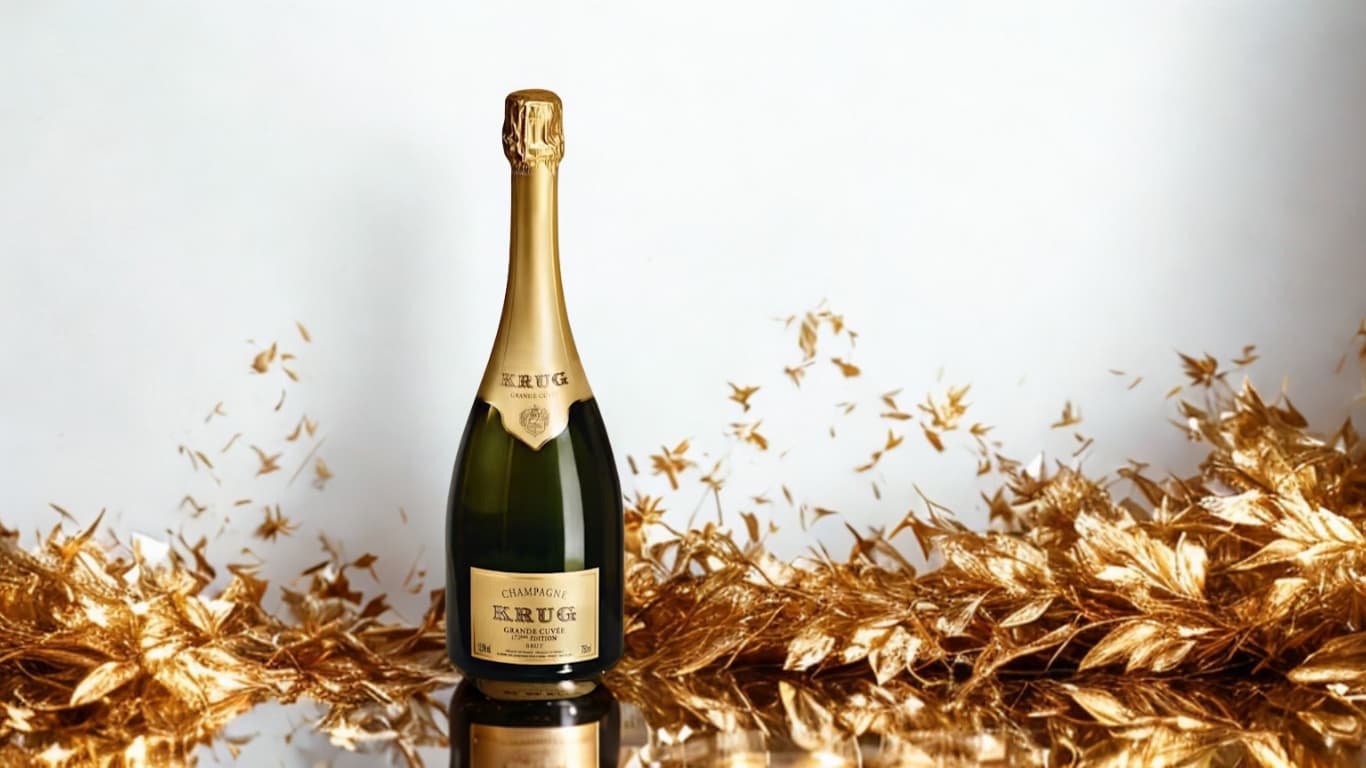
At most Champagne houses the order of seriousness is settled before you open the catalogue. The blend is the volume wine, the dependable house style, the bottle you pour without ceremony. The vintage and the prestige cuvee sit above it, reserved for the great years. Krug Champagne reads that hierarchy and quietly turns it upside down. Here the multi vintage blend is not the floor of the range. It is the summit, the wine the entire cellar exists to make, and everything else orbits it.
That blend is the Grande Cuvee, and the conviction behind it is total. Reblended every single year from a library of reserve wines stretching back more than a decade, it is assembled from well over a hundred different wines drawn from a dozen or more harvests. Decanter has long treated it as one of the benchmark expressions of the category rather than a mere house pour, and the secondary market agrees: on Liv-ex Krug trades with the gravity of a first growth, not a non vintage label. Founded in Reims in 1843 by Joseph Krug and today part of LVMH, this is a house that decided, almost from the outset, that the most demanding thing it could possibly do was the blend. We find that decision quietly radical, and the proof is in every numbered bottle.

Key Takeaways & The 5Ws
- Krug Champagne was founded in Reims in 1843 by Joseph Krug and is now part of LVMH.
- The Grande Cuvee is a multi vintage blend, reblended every year from a deep library of reserve wines.
- The house treats the blend as its flagship, not its entry rung.
- Krug Vintage, Krug Rose, Clos du Mesnil and Clos d'Ambonnay complete the range.
- Each bottle carries a Krug ID code that lets the drinker trace the exact blend.
- Who is this for?
- Collectors and serious drinkers who want Champagne treated with the seriousness usually reserved for grand cru Burgundy.
- What is it?
- A Reims house whose flagship is a reblended multi vintage cuvee rather than a single great year.
- When does it matter most?
- When a drinker stops thinking of the blend as ordinary and starts reading it as the house's defining statement.
- Where does it apply?
- Across fine Champagne collecting, from the cellar to the saleroom to the dinner table.
- Why consider it?
- Because no other major house has built its whole identity on the conviction that the blend is the hardest, finest thing it makes.
The Grande Cuvee Gamble That Defines the House
The founding idea is almost contrarian. When Joseph Krug set up in Reims in 1843, the prevailing logic held that the finest Champagne came from the finest single year, with the blend serving as a way to smooth over the lesser ones. Krug rejected the premise. His conviction, recorded in the house's own founding notes, was that a great Champagne should not be hostage to the weather of one harvest. It should instead capture an ideal of the house style every year, in good vintages and difficult ones alike, by blending across many. The Grande Cuvee is the living expression of that founding bet.
Doing this well is far harder than declaring a vintage. A vintage wine is, in a sense, a wine the season hands you. The Grande Cuvee has to be constructed from nothing each year, balanced and rebalanced until it matches an idea that exists only in the cellar master's palate. The house keeps an enormous library of reserve wines, some of them many years old, precisely so the blend never depends on the mood of a single growing season. We would argue this is the most underappreciated form of ambition in all of Champagne. Anyone can wait for a great year. Building greatness deliberately, every year, from a deep memory of past harvests, is a different order of difficulty entirely.
The Reserve Library Behind Every Reblend
The engine of the whole project is the reserve library, and it is vast. Krug holds a standing collection of older still wines, kept back from previous harvests, that the blending team draws on to compose each new edition of the Grande Cuvee. A single release commonly weaves together more than a hundred individual wines spanning ten harvests or more, the youngest giving freshness and drive, the oldest lending the depth, roundness and savoury complexity that no young wine can fake. The library is the house's memory, and the blend is what that memory makes possible.
This is why the Grande Cuvee tastes the way it does, with a richness that genuinely rivals many a single vintage prestige cuvee from elsewhere. The reserve wines act as a deep keel, giving the wine a maturity well beyond its base year. It also explains the patience the house demands of itself. These wines are aged at length in the cellars before release, the reserve component already carrying years of its own before the blend is assembled. The contrast with the way many houses approach the question is the whole point, and it is worth sitting with how differently a vintage and a non vintage cellar actually behave once you stop assuming the blend is the lesser wine.
The chalk soil vineyards of Champagne that feed houses like Krug.
The Krug ID Code and the Editions It Reveals
Krug took the conviction one step further and made the blend transparent. Every bottle carries a Krug ID, a short code printed on the back label that the drinker can enter on the house's site or app to learn precisely which edition they are holding: the base year of the blend, the year it was disgorged, the reserve wines woven through it and the cellar master's own notes on the assemblage. Far from treating the blend as an anonymous house pour, Krug invites you to read it like a vintage, edition by edition.
We think this is the most quietly revolutionary thing the house does. By numbering the editions of a non vintage wine, Krug effectively argues that the blend deserves the same scrutiny, the same vintage by vintage comparison, the same cellar tracking a collector would lavish on a great single year. It dignifies the category. A drinker can now lay down several editions of the Grande Cuvee and taste the house's thinking evolve across them, which is the sort of attention usually reserved for the prestige tier alone. The ID code turns a bottle of blended Champagne into a documented object with provenance, and that reframing is precisely the point.
Vintage, Rose and the Walled Vineyard Rarities
The Grande Cuvee may be the cornerstone, but the house surrounds it with a range that extends the same philosophy rather than contradicting it. Krug Vintage is made only in years the house judges worthy and is, in its own way, an exception that proves the rule: even when Krug does declare a vintage, it does so sparingly and on its own terms. Krug Rose, introduced in the 1980s, applied the multi vintage blending approach to a pink Champagne of unusual seriousness, treating rose as a wine for the cellar rather than a summer indulgence.
Then come the single vineyard rarities, the wines that show what the house can do when it narrows its focus to a single walled plot. Clos du Mesnil is a blanc de blancs from a small walled Chardonnay vineyard in Le Mesnil sur Oger, vinified and bottled entirely on its own, a study in the precision of one site. Clos d'Ambonnay is its even rarer counterpart in Pinot Noir, from a tiny walled plot in Ambonnay. These are among the most coveted Champagnes on earth, produced in minute quantities, and they sit at the very apex of a range that runs deeper than most collectors realise. For anyone weighing where Krug stands against its peers, the comparison with Cristal and the prestige tier is the natural next step.
Why the Blend Outranks the Vintage at Krug
What makes Krug genuinely singular is that the blend, not the vintage, carries the house's identity. At nearly every other great name, the prestige cuvee is the flag and the non vintage is the workhorse. At Krug the relationship is reversed: the Grande Cuvee is the flag, and the vintage wines are the exceptions. This is not marketing sleight of hand. It is the direct consequence of a founding philosophy that held the blend to be the truest expression of a house, because only the blend can deliver the complete Krug style every single year regardless of the weather.
The drinker who internalises this stops looking for the bottle's base year as a measure of seriousness and starts reading the edition, the reserve composition and the depth of the library behind it. That shift in attention is exactly what the house has spent more than a century building toward. It is also part of a wider change in how the fine wine world reads Champagne at all, a region that connoisseurs increasingly treat with the gravity once reserved for Burgundy, a shift we have tracked in detail in how Champagne is eating Bordeaux's lunch. Krug got there first, and it got there by insisting the blend was never the lesser wine.
Strip the question to its core and Krug's whole achievement is a single inverted assumption. Where the category said the blend is ordinary and the vintage is great, Joseph Krug said the blend, done with enough patience and enough memory, is the greatest thing of all. The Grande Cuvee is the proof, reblended every year from a library that stretches back over a decade, numbered so the drinker can read it like a vintage. The vintage wines and the walled vineyard rarities are extraordinary, but they are satellites. The sun is the blend. A house that made the non vintage cuvee its most serious wine has told you something no prestige bottling ever could, and it keeps telling you, edition after edition.

Stefanos Moschopoulos
Stefanos Moschopoulos founded The Luxury Playbook in Athens and has spent the better part of a decade following the auction calendar, the en primeur releases, and the watchmakers, gallerists, and shipyards the magazine covers. He writes the field guides and listicles that anchor the Connoisseur section — pieces built on Phillips and Christie's results, Liv-ex movements, and conversations with collectors he has met across Geneva, Bordeaux, Basel, and Monaco. His own collecting habits sit closer to watches and wine than art, and it shows in the level of detail in the magazine's coverage of those categories. Under his direction, The Luxury Playbook now publishes long-form field guides, market-defining year-end listicles, and the Voices interview series with the founders behind the houses and the brands.