The vintage versus non-vintage Champagne decision is one of the most important structural choices a cellar makes about the sparkling category. The two tiers behave differently at every level: production approach, ageing arc, secondary-market dynamics, and the role they play in a serious cellar.
- The vintage versus non-vintage Champagne decision is one of the most important structural choices a cellar makes about the sparkling category.
- The two tiers behave differently at every level, production approach, ageing arc, secondary-market dynamics, and the role they play in a serious cellar.
- Vintage Champagne has shown structurally better price stability through the 2022 to 2026 correction than non-vintage, according to Liv-ex secondary-market data.
- Non-vintage Champagne is the volume base of the category and the house-style anchor, with structurally lower secondary-market depth than vintage releases.
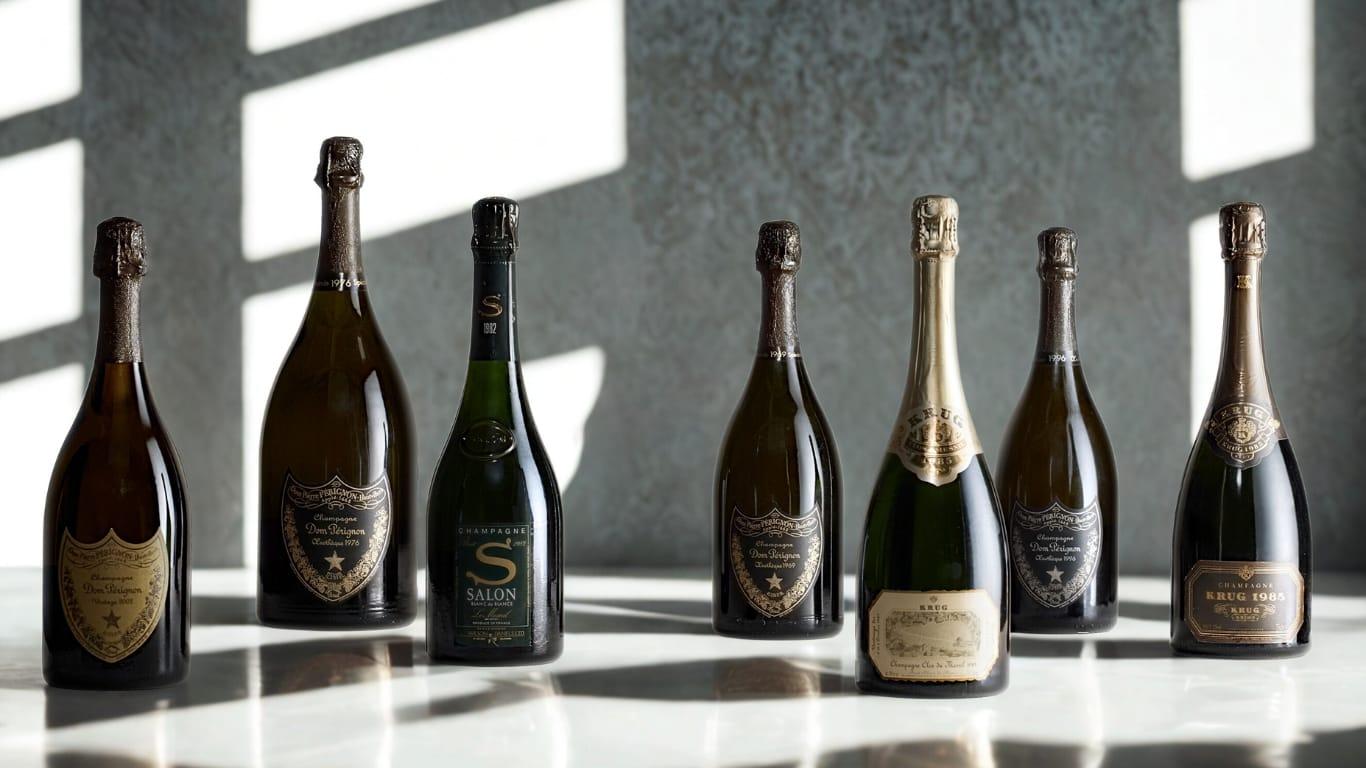
- Apex vintage Champagne, Krug Vintage, Dom Perignon, Cristal, Salon, and Bollinger Grande Annee, anchors the structural top of the category alongside non-vintage Krug.
- For serious cellars the honest answer is that both tiers deserve weight, but in different proportions and for structurally different reasons.
- Who is this for?
- Cellar builders working through Champagne positions, and serious collectors evaluating the structural balance between vintage and non-vintage allocations.
- What is happening?
- We compare vintage and non-vintage Champagne as structural cellar positions, with the production, ageing, and secondary-market variables that distinguish each.
- When did this emerge?
- The piece reads the contemporary 2026 market, with the post-2022 Champagne correction and the Liv-ex Champagne 50 trajectory as live structural context.
- Where is this happening?
- The Champagne region broadly, with the negociant-manufacturier (NM) house tier and the grower-producer (RM) tier as the structural reference.
- Why does it matter?
- Sizing vintage and non-vintage Champagne correctly is foundational for serious sparkling cellar architecture, and the structural cellar logic for each is meaningfully different.
This is our editorial read on how to think about the comparison. The honest answer is that a serious cellar wants both, but in different proportions and for different reasons.
According to Liv-ex secondary-market data, vintage Champagne has shown structurally better price stability through the 2022 to 2026 correction than non-vintage Champagne, with the Liv-ex Champagne 50 dominated by vintage releases reflecting the structural shift in serious-collector positioning.
Non-vintage Champagne: the structural workhorse
Non-vintage Champagne is the volume base of the category and the house-style anchor. It is built from blends across multiple years (typically three to five), with each major house's reserve wines providing structural continuity from release to release.
The structural promise is consistency. Moët et Chandon Impérial in 2026 should taste meaningfully similar to Moët et Chandon Impérial in 2023, with the house's blend discipline smoothing vintage variation. Veuve Clicquot Yellow Label, Mumm Cordon Rouge, Pol Roger Brut Reserve, and the broader major-house non-vintage tier all work on the same logic.
For cellar-building purposes, non-vintage Champagne is a drinking-window category. The wines are released ready-to-drink and improve marginally with one to three years of cellar time. They are not built for long-arc ageing.
Vintage Champagne: the cellaring category
Vintage Champagne is declared only in years a house considers exceptional. The wines are made from a single year's harvest and spend significantly more time on lees (typically five to ten years for major-house releases, considerably longer for prestige cuvées).
The structural ageing arc is different. Vintage Champagne released in 2026 typically reflects a 2014 or 2015 harvest at the major-house tier, and a 2008 or 2012 harvest at the prestige tier (Krug 2008, Salon 2008, Dom Pérignon P2). The wines reward serious cellar time and continue to develop in bottle for decades.
Krug 2008, Salon 2008, Dom Pérignon 2008 are reference points for what vintage Champagne can do across a 15-to-20-year ageing arc. The structural promise is depth, complexity, and the kind of slow oxidative development that defines the category at its best.
How the two compare for serious cellar building
Non-vintage Champagne earns its cellar place as a drinking-window category. A serious cellar wants a modest standing position (typically half a case to a case across two to three house styles) for ready-to-drink occasions. Pol Roger Brut Reserve, Bollinger Special Cuvée, and Charles Heidsieck Brut Reserve are reference points for what non-vintage Champagne can deliver at its best.
Vintage Champagne earns its cellar place as a long-arc ageing category. A serious cellar wants meaningful allocation (typically multiple cases across multiple vintages) in named-house vintage releases, particularly Dom Pérignon, Cristal, Krug, Pol Roger Sir Winston Churchill, and the broader prestige tier.
For broader cellar building context, vintage Champagne sits alongside Burgundy named domaine and Bordeaux First Growth as one of the structural anchor categories for serious sparkling-and-white positioning. Non-vintage Champagne sits in a different role.
The price points and the value question
Non-vintage Champagne from named major houses sits in the £40 to £80 retail range. Pol Roger Brut Reserve, Bollinger Special Cuvée, and Charles Heidsieck Brut Reserve all sit in this band. Grower-producer non-vintage Champagne (Egly-Ouriet, Larmandier-Bernier, Selosse Initial) sits structurally higher, typically £80 to £160.
Vintage Champagne from major houses sits in the £120 to £250 range at release. Prestige cuvée Champagne (Dom Pérignon, Cristal, Krug Grande Cuvée) sits in the £180 to £350 range at release, with secondary-market pricing on aged vintages reaching meaningfully higher.
The named tête de cuvée releases (Cristal Rosé, Dom Pérignon Rosé, Krug Clos du Mesnil, Salon Le Mesnil) sit at the top of the category, typically £400 to £1,200 at release. Cristal remains the structural reference point for prestige-cuvée Champagne value.
The structural shift in the category
Serious cellars have shifted meaningfully toward vintage Champagne allocation across the past five years. The Liv-ex Champagne 50 is dominated by vintage releases, and auction trade volume at Sotheby's Wine and Christie's Wine has tilted further toward vintage Champagne through the 2022 to 2026 cycle.
The non-vintage tier remains a drinking-window category for serious cellars but is no longer a structural ageing position. The category implications of this shift sit at the centre of broader Champagne house dynamics, and we have written separately on Champagne house pressure across the current cycle.
The broader sparkling category context, including sparkling wine growth dynamics, also matters for thinking about how vintage Champagne fits into a serious cellar through 2030.
The bottom line for serious cellar building
A serious cellar wants both. Vintage Champagne earns the structural ageing position, with meaningful allocation across multiple named-house vintage releases. Non-vintage Champagne earns a smaller standing position for drinking-window occasions.
The pricing dynamics, ageing arcs, and structural roles are different enough that the choice is not vintage versus non-vintage. The choice is how to allocate across both tiers in a way that builds a cellar with structural depth across drinking horizons.
And for the broader category framing on why this matters across the fine-wine landscape, Why Burgundy and Champagne Are Quietly Eating Bordeaux's Lunch sits at the centre of how named Champagne has rebuilt its structural position in serious cellars across the past decade.
We last reviewed this analysis in May 2026.