The Champagne category is going through its hardest market test in a decade. Houses that spent the 2010s building structurally higher list prices are now watching consumer demand soften across multiple core markets, and the September 2025 Comité Champagne shipment data made the structural shift impossible to dismiss.
- The Champagne category is going through its hardest market test in a decade, with houses that spent the 2010s building structurally higher list prices watching consumer demand soften.
- The September 2025 Comite Champagne shipment data made the structural shift impossible to dismiss, with total Champagne shipments in 2025 falling roughly 9 percent year-over-year.
- US and UK markets accounted for the bulk of the volume decline, with the major negociant-manufacturier (NM) houses absorbing the structural pressure.
- Three things compounded, list price rises across the 2022 to 2024 release calendar, post-pandemic consumer reset, and the broader drink-less-but-better shift.
- Vintage Champagne has held its structural pricing better than non-vintage, with the Liv-ex Champagne 50 dominated by vintage releases reflecting the shift.
- For serious cellars the confidence test creates selective buying opportunities at the apex vintage tier, with the structural correction unevenly distributed.
- Who is this for?
- Active collectors reading the contemporary Champagne market, and cellar builders evaluating where the structural correction creates selective buying opportunities.
- What is happening?
- We read what is happening to major Champagne house consumer confidence, with the shipment data, pricing dynamics, and structural cellar implications as live context.
- When did this emerge?
- The piece reads the September 2025 Comite Champagne data through the contemporary 2026 market, with the post-2022 price-rise cycle as live reference.
- Where is this happening?
- The Champagne region, with US and UK markets as the structural demand context anchoring the analysis.
- Why does it matter?
- The Champagne confidence test creates selective apex buying opportunities, and reading the structural correction correctly matters for serious-cellar strategy.
This is our editorial read on what is happening, why it matters for serious collectors, and which houses are best positioned through the cycle. The picture is more complicated than the headlines suggest.
According to Comité Champagne, total Champagne shipments in 2025 fell roughly 9% year-over-year, with US and UK markets accounting for the bulk of the volume decline.
What changed in the past 18 months
Three things happened, and they compounded. First, the major négociant-manufacturier (NM) houses raised list prices aggressively across the 2022 to 2024 release calendar, with some prestige cuvées rising more than 30%. Second, the broader US consumer trade-down across alcohol categories caught Champagne at exactly the wrong moment in its pricing cycle.
Third, the global trade-down to vintage Champagne away from non-vintage tier accelerated, revealing how dependent the broader category was on entry-tier volume.
The compound effect has been sharp. Liv-ex Champagne 50 finished 2025 down 14% from the 2022 peak, against the broader Liv-ex 1000 down closer to 12%. Auction clearance rates for prestige cuvée Champagne at Sotheby's Wine and Christie's Wine fell to multi-year lows in late 2025.
The houses under most pressure
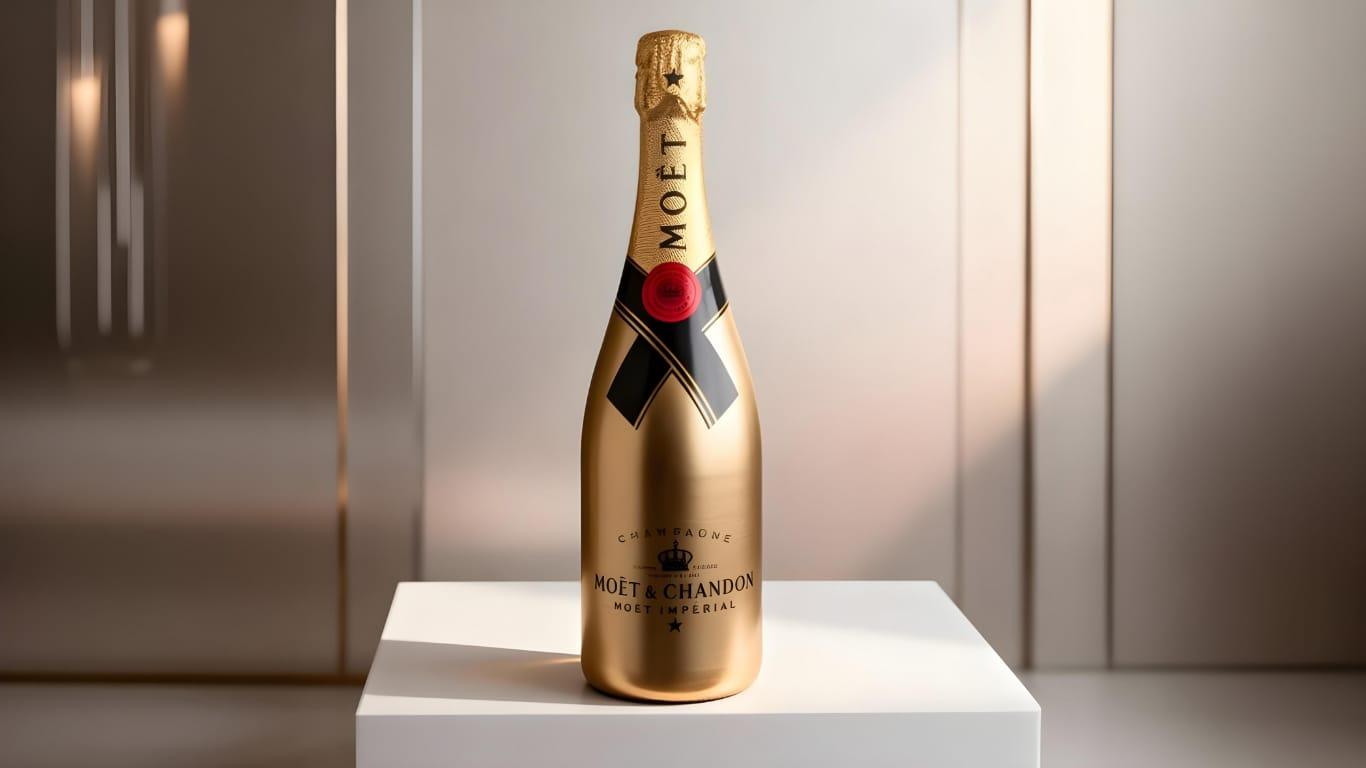
The major NM houses with broad non-vintage exposure are taking the hardest hit. Moët et Chandon Impérial, Veuve Clicquot Yellow Label, and Mumm Cordon Rouge have all seen meaningful volume compression in 2025 shipments.
The structural problem is that non-vintage Champagne is the volume base, and that is exactly where consumer trade-down is hitting hardest. The prestige tier (Dom Pérignon, Cristal, Krug Grande Cuvée, Pol Roger Sir Winston Churchill) has held value better but is not immune.
Cristal remains the structural exception. The Louis Roederer prestige cuvée has held value better than any other major-house prestige Champagne through the correction, supported by its tightly-controlled production volume and the structural strength of its primary buyer base.
The smaller grower-producer Champagne picture
Grower-producer Champagne (RM, récoltant-manipulant) has shown more resilience through the correction than the major NM houses. Houses like Selosse, Egly-Ouriet, Larmandier-Bernier, Ulysse Collin, and the broader RM tier have continued to clear at auction at meaningful prices.
The structural reason is allocation rather than list-price discipline. Top grower producers ship small volumes to a constrained set of distributors and retailers, with secondary-market pricing reflecting genuine scarcity rather than house list-price discipline. The structural buyer base is also different: serious collectors building positions, rather than the broader gift-and-celebration market.
The trend toward grower-producer Champagne in serious cellars has been building for over a decade. The current major-house pressure is accelerating it.
What this means for serious collectors
The current market correction is a structurally helpful moment for collectors building positions. List-price compression at the major NM houses means entry tier into prestige cuvée Champagne is more accessible than at any point since 2021.
The structural cellar play is to allocate across both major-house prestige (Dom Pérignon, Cristal, Krug) and named grower-producer (Selosse, Egly-Ouriet, Larmandier-Bernier, Ulysse Collin). The pricing dynamics are different at each tier, and a meaningful cellar position benefits from exposure to both.
The named vintage releases (Cristal 2014, Dom Pérignon 2015, Krug 2008 if still accessible) deserve disciplined allocation through the current cycle. The Liv-ex secondary-market data on top-tier vintage Champagne shows the strongest structural floor in the broader category.
The category context
The major Champagne house pressure sits inside a broader sparkling-wine category shift. Why Burgundy and Champagne Are Quietly Eating Bordeaux's Lunch describes the structural pull of named Champagne into the broader fine-wine category. The pressure on the major houses is a moment in that arc rather than a reversal of it.
The broader fine-wine recovery picture, including Fine Wine Market Shows Signs Of Recovery But Remains Fragile, also frames how Champagne fits into the 2026 fine-wine landscape. Champagne is one of the categories where the recovery is showing up first.
And for the wider sparkling category context that frames Champagne's structural position, Why Is the Sparkling Wine Market Growing Faster Than Other Wine Categories? sits at the centre of how non-Champagne sparkling is rebuilding share.
What we watch next
Three signals will tell us whether the major-house confidence recovers or whether the structural shift sticks: first, the 2026 release pricing from Moët, Veuve Clicquot, and Mumm; second, the Comité Champagne quarterly shipment data through 2026; third, the secondary-market clearance rates on prestige cuvée releases at the major auction houses.
The Champagne category will rebuild. The question is what proportion of that rebuilding accrues to the major NM houses versus the grower-producer tier. Our view is that the structural shift toward named growers in serious cellars continues, even as the major houses recover volume.
We last reviewed this analysis in May 2026.