Burgundy and Champagne are quietly eating Bordeaux's lunch, and the Liv-ex secondary-market data tells the story. The Liv-ex Burgundy 150 has consistently outperformed the Bordeaux 500 since 2017, and Champagne's named single-vintage tier has built parallel structural gains. The shift is not subtle and it is not recent.
- Burgundy and Champagne are quietly eating Bordeaux's lunch in serious wine collecting, and the Liv-ex secondary-market data tells the structural story.
- The Liv-ex Burgundy 150 has consistently outperformed the Bordeaux 500 since 2017, with Champagne's named single-vintage tier building parallel structural gains.
- What started as a thin rebalancing in the late 2010s has become the dominant structural story in fine wine across the past five years.
- Burgundy has taken record share of Liv-ex trading volume while Bordeaux has ceded ground, even at the apex of its First Growth tier.
- Champagne's vintage releases have built structural pricing momentum, with the Liv-ex Champagne 50 absorbing collector attention through the broader Bordeaux softness.
- For serious cellars the structural rotation matters for both allocation strategy and the broader question of where structural cellar weight should sit through the rest of the decade.
- Who is this for?
- Cellar builders working through the structural Burgundy-Bordeaux-Champagne rotation, and serious collectors reading the contemporary fine-wine demand architecture.
- What is happening?
- We read why Burgundy and Champagne are eating Bordeaux's lunch, with the Liv-ex secondary-market data, producer rebalancing, and structural rotation as live context.
- When did this emerge?
- The piece reads the post-2017 structural rotation through the contemporary 2026 market, with the Liv-ex Burgundy 150 and Champagne 50 trajectories as live reference.
- Where is this happening?
- Burgundy's Cote d'Or, the Champagne region, and Bordeaux as the three structural regions defining the contemporary rotation in serious wine collecting.
- Why does it matter?
- The Burgundy and Champagne rotation represents one of the most meaningful structural shifts in modern fine-wine collecting, and reading it correctly matters for cellar architecture through 2030.
What started as a thin rebalancing in the late 2010s has, across the past five years, become the dominant structural story in fine wine. Burgundy has taken record share of Liv-ex trading volume while Bordeaux has ceded ground, even at the apex of its First Growth tier.
This is our editorial read on what is driving the rotation and what it tells us about the wider fine-wine market in 2026.
The data behind the rotation
Liv-ex publishes monthly secondary-market trading data that breaks down volume and value share across the major fine-wine regions. The 2024 annual report flagged that Burgundy reached its highest-ever share of total Liv-ex trading volume across the year, while Bordeaux's share fell to its lowest level in the modern era.
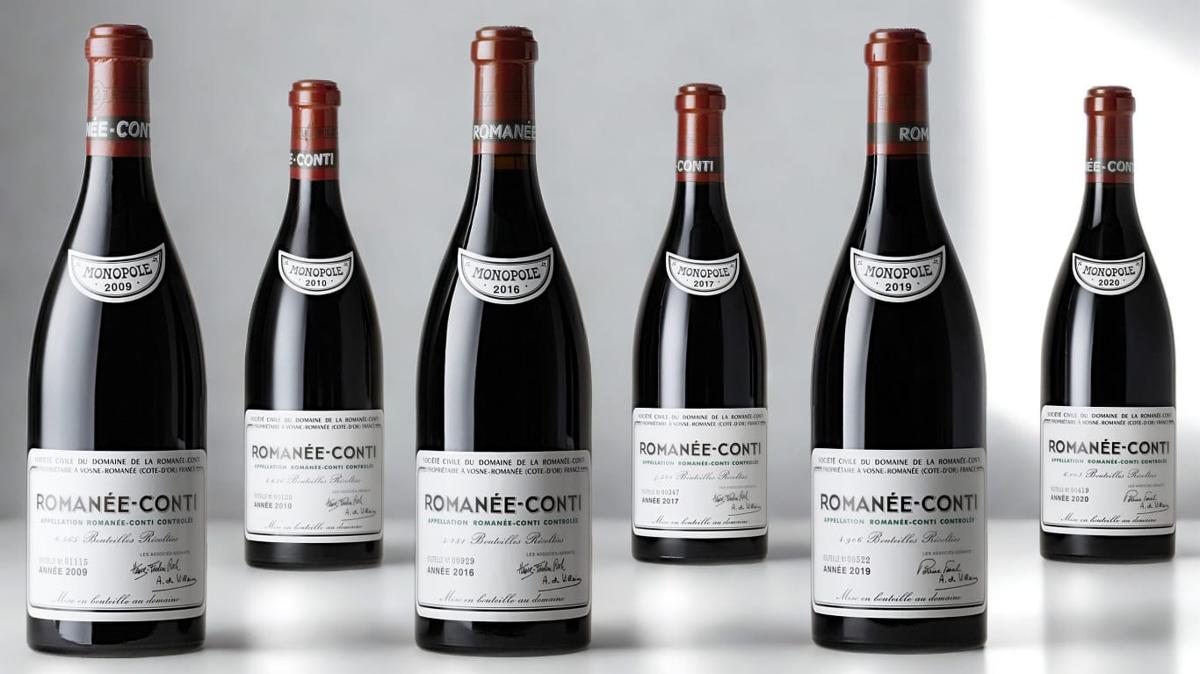
The pricing data backs the narrative. Domaine de la Romanée-Conti's apex bottlings, Domaine Leroy, Domaine Roumier, and the wider Grand Cru Burgundy tier have all carried meaningful price gains across the past five years. Bordeaux First Growth release pricing has been flat to declining over the same period, with the 2022 and 2023 en primeur campaigns clearing at meaningful discount to the prior years.
The named single-vintage Champagne tier (vintage Krug, vintage Dom Pérignon, vintage Bollinger La Grande Année, vintage Pol Roger Sir Winston Churchill) has built its own parallel category gain. The Liv-ex Champagne 50 has been one of the most consistently positive regional indices across the post-2020 cycle. The wider vintage Champagne story is one we have covered.
Why Bordeaux is losing structural ground
The structural argument for Bordeaux's decline is layered. First, the volume problem. Bordeaux is, structurally, a higher-volume fine wine region than Burgundy.
Pétrus produces around 30,000 bottles per vintage; Domaine de la Romanée-Conti's Romanée-Conti monopole produces around 5,000 bottles per vintage. The structural scarcity discipline favors Burgundy.
Second, the release-pricing problem. Across the past decade, Bordeaux's en primeur release pricing has consistently failed to clear at meaningful discount to subsequent secondary-market trading. The 2022 and 2023 campaigns were the most acute examples, but the pattern goes back further.
Bordeaux Index and Berry Bros & Rudd have both publicly stated that the en primeur model needs structural reform.
Third, the critical-recognition problem. Decanter, Wine Advocate, Vinous, and Jancis Robinson have all, across the past five years, produced increasingly divergent scoring on the leading Bordeaux releases. Burgundy has not had the same problem.
The critical infrastructure on the Burgundy tier has converged around a stable consensus that the major Grand Cru sites are producing the best work the region has produced in modern memory.
Why Burgundy has built structural advantage
Burgundy's structural gains have three structural drivers. First, the scarcity discipline. Grand Cru and Premier Cru production volumes are inherently small.
The total production of the named DRC bottlings across all sites combined is around 8,000 bottles per vintage. Domaine Leroy's annual production is similarly tiny. The structural supply-demand mathematics favors the category.
Second, the generation transition. The Henri Jayer, Domaine Dujac, Comte de Vogüé, Armand Rousseau, and Domaine Méo-Camuzet generation of producers has either passed on or transitioned to next-generation winemaking. The succession in most cases has been credible.
The new generation has, in many cases, sharpened the quality of the work.
Third, the international collector base. Burgundy's serious-collector demographic has broadened across the past decade. The Tokyo, Hong Kong, Singapore, London, and US-based Burgundy collector base now meaningfully exceeds the equivalent Bordeaux-collector base in active secondary-market trading.
The wider story of where the fine-wine market sits in 2026 is something we have covered in our The Fine Wine Market in 2026: A Collector's Read.
The Champagne category gain
Champagne's structural gain across the rotation is the story that has drawn less attention but is arguably the most interesting. The named single-vintage tier (vintage Krug, Cristal, Dom Pérignon, Salon Blanc de Blancs, the grower-Champagne tier at the apex) has built consistent secondary-market gains across the past five years.
What is driving the Champagne gain is, in our editorial read, the wider category recognition. Champagne is no longer treated structurally as a "celebration purchase" category. Serious collectors increasingly hold mature Champagne (the named single-vintage tier from 1990, 1996, 2002, 2008) alongside Burgundy and Bordeaux in their long-aging cellars.
The category has become an aging-cellar category, not just a near-term consumption category.
The grower-Champagne movement has expanded the category further. Producers like Selosse, Egly-Ouriet, Pierre Péters, Cédric Bouchard (Roses de Jeanne), Agrapart, Vouette et Sorbée, and Ulysse Collin have built genuine serious-collector demand at the smaller-production tier. Their work sits alongside the houses' single-vintage releases in serious cellars.
What the rotation tells us about the wider market
The Burgundy-and-Champagne ascendance is the single most important structural story in fine wine in the post-2020 cycle. It tells us several things about how the market actually functions.
It tells us that critical and merchant trust matters. Burgundy's structural advantage has been built on consistent, convergent critical recognition and disciplined merchant allocation. Bordeaux's structural decline has been compounded by divergent critical scoring and persistent release-pricing concerns.
It tells us that scarcity discipline is more powerful than scale. The Burgundy categories with the smallest production volumes have carried the largest secondary-market gains. The Bordeaux categories with the largest production volumes have carried the largest secondary-market declines.
The mathematics of the rotation favors the structural-rarity side.
It tells us that international collector breadth matters. The categories with the broadest international serious-collector base (Burgundy Grand Cru, Champagne single-vintage) have been the most resilient. The categories with the most concentrated regional collector base have been the most vulnerable to demand shifts.
The US and Asian collector behavior shift is something we covered in our recent U.S. Buyers Still Dominate Fine Wine, but the Buying Has Shifted.
What this means for collectors
The straightforward read for collectors in 2026 is that the structural rotation toward Burgundy and Champagne is real, deep, and unlikely to reverse in the next 18 to 24 months. The reasons that drive it (scarcity discipline, critical convergence, international collector breadth) are durable.
What this does not mean is that Bordeaux is finished. The First Growth bottles age, the apex Right Bank work (Pétrus, Lafleur, Le Pin, Cheval Blanc) remains structurally important, and the secondary-market pricing decompression of the past five years has, in some cases, created meaningful value at the second-tier Pomerol and Saint-Émilion level.
The straightforward strategy for a serious cellar in 2026: weight the new allocation toward Burgundy Grand Cru and Premier Cru work alongside vintage Champagne, hold existing Bordeaux positions, and approach new Bordeaux en primeur with selective discipline. The categories carrying the structural gains are the ones to weight more heavily in the marginal allocation decision.
What we will watch next
Two signals to track. First, whether the 2024 Burgundy vintage (released in 2026) carries the kind of release-pricing discipline that has defined the past five years, or whether the Place de Beaune sees inflation pressure as global demand intensifies. Second, whether the 2025 Bordeaux en primeur campaign launching in spring 2026 delivers release pricing that genuinely restores the structural discount.
Each signal would tell us whether the rotation continues to compound or whether the structural reset begins. Either way, the Burgundy-and-Champagne story is unlikely to fade quickly.
We last reviewed this analysis in May 2026.