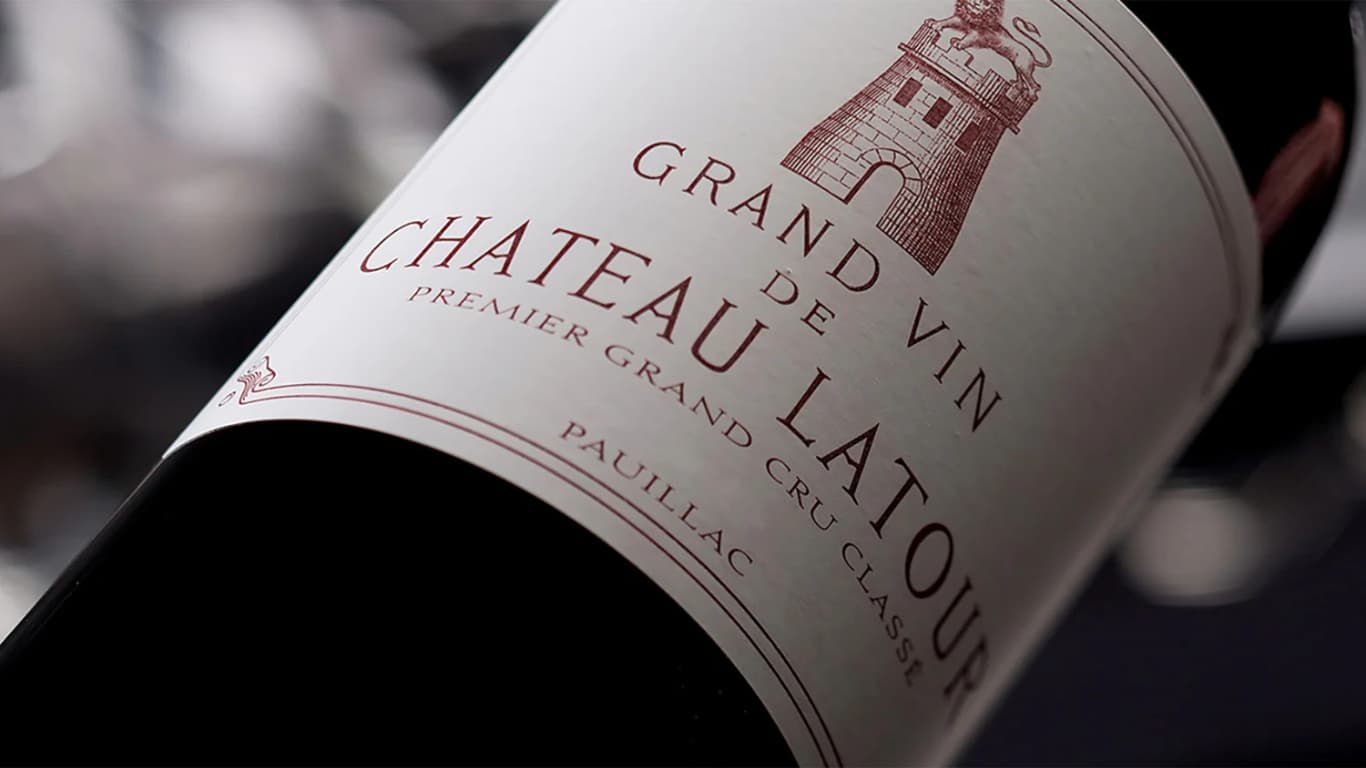
Of the five Bordeaux first growths, Château Latour is the one collectors reach for when they want a wine to outlive them. It is the most reliably powerful, the most structured, and the most stubbornly slow to reveal itself, a Pauillac built on Cabernet Sauvignon and engineered, vintage after vintage, for the very long haul in the cellar. Where some great names flatter early, Latour makes its drinkers wait, and the patience is the whole point.
The estate stands on the Left Bank, in the commune of Pauillac in Bordeaux, and ranks among the original first growths of the 1855 classification, the hierarchy that still anchors the region's reputation today. Decanter has long counted it among the most age worthy reds in the world, and the secondary market bears that out: Liv-ex tracks mature Latour as one of the most durable and consistently traded names in Bordeaux. We think two things set it apart from its peers. The first is the ground it grows on, a single walled vineyard around the estate. The second is a decision, taken in 2012, that no other first growth has matched.

Key Takeaways & The 5Ws
- Château Latour is a first growth of the 1855 classification, on the Left Bank in Pauillac.
- Its Cabernet Sauvignon dominant Grand Vin is powerful and built for very long ageing.
- The best fruit comes from the walled Enclos, the historic vineyard around the estate.
- In 2012 Latour left the en primeur system to release wines closer to ready to drink.
- The second wine is Les Forts de Latour, drawn largely from outside the Enclos.
- Who is this for?
- Collectors and serious drinkers who lay down Bordeaux for decades and prize structure over early charm.
- What is it?
- A Pauillac first growth, famed for powerful, age worthy Cabernet Sauvignon dominant reds.
- When does it matter most?
- When building a long term cellar, and when a mature vintage finally enters its drink window.
- Where does it apply?
- The Left Bank of Bordeaux, the commune of Pauillac, above all the walled Enclos.
- Why consider it?
- Because no first growth ages more reliably, and its release strategy now sets it apart.
The Walled Enclos at the Heart of It
The soul of Château Latour is a single vineyard, the Enclos, the walled expanse that wraps around the estate close to the Gironde estuary. This is the historic heart of the property, and the Grand Vin is drawn above all from its rows. The ground here is a deep bed of gravel over clay, the classic Left Bank recipe, but the Enclos has a character all its own: warmer, more sheltered, and consistent enough that Latour produces a great wine in vintages where lesser sites struggle.
That consistency is the foundation of the estate's reputation for power. Cabernet Sauvignon, the dominant grape, ripens fully and reliably on this gravel, building the firm tannin and dense fruit that define the house style. We have always seen the Enclos as the reason Latour can be so forbidding young and so magnificent old. The wine is not made austere by accident; it is born structured, because the ground gives it the backbone to carry decades. Bordeaux is full of fine vineyards, but few deliver a Grand Vin of this depth with such regularity, and the walls around the Enclos enclose something genuinely rare.
A Wine Built for Decades, Not Years
To open a young Latour is often to wonder what the fuss is about. The wine can be tight, brooding, almost severe, its fruit locked behind a wall of tannin that gives little away. This is by design. Latour is among the most age worthy wines in all of Bordeaux, built to spend twenty, thirty, even forty years in a cool cellar before it unfurls into the dense, savoury, endless wine its admirers prize. Drinking it too soon is not a crime, but it is a waste.
The contrast with the rest of Bordeaux is instructive. Many great reds soften and become approachable within a decade; Latour, in a serious vintage, is often only beginning to stir. This is precisely why it is the first growth collectors lay down deepest, the one bottle they are most willing to forget at the back of the cellar and rediscover a generation later. For anyone weighing how the great Left Bank names differ from their Right Bank counterparts in the cellar, the Left Bank versus Right Bank comparison lays out why structure like this rewards patience. Latour is the clearest case on either bank for buying young and waiting long.
Why Latour Walked Away From En Primeur
For centuries the great Bordeaux estates sold their wine en primeur, as futures, with buyers committing in the spring after the harvest, long before the wine was bottled or ready to drink. It is a system the whole region was built on, and it shaped the global market that grew up around the famous 1982 campaign and others like it. Then, in 2012, Château Latour did something no other first growth had dared. It left en primeur entirely.
The decision was a genuine landmark. From the 2012 vintage onward, the estate stopped selling new releases as futures and chose instead to hold its wines back, releasing them only when they were closer to ready to drink. The reasoning was a kind of conviction made policy. If Latour is a wine built to mature, why sell it as a barely formed infant and let speculators trade it for years before anyone could open it? Better, the estate decided, to cellar the wine itself and release bottles that were actually approaching their window. We read this as the most confident move any first growth has made in modern memory, an estate betting that the wine, given time in its own cellars, was the more honest product than the futures contract.
The Release Strategy That Set It Apart
The consequences of that 2012 break are still unfolding, and they have reshaped how Latour reaches collectors. Rather than a single feverish futures campaign, the estate now releases older vintages in measured tranches when it judges them ready, so a buyer today might be offered a wine with a decade or more of bottle age already behind it, cellared in perfect conditions at the château itself. Provenance, the eternal anxiety of the mature wine market, is answered at the source.
This is the quiet brilliance of the strategy. The greatest worry when buying old Bordeaux is how it was stored across the decades; a bottle released directly from the estate's own cellars carries an assurance no auction lot can fully match. At Christie's and Sotheby's, Latour with verified château provenance is prized accordingly, and the estate's decision to control its wines for longer has only deepened that trust. We would argue Latour traded the short term liquidity of futures for something more durable, a reputation for releasing wines that are ready, authentic and impeccably kept. Few estates have the standing to make that trade, and fewer still the nerve.
Les Forts de Latour and the Second Wine
No portrait of the estate is complete without its second wine, Les Forts de Latour, which is far more than an afterthought. Drawn largely from plots outside the walled Enclos, along with fruit from younger vines and barrels not selected for the Grand Vin, Les Forts is a serious Pauillac in its own right, structured and age worthy in a way that would flatter many a classed growth elsewhere. It is the first growth's second wine, but it wears the family resemblance proudly.
For collectors, Les Forts serves a real purpose. It offers the Latour signature, that firm Cabernet driven structure, at a more attainable level, and it tends to come into its drink window earlier than the Grand Vin, rewarding patience without demanding quite so much of it. The estate also makes a straightforward Pauillac under its own appellation, completing a three tier range that lets the house place every parcel where it belongs. Among the great names sought across the region, Latour sits alongside benchmarks like Pétrus on the Right Bank, each defining excellence in its own idiom. The Grand Vin remains the summit, but the strength in depth is part of what makes Latour an estate collectors come back to rather than visit once.
Power, patience and conviction: those three words carry the Latour story. A walled vineyard that gives the wine its backbone, a structure that demands decades rather than years, and a 2012 decision to leave en primeur that turned the estate's own confidence into policy. Among the first growths, Latour is the one most willing to make its drinkers wait, and the one that has staked its name on the belief that a wine built to age should be sold ready to reward the waiting. That is why collectors cellar it deepest, and why, more than a century and a half after 1855, it still feels like the most uncompromising first growth of them all.

Stefanos Moschopoulos
Stefanos Moschopoulos founded The Luxury Playbook in Athens and has spent the better part of a decade following the auction calendar, the en primeur releases, and the watchmakers, gallerists, and shipyards the magazine covers. He writes the field guides and listicles that anchor the Connoisseur section — pieces built on Phillips and Christie's results, Liv-ex movements, and conversations with collectors he has met across Geneva, Bordeaux, Basel, and Monaco. His own collecting habits sit closer to watches and wine than art, and it shows in the level of detail in the magazine's coverage of those categories. Under his direction, The Luxury Playbook now publishes long-form field guides, market-defining year-end listicles, and the Voices interview series with the founders behind the houses and the brands.