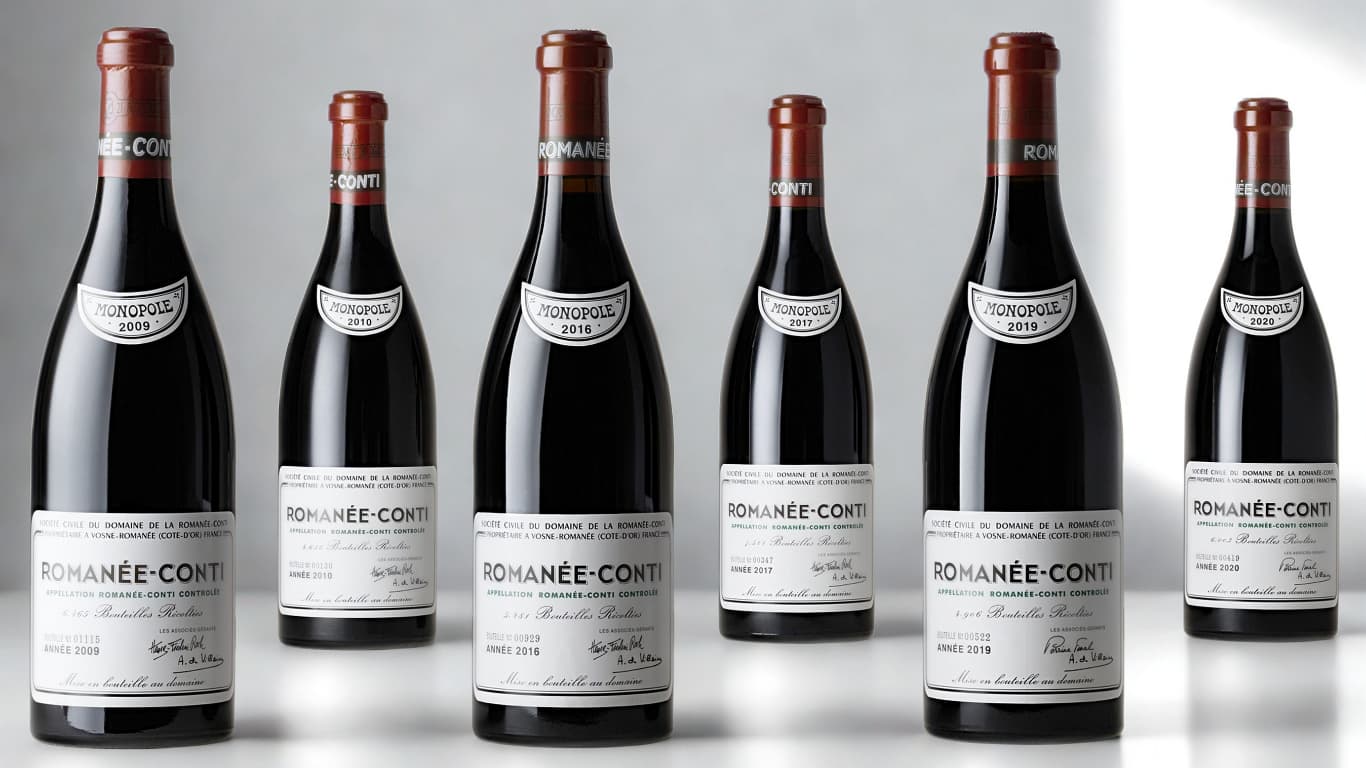
There is a stone cross at the edge of a vineyard in Vosne-Romanee, and behind it lies a parcel of barely 1.8 hectares that produces the most coveted red wine on earth. This is Romanee-Conti itself, the monopole that gives Domaine de la Romanée-Conti its name, and the estate that farms it is the one address every serious collector eventually circles back to. Known almost everywhere simply as DRC, it owns no grand château, mounts no marketing, and makes so little wine that owning a single bottle can take years of patience and a place on a list that rarely opens.
The estate sits in the commune of Vosne-Romanee, in the heart of Burgundy's Côte de Nuits, and the scale of what it controls is almost absurd. Decanter has long treated its wines as the reference point against which all other Pinot Noir is measured, and the data houses agree: Liv-ex records Romanee-Conti as routinely the single most expensive wine in the world by the bottle, year after year. We think the more revealing fact is not the price but the arithmetic behind it. A few hectares, farmed by hand, biodynamically, yielding a quantity so small that global demand can never come close to being met. Everything that follows flows from that.

Key Takeaways & The 5Ws
- DRC sits in Vosne-Romanee, in Burgundy's Côte de Nuits, and farms several grand cru parcels.
- It holds two monopoles, Romanee-Conti and La Tache, owned by no one else.
- Other holdings include Richebourg, Romanee-Saint-Vivant, Grands-Echezeaux, Echezeaux and Montrachet.
- Farming is biodynamic, production is tiny, and wines are sold in allocated cases, not singly.
- Romanee-Conti is routinely the most expensive wine in the world by the bottle.
- Who is this for?
- Collectors and serious drinkers drawn to the apex of Burgundy and the rarest Pinot Noir on earth.
- What is it?
- A single Vosne-Romanee estate, known as DRC, farming grand cru parcels and two monopoles.
- When does it matter most?
- At the annual allocation, at auction, and when a mature vintage finally enters its drink window.
- Where does it apply?
- Vosne-Romanee and the surrounding grand crus of Burgundy's Côte de Nuits.
- Why consider it?
- Because scarcity, monopole terroir and biodynamic farming have made it the benchmark of fine wine.
The Monopoles That Cannot Be Bought Anywhere Else
Two of the estate's vineyards are monopoles, meaning DRC is their sole owner and the only producer on earth permitted to put their names on a label. Romanee-Conti, the parcel behind the stone cross, runs to roughly 1.8 hectares. La Tache, larger but still tiny by any sane measure, covers around 6 hectares. No other house bottles a wine from either site, because no other house owns a single row. This is the rarest condition in all of fine wine: not merely a great vineyard, but a great vineyard that belongs entirely to one producer.
The significance is hard to overstate. In most of Burgundy a celebrated grand cru is carved among many growers, each farming a few rows and bottling a few barrels, so a buyer can chase the same appellation across a dozen labels of varying quality. The monopole erases that choice. If you want Romanee-Conti, there is exactly one wine called Romanee-Conti, made by exactly one estate, in a quantity that would not fill a single supermarket aisle. We have always read the monopole as the purest expression of terroir there is. One ground, one hand, one bottle, and nothing to compare it against but itself.
A Roll Call of Grand Cru Parcels
Beyond the two monopoles, the estate farms holdings in several of the most exalted grand crus in Burgundy, and the list reads like a wish book no collector could assemble twice. Richebourg, with its depth and brooding power. Romanee-Saint-Vivant, the most perfumed and aerial of the reds. Grands-Echezeaux and Echezeaux, slightly more approachable but unmistakably of the same lineage. And, in white, a tiny parcel of Montrachet that yields one of the rarest and most sought after dry whites on the planet.
Each of these wines carries the estate's signature while speaking in the accent of its own ground, and that is the quiet genius of the place. The house does not impose a uniform style; it lets each grand cru say its piece. A collector who lines up a Richebourg beside a Romanee-Saint-Vivant from the same vintage is tasting the difference a few hundred metres of Vosne-Romanee soil can make, rendered by a single team farming to a single standard. The same forces have pushed Burgundy to a record share of the fine wine market while Bordeaux cedes ground, and DRC operates almost entirely at the very top of that pyramid.
Farming the Vines Biodynamically
None of this would mean much without the farming, and here the estate has long been an evangelist rather than a follower. DRC works its vineyards biodynamically, the most demanding form of organic viticulture, in which the soil is treated as a living system and the calendar of work follows lunar and seasonal rhythms rather than industrial convenience. It is labour intensive, expensive and unforgiving, and on parcels this precious there is no room for a careless season.
The choice is not fashion. It is a conviction that the singularity of these grand cru sites can only be captured if the ground beneath them is kept vital and the vine is left to express where it grows. Yields are kept low, the fruit is sorted with near obsessive care, and the winemaking is famously restrained, intervention kept to the minimum the vintage will allow. We find this the most instructive part of the DRC story for anyone who wants to understand great Burgundy. The estate does not make the wine so much as it tends the place and then gets out of the way. That patience is exactly why these bottles age for decades and why DRC sits among the most coveted bottles serious collectors chase.
Why You Cannot Simply Buy a Bottle
Acquiring DRC is its own discipline, and it frustrates anyone who assumes money alone will do it. The estate sells its wine in allocated mixed cases, not as single bottles cherry picked off a shelf. A buyer fortunate enough to hold an allocation typically receives an assortment across the range, with the prized Romanee-Conti the smallest portion of all, and that allocation is a relationship built over years through trusted merchants, not a transaction opened on a whim. There is no checkout for the summit of Burgundy.
This structure is itself a form of stewardship. By refusing to sell the most famous wine on its own, the estate spreads its rarest fruit thinly and keeps the whole range in the hands of people who actually drink and cellar it. The secondary market is another matter entirely. At Christie's and Sotheby's, single bottles and full cases change hands at figures that confirm the estate's standing season after season, and a verified DRC lot with clean provenance is among the most fiercely contested in any wine sale. The lesson is plain. The estate controls the front door tightly, and the saleroom records what that scarcity is truly worth.
The Summit of Fine Wine Collecting
Put it all together and the position becomes almost inevitable. A handful of hectares in one of Burgundy's most storied communes. Two monopoles owned by no one else. A roll call of grand crus farmed to a standard few can match. Biodynamic viticulture on ground treated as sacred. And a production so small that demand will forever outrun supply. No other estate combines all of these at once, and that is why DRC is not merely expensive but singular.
The wider context only sharpens the point. As Burgundy quietly eats Bordeaux's lunch at the very top of the collecting world, DRC stands as the clearest evidence of the shift, the one name that captures why so much serious attention has moved east from the Médoc, a story you can read across the fine wine market in 2026. Wine Spectator and every major critic treat its wines as a class apart, and the collectors who chase them are not buying a label. They are buying a piece of ground that cannot be bought anywhere else, in a bottle that almost no one will ever taste. That, in the end, is what the summit means.
Stand again at that stone cross in Vosne-Romanee and the whole story is laid out in front of you. A small parcel of vines, farmed by hand, on ground no one else can own, producing a wine the entire world wants and almost no one can have. Strip away the auction theatre and the legend, and Domaine de la Romanée-Conti is finally just this: the purest case in all of wine for the idea that place, in the right hands, is everything. The most coveted bottle on earth is the one that never had to try to be, and that is the measure of the estate.

Stefanos Moschopoulos
Stefanos Moschopoulos founded The Luxury Playbook in Athens and has spent the better part of a decade following the auction calendar, the en primeur releases, and the watchmakers, gallerists, and shipyards the magazine covers. He writes the field guides and listicles that anchor the Connoisseur section — pieces built on Phillips and Christie's results, Liv-ex movements, and conversations with collectors he has met across Geneva, Bordeaux, Basel, and Monaco. His own collecting habits sit closer to watches and wine than art, and it shows in the level of detail in the magazine's coverage of those categories. Under his direction, The Luxury Playbook now publishes long-form field guides, market-defining year-end listicles, and the Voices interview series with the founders behind the houses and the brands.