Settle a table of Piedmont obsessives and you will eventually arrive at the same argument. Not modernist against traditionalist, that war is largely over, but a subtler quarrel between two houses that took the traditional path and arrived at very different destinations. Giuseppe Mascarello and Bruno Giacosa both built their reputations on long maceration, large old oak and a refusal to flatter Nebbiolo into something glossier than it is. Put their bottles side by side, though, and they could be speaking different dialects of the same language.
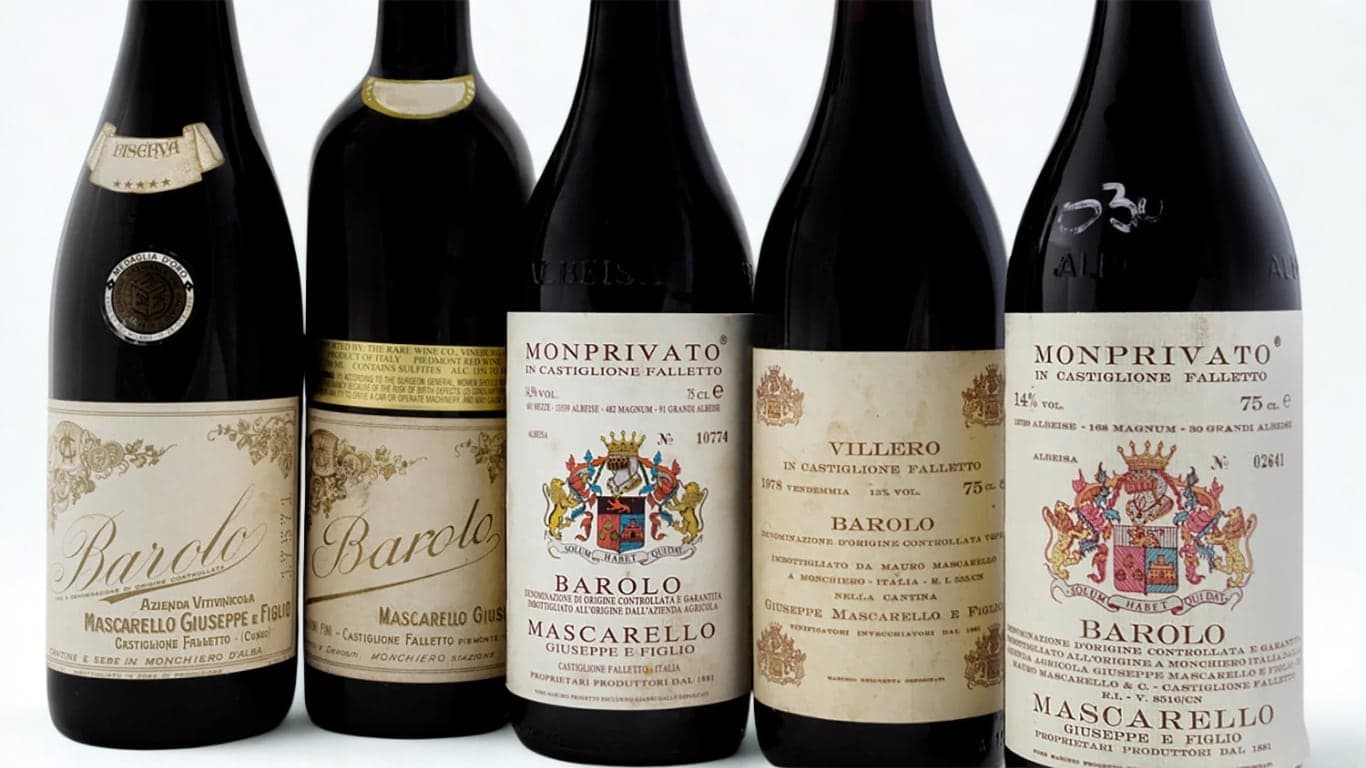
First, a clarification the trade still gets wrong, because two famous Mascarellos sit a short drive apart. Giuseppe Mascarello & Figlio is not Bartolo Mascarello; they are separate estates with separate cellars and separate cult followings, and this piece concerns the former, the house whose name is fused to a single hillside called Monprivato in Castiglione Falletto. Decanter has long treated Monprivato as one of Barolo's grand sites, and Liv-ex's secondary market chatter places both producers among the appellation's blue chips. That is the company they keep. The question is how they keep it so differently.

Key Takeaways & The 5Ws
- Giuseppe Mascarello & Figlio is a separate estate from Bartolo Mascarello, a common point of confusion.
- Mascarello's fame rests on Monprivato, its near monopole single vineyard in Castiglione Falletto.
- Bruno Giacosa was a grower and negociant in Neive, revered across Barolo and Barbaresco.
- Giacosa's red label denotes Riserva bottlings; the white label is the regular release.
- Both are traditionalists: long maceration, large old botti, transparent terroir over oak.
- Who is this for?
- Drinkers and collectors who already love Nebbiolo and want to understand how two traditionalist benchmarks differ in the glass.
- What is it?
- A comparison of Giuseppe Mascarello and Bruno Giacosa, two cult Piedmont houses, their signature crus and stylistic fingerprints.
- When does it matter most?
- When you are choosing a bottle for the cellar, reading an auction catalogue, or deciding which house to taste against the other.
- Where does it apply?
- Across Barolo and Barbaresco, from Castiglione Falletto and Serralunga to the Barbaresco crus of Neive and beyond.
- Why consider it?
- Because understanding the difference sharpens how you taste, what you seek out, and why each house earned its standing.
Two Estates, One Confusion to Clear
Begin with the housekeeping, because nothing erodes a wine conversation faster than crossed wires over a shared surname. Giuseppe Mascarello & Figlio is the estate now run by the Mascarello family with Mauro Mascarello long its guiding hand, and its cellar sits in Monchiero. It is a different operation entirely from Bartolo Mascarello, the equally celebrated traditionalist house in Barolo village associated with Maria Teresa Mascarello and those famous hand painted labels. The two are frequently muddled by newcomers and occasionally by people who should know better. They are not related ventures, not a parent and an offshoot, simply two great names that happen to be Mascarellos.
Bruno Giacosa presents no such trap, but it carries its own lore. Giacosa worked as a grower and negociant out of Neive in the Barbaresco zone, a man with a near mythic palate who for decades bought fruit from the finest sites before securing prized vineyards of his own. He moved with equal authority across both appellations, Barolo and Barbaresco, which is itself unusual; most houses plant their flag firmly in one. Where Mascarello is the story of a family welded to a single hill, Giacosa is the story of a singular taster reading the whole of the Langhe and choosing only the passages he judged sublime.
Monprivato, the Hill That Made a House
Monprivato is the reason Giuseppe Mascarello matters to anyone beyond Piedmont. The vineyard, on the Castiglione Falletto side of the Barolo zone, sits at a kind altitude on calcareous marl, and Mascarello controls the overwhelming majority of it, which is why the wine carries a monopole like aura even where the technical label does not. From this site the estate makes a Barolo of perfume and tension rather than brawn. In strong vintages a selection within the cru, bottled under the Ca' d'Morissio name, pushes the expression further into structure and longevity. The signature is florality, red fruit, fine grained tannin and an almost transparent sense of place.
What Mascarello does with Monprivato is the traditionalist creed in microcosm. Long macerations on the skins, ageing in large Slavonian botti rather than small new barrique, no cosmetic concentration. The wine asks for patience and rewards it; young Monprivato can read austere, even severe, and only with a decade or more in the cellar does the perfume unfurl into the haunting, rose and tar register that makes mature Nebbiolo, and Italian fine wine at large, one of the great experiences in the glass. This is a house that trusts a single site to speak, and spends its craft amplifying that voice rather than overdubbing it.
Giacosa, the Negociant With the Golden Ear
Giacosa's genius was selection, and his range reads like a tour of the Langhe's top crus. In Barolo he is revered above all for Falletto and the parcel within it, Le Rocche del Falletto, both in Serralunga d'Alba, a commune whose iron rich soils give some of the most powerful, structured Nebbiolo in the appellation and the home of Barolo's benchmark Monfortino bottlings. In Barbaresco the names to know are Asili, a cru of supreme elegance, and Santo Stefano in Neive, source of some of the most legendary bottles he ever made. Across all of them the Giacosa hallmark holds: depth without heaviness, a sappy red fruited intensity, and aromatics that seem lit from within.
If Mascarello is a house defined by one hill, Giacosa is defined by a sensibility applied across many. He worked, like Mascarello, in the traditional idiom, favouring extended maceration and large old oak, distrusting the modernist taste for short fermentations and toasty barrique. Yet his wines often carry a fraction more flesh and immediate generosity than Mascarello's more ascetic Monprivato, a difference of temperament as much as technique. Serralunga power on the Barolo side, Barbaresco grace on the other, all filtered through one of the most acute palates the region has produced. The fruit came from many places; the judgement came from one man.
Reading the Labels, Reading the Style
With Giacosa, the label is a code worth learning, because it tells you what is in the bottle before you pull the cork. The garnet red label denotes his Riserva bottlings, reserved for the finest fruit in the finest years and built for the long haul. The white label marks the regular release, no lesser wine in a poor vintage sense but a different statement of intent, more approachable in its youth. Collectors track red label Giacosa with particular devotion, and the saleroom reflects it; the great red label Falletto and Santo Stefano Riservas are among the most sought Italian wines at auction, a status Christie's and Sotheby's catalogues have long acknowledged.
Mascarello plays a quieter game on the label but a comparable one in the cellar. The straight Monprivato is the house's calling card; the Ca' d'Morissio selection is the rarer, more structured expression drawn from old vines within the cru in suitable years. Neither house chases points or fashion. Both reward the drinker willing to read a back label, learn a cru, and understand that a name like Le Rocche del Falletto or Monprivato is not decoration but an address, a specific patch of hill whose character the wine is sworn to carry faithfully into the glass.
Which House, Which Mood
So how does a thoughtful drinker choose, given two houses of such standing? Not by ranking, because ranking them is a category error, but by occasion and by appetite. Reach for Mascarello's Monprivato when you want Nebbiolo at its most filigreed and contemplative, a wine of perfume and line that flatters a long table and a longer evening, and that punishes impatience. It is the bottle for the drinker who prizes transparency above all, who wants the hill to speak with as little interference as the cellar can manage, and who has the discipline to wait out its austere youth.
Reach for Giacosa when you want range and a touch more immediate seduction, the choice sharpened by which cru speaks to the moment. A Serralunga Falletto for power and gravity, an Asili for perfumed Barbaresco elegance, a red label Riserva when the occasion deserves a wine built to outlive the dinner by decades. The deeper pleasure, of course, is to taste them together, a Monprivato beside a Falletto, and let the contrast teach you what each house values. Do that once and the textbook distinctions dissolve into something you can simply taste: two readings of the same noble grape, both true, neither replaceable. It is the kind of contrast that, much like setting Tuscany's modern icons against one another, teaches more in a single sitting than any tasting note can.
The argument at that imagined Piedmont table never really resolves, and it is not supposed to. Giuseppe Mascarello and Bruno Giacosa represent two honest answers to the same question of how to make Nebbiolo tell the truth, and the fact that the answers diverge is the whole reward. One house bound its name to a single hill and spent generations learning its every mood. The other roamed the Langhe with an unerring ear and bottled only the passages it judged perfect. Both held the traditionalist line when fashion pulled the other way, and both were vindicated. The cellar with room for both is the richer cellar, because the comparison is the education. Drink them side by side, and the appellation explains itself.
Frequently Asked Questions
- Is Giuseppe Mascarello the same as Bartolo Mascarello?
- No. They are two separate Piedmont estates that share the Mascarello surname, a common source of confusion. Giuseppe Mascarello & Figlio is famous for the Monprivato vineyard in Castiglione Falletto, while Bartolo Mascarello is a distinct traditionalist house in Barolo village known for its hand painted labels. They are not related ventures.
- What is Monprivato?
- Monprivato is a celebrated single vineyard cru in Castiglione Falletto, in the Barolo zone of Piedmont. Giuseppe Mascarello controls the great majority of it, giving the wine a monopole like aura. It produces a Barolo prized for perfume, tension and fine tannin, with a rarer, more structured selection bottled as Ca' d'Morissio.
- What do Bruno Giacosa's red and white labels mean?
- The colour signals the tier. Giacosa's garnet red label denotes his Riserva bottlings, made from the finest fruit in the best vintages and built for long ageing. The white label marks the regular release, generally more approachable in its youth. Collectors prize the red label Riservas, especially Falletto and Santo Stefano, very highly at auction.
- Are Giuseppe Mascarello and Bruno Giacosa traditional or modern producers?
- Both are benchmark traditionalists. They favour long maceration on the skins and ageing in large old Slavonian botti rather than the modernist style of short fermentations and small new barrique. The aim in both cellars is transparent terroir expression, letting the specific crus, Monprivato for Mascarello, Falletto and Asili for Giacosa, speak with minimal intervention.

Stefanos Moschopoulos
Stefanos Moschopoulos founded The Luxury Playbook in Athens and has spent the better part of a decade following the auction calendar, the en primeur releases, and the watchmakers, gallerists, and shipyards the magazine covers. He writes the field guides and listicles that anchor the Connoisseur section — pieces built on Phillips and Christie's results, Liv-ex movements, and conversations with collectors he has met across Geneva, Bordeaux, Basel, and Monaco. His own collecting habits sit closer to watches and wine than art, and it shows in the level of detail in the magazine's coverage of those categories. Under his direction, The Luxury Playbook now publishes long-form field guides, market-defining year-end listicles, and the Voices interview series with the founders behind the houses and the brands.