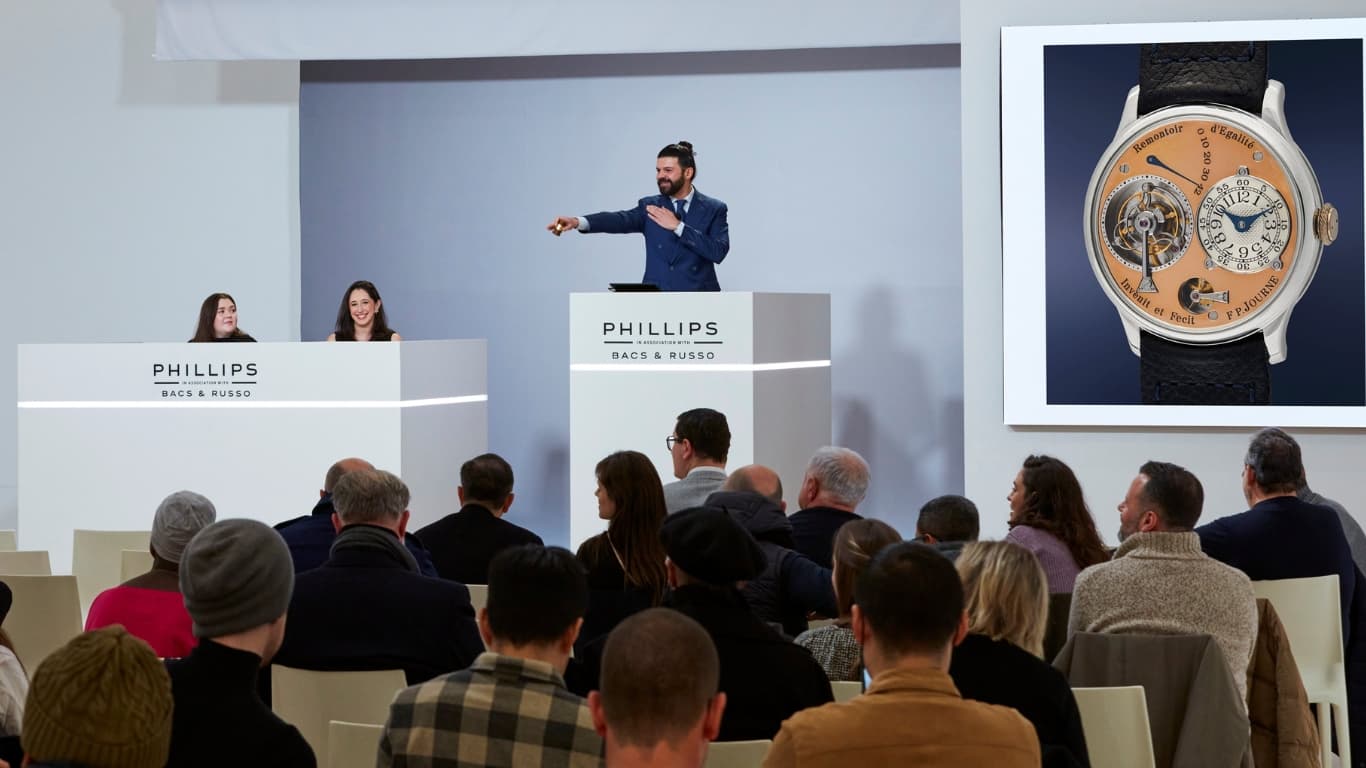
There was a time when a watch at auction was a line item. A reference, a metal, a movement, an estimate, and a hammer that fell with little ceremony. Phillips watch auctions changed that, and the change ran deeper than the numbers. The house in association with Bacs and Russo, led by Aurel Bacs, took the vintage watch sale and turned it into theatre, where the story of a single watch could fill a room and the complication and the provenance, not just the brand on the dial, became the headline.
The proof arrived in the most public way imaginable. In 2017, as documented by Hodinkee and the wider trade, Phillips in New York sold Paul Newman's own Rolex Daytona, reference 6239, for US$17.75 million, then a world record for any wristwatch at auction. Rival houses Christie's and Sotheby's had long traded great watches, but that night confirmed a shift Phillips had been building for years. The watch was not just a Rolex. It was a story, and the story is what the room had come to buy.

Key Takeaways & The 5Ws
- Phillips runs its watch department in association with Bacs and Russo, led by the dealer and specialist Aurel Bacs.
- The Geneva Watch Auction series and themed sales reset how vintage watches are presented and priced.
- Phillips sold Paul Newman's own Rolex Daytona reference 6239 for US$17.75 million in New York in 2017, then a world record for any wristwatch.
- The house has set records for steel Patek Philippe perpetual calendars, prizing the rarest configurations.
- The lasting change is conceptual: Phillips made the complication and the provenance, not just the brand, the centre of the sale.
- Who is this for?
- Collectors and enthusiasts who want to understand how the modern vintage watch market came to value provenance above all.
- What is it?
- An explainer on how Phillips watch auctions, led by Aurel Bacs, reshaped the way vintage watches are sold and priced.
- When does it matter most?
- When you are reading an auction catalogue, weighing one watch against another, or trying to grasp why provenance commands such sums.
- Where does it apply?
- Across the vintage watch salerooms, above all the Geneva Watch Auction series and the themed sales Phillips pioneered.
- Why consider it?
- Because Phillips changed the rules of the room, and understanding that change is how you read the modern market.
The Bacs and Russo Partnership Behind the Sales
To understand Phillips in watches, you have to understand Aurel Bacs. A specialist who had already built a formidable reputation running watch sales elsewhere, Bacs joined Phillips so that the department operates in association with Bacs and Russo, the consultancy he leads with Livia Russo. The arrangement gave Phillips something money alone cannot buy: a figure whose name on a sale signals a particular standard of scholarship and showmanship to the entire collecting world.
Bacs brought a clear philosophy to the saleroom. Rather than simply gathering consignments and listing them, he treated each major sale as a curated event, where the quality and the story of every lot mattered, and where the act of presenting a watch was as considered as the watch itself. That approach turned the auctioneer from a functionary into a performer and a scholar at once, someone who could explain why a watch mattered and make a room feel the stakes of bidding on it. This is the part rivals found hardest to copy. A catalogue can be matched and an estimate undercut, but the particular chemistry of a Bacs led sale, the authority, the wit, the sense that you are watching history rather than commerce, proved difficult to replicate. The partnership did not just bring expertise to Phillips. It brought a voice, and that voice reshaped what a watch auction could be.
The Geneva Watch Auction and Catalogue as Theatre
The clearest expression of the new approach was the Geneva Watch Auction series, the numbered Phillips sales that became fixed points on the collecting calendar. These were not catch all events but carefully built sales, each assembled to tell a coherent story about taste and rarity, and each anticipated the way an audience anticipates a premiere. The numbering itself, sale after sale building into a running history, signalled an ongoing project rather than a series of one off transactions.
Alongside the numbered sales came the themed auctions, and here the storytelling reached its fullest pitch. Phillips built entire sales around a single subject, devoting catalogue style scholarship to vintage Rolex and Patek Philippe, a perennial cornerstone of serious collecting, in ways the trade had not seen before. A themed sale might trace the evolution of a single model across decades, or gather the finest known examples of one reference, presenting each watch not as an isolated lot but as a chapter in a larger argument. The catalogues themselves became collectible objects, dense with research, photography and context.
The effect was to make the sale itself a piece of theatre. Where watches had once been sold quickly and quietly, Phillips slowed the moment down and gave it weight, building anticipation around marquee lots and letting the drama of competing bids play out in full. By treating the auction as performance, it changed not just how much watches sold for but how the act of selling them felt.
The Daytona That Rewrote the Record Book
No single lot captured the Phillips method better than Paul Newman's own Daytona. In October 2017, in New York, Phillips offered the actor's personal Rolex Cosmograph Daytona, reference 6239, the very watch given to him by his wife Joanne Woodward, its caseback engraved with her message to him. When the hammer fell, it had sold for US$17.75 million, then a world record for any wristwatch at auction, a number that travelled far beyond the watch world into the general press.
What made the result so significant was not the metal or the movement, both of which were, in themselves, relatively modest. It was a steel chronograph, the kind of watch that in other hands and without its history would command a fraction of the figure. The price was a measure of provenance in its purest form: the watch had belonged to Paul Newman, it carried the exotic dial that bears his name, and the chain of ownership was beyond question. For collectors learning to read these references, the sale remains the defining lesson in mapping the Paul Newman Daytona references.
The 6239 result became a marker the whole market measured itself against. It proved, in the most public way possible, that with the right watch and the right story, provenance could carry a sale to heights no specification sheet could justify. Phillips had argued for years that the story was the value, and the Newman Daytona settled the argument for good.
How Phillips Made Steel Patek the Prize
The Newman Daytona was the headline, but the deeper pattern shows in how Phillips handled Patek Philippe. The house set records for steel Patek perpetual calendars, watches that overturn the usual assumption that precious metal commands the highest prices. A perpetual calendar is among the great complications, and when one of the rarest appears in steel rather than gold, in tiny numbers from a period when steel cases were highly unusual for such a watch, it becomes precisely the kind of lot Phillips was built to sell.
This is where the conceptual shift becomes clearest. The conventional logic said gold and platinum should sit at the top of the market, with steel a step below. Phillips helped invert that, demonstrating that an exceptionally rare steel complication could outrun its gold equivalent because rarity and the right configuration, not the value of the raw material, were what the most serious collectors prized. Collectors learned to look past the obvious markers of value, the metal, the size, the brand alone, and to read the harder signals: the rarity of the configuration, the difficulty of the complication, the originality of the example in front of them. That education, carried out sale after sale, is part of the same dynamic now driving questions like which Patek models get discontinued next, and it changed what collectors chase.
How Phillips Watch Auctions Reshaped the Whole Market
The influence of Phillips watch auctions extends well beyond the lots Phillips itself has sold. The house effectively rewrote the rules of how vintage watches are presented, and the rest of the trade has followed. The deep catalogue scholarship, the themed sales, the emphasis on originality and provenance, the treatment of the auction as an event rather than a transaction: these have become the standard rather than the exception across the salerooms.
The most lasting change is conceptual. Phillips moved the centre of gravity in collecting away from the brand alone and toward the complication and the provenance, teaching a generation of collectors to ask not merely what a watch is but whose it was, how rare its configuration is, and how completely its history survives. The brand on the dial still matters enormously, but it is no longer the whole story. It is a key thread in why collectors have returned to the vintage market with such conviction. None of this means the other houses have ceased to matter: Christie's and Sotheby's remain formidable, and the market is healthier for the competition. But the modern grammar of the vintage watch sale, the storytelling, the scholarship, the theatre, owes an enormous debt to what Phillips and the Bacs and Russo partnership built. They changed what a watch auction is.
Phillips watch auctions reshaped the market by understanding something the trade had underrated: that a watch is a story, and the story, told well, is where the value lives. Under Aurel Bacs and the Bacs and Russo partnership, the house turned the sale into theatre, built the Geneva Watch Auction series and the themed sales into events, and proved with Paul Newman's US$17.75 million Daytona and its steel Patek records that provenance and the rarest configurations, not the brand alone, decide what the room will pay. The salerooms today all speak the language Phillips refined: read the complication, read the provenance, and the watch tells you what it is. That is the lasting legacy, and it has changed collecting for good.

Stefanos Moschopoulos
Stefanos Moschopoulos founded The Luxury Playbook in Athens and has spent the better part of a decade following the auction calendar, the en primeur releases, and the watchmakers, gallerists, and shipyards the magazine covers. He writes the field guides and listicles that anchor the Connoisseur section — pieces built on Phillips and Christie's results, Liv-ex movements, and conversations with collectors he has met across Geneva, Bordeaux, Basel, and Monaco. His own collecting habits sit closer to watches and wine than art, and it shows in the level of detail in the magazine's coverage of those categories. Under his direction, The Luxury Playbook now publishes long-form field guides, market-defining year-end listicles, and the Voices interview series with the founders behind the houses and the brands.