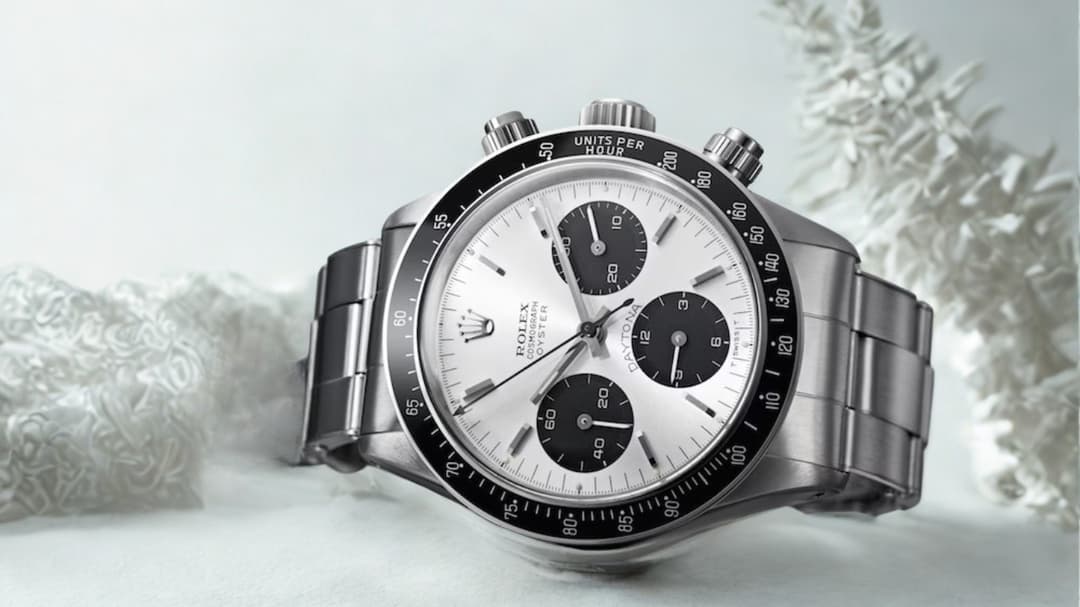
There is a persistent misconception that the "Paul Newman" Daytona is a single watch. It is not. It is a dial, and the watches that wear it span the better part of a decade of manually wound Rolex Cosmographs. Get that distinction right and the entire field opens up; get it wrong and you will misread catalogues, mistake one reference for another, and overpay for the wrong configuration. The exotic dial is the thread. The references are the map.
The stakes here are not abstract. In October 2017, Phillips in New York sold Paul Newman's own personal reference 6239, the watch given to him by Joanne Woodward with the caseback engraved "DRIVE CAREFULLY ME," for US$17.75 million, then a world record for any wristwatch at auction. That result, watched closely by Christie's and Sotheby's alike, hardened a truth the market had long suspected: with these watches, the dial, the precise reference and the provenance behind them are everything. This is our field guide to reading all three.

Key Takeaways & The 5Ws
- The "Paul Newman" is an exotic dial, not a single reference, found across the manually wound Daytonas of the 1960s and 1970s.
- Pump pusher references include the 6239, 6241, 6262 and 6264; the related 6240 introduced screw down pushers.
- Screw down pusher references 6263 and 6265 are the Oyster cased, water resistant evolution.
- Paul Newman's own 6239 sold at Phillips in 2017 for US$17.75 million, then a world auction record.
- Originality drives desirability: correct exotic dial, unpolished case, full service history and the original box and papers.
- Who is this for?
- Collectors and enthusiasts learning to read vintage Daytona catalogues and tell the references apart with confidence.
- What is it?
- A reference by reference field guide to the exotic dial Cosmograph Daytonas known as Paul Newmans.
- When does it matter most?
- When you are reading an auction listing, inspecting a watch in the metal, or weighing one configuration against another.
- Where does it apply?
- Across the manually wound Daytona references of the 1960s and 1970s, and the salerooms that trade them.
- Why consider it?
- Because reference, dial and provenance set desirability here, and confusing them is the costliest beginner's error.
The Exotic Dial Is the Whole Game
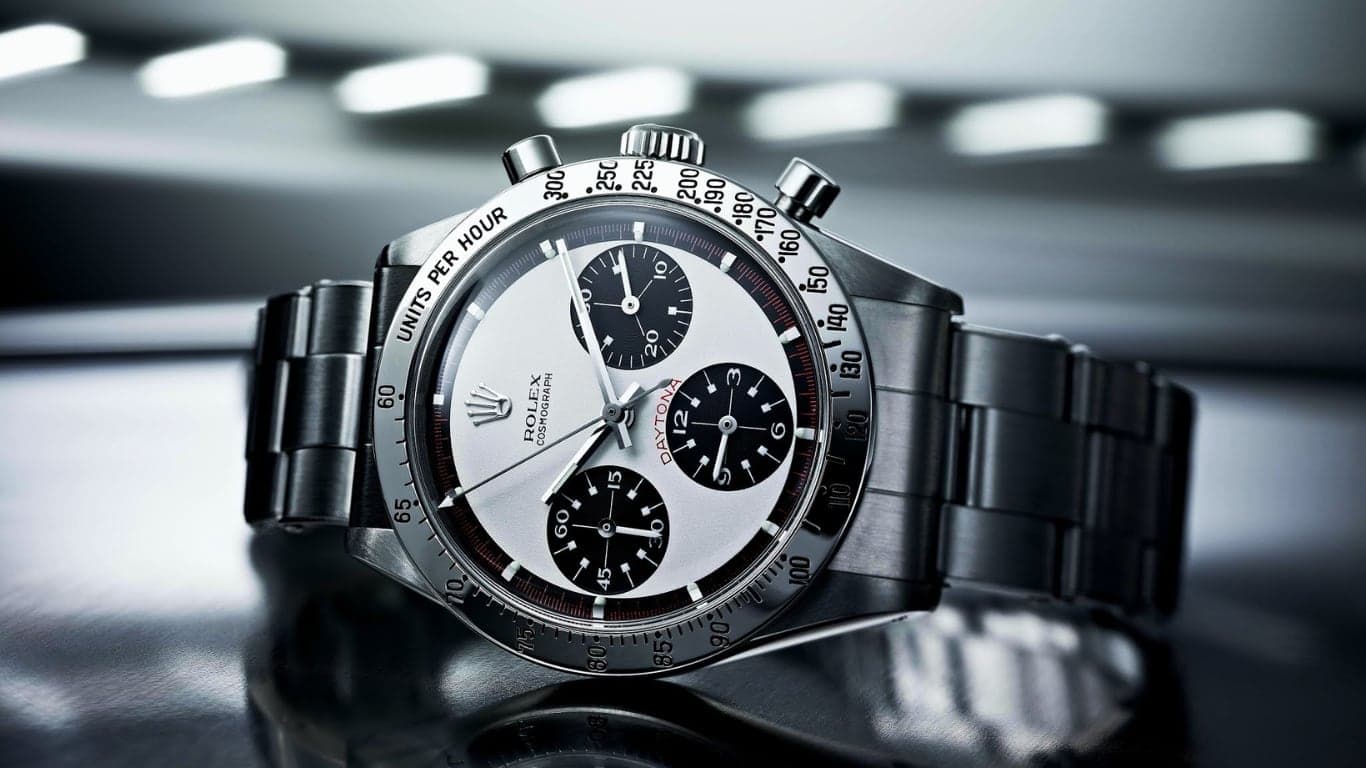
Start with the dial, because the dial is what makes a Paul Newman a Paul Newman. The exotic dial is an Art Deco flavoured variant of the standard Cosmograph layout, and once you have learned its tells you cannot unsee them. The three subdials carry a distinctive treatment, with little blocks or crosshairs at the markers rather than plain printing. The minute track is stepped, often rendered in a contrasting colour that sets the outer ring apart from the dial centre. The numerals on the subdials use a particular Art Deco font, squared off and unmistakable once it is in your eye.
Rolex never officially called these "Paul Newman" dials; the trade did, after the actor was so closely associated with the look. They were the slow sellers of their day, ordered less often than the cleaner standard dials, which is precisely why surviving examples are scarce now, and why they sit among the exotic dial variants collectors hunt most patiently. That scarcity is the foundation of the whole phenomenon. A correct, untouched exotic dial is the single most important thing a collector verifies, because everything else about the watch, the case and the provenance, is read in relation to it. A standard dial Daytona of the same reference is a fine watch. It is simply not a Paul Newman.
Pump Pushers and the Earliest References
The earliest Paul Newman references wear what collectors call pump pushers, the simple round chronograph buttons that screw into nothing and sit proud of the case. This group is the foundation of the family: the 6239, the 6241, the 6262 and the 6264. The 6239 is the archetype, with an engraved metal tachymetre bezel, and it is the reference Newman himself wore. The 6241 is closely related but carries a black acrylic bezel insert, a small change that gives it a distinctly different face. The 6262 and 6264 followed as short lived references with upgraded movements, produced in modest numbers.
These pump pusher watches are not water resistant in any meaningful sense, a consequence of the pushers that do not seal and the case construction of the period. Collectors do not hold that against them; it is simply part of reading the reference correctly. What matters is matching the dial, the bezel and the case details to the specific reference, because the differences between a 6239 and a 6241, or a 6262 and a 6264, are exactly the kind of subtleties that separate an honest watch from a married one. The pump pusher group is where most newcomers begin, and where the closest looking is required.
Screw Down Pushers Changed the Case
The later evolution brought screw down pushers, and with them a genuinely different watch. The transitional reference 6240 introduced the screw down pushers and the water resistant Oyster case, and it pointed the way to the two references that would define the screw down era: the 6263 and the 6265. On these, the pushers screw down into the case to seal it, and the watch earns Oyster water resistance that the pump pusher references never had. The 6263 carries a black acrylic bezel, the 6265 a metal one, mirroring the earlier bezel split between the 6241 and the 6239.
The practical upshot for a collector is that the screw down references read differently in the metal and command their attention for different reasons. They are the sturdier, more wearable evolution of the line, and a screw down Paul Newman, an exotic dial inside an Oyster case, ranks among the discontinued Rolex references worth hunting and the most coveted configurations in all of vintage collecting. The point of the map is to know which is which on sight. A buyer who can tell a 6263 from a 6265, and either from a pump pusher 6241, is reading the family the way the salerooms do.
How Provenance and Originality Set the Price
With these watches, condition is not a tidy bonus; it is the heart of the matter. The market rewards originality with a ferocity that catches newcomers off guard. An unpolished case, one that retains its original lines and sharp lugs rather than the softened, overly buffed edges of a watch that has been through careless servicing, will outrun a polished example of the identical reference every time. Collectors speak of "fat" lugs and crisp chamfers for a reason: the metal tells the watch's life story, and the salerooms price that story precisely.
Then there is the dial again. A correct exotic dial with even, period appropriate ageing of its lume, untouched and unrelumed, is what the whole valuation rests on. Dials replaced during service, refinished surfaces and swapped components all pull desirability down hard. Provenance compounds everything: documented ownership, a full service history, and the original box and papers turn a strong watch into a great one. Newman's own 6239 is the extreme case, where the engraved caseback and the story behind it carried the watch to US$17.75 million at Phillips. The principle scales all the way down. The more of the original watch and its history that survives, the more the market cares.
Reading a Listing Like a Collector
Put the map to work and a catalogue listing stops being a wall of numbers and becomes legible. Begin with the reference, because it tells you the case type and the pusher system before you read another word: a 6239 or 6264 is a pump pusher watch, a 6263 or 6265 is screw down Oyster. Then go straight to the dial and confirm it is a genuine exotic, reading the subdial treatment, the stepped minute track and the Art Deco font against examples known to be correct. A reference can be right while the dial is wrong, and that gap is where mistakes are made.
From there, the questions follow a settled order. Is the case unpolished, with its original geometry intact? Is the dial original and unrelumed, ageing honestly? Is there service history, and crucially, is there box and papers? Reputable houses such as Phillips, Christie's and Sotheby's document these points in their catalogues precisely because their bidders demand it, and the gap between a fully original, fully papered example and a merely good one is enormous. Learning to read that gap is the whole reason to learn the references at all.
The Paul Newman Daytona rewards knowledge more directly than almost any watch in the modern collecting world. It is not one object to be memorised but a family to be read, a single exotic dial running through references from the pump pusher 6239 to the screw down 6263, each distinct in case, bezel and character. The US$17.75 million record setting sale at Phillips is the headline, but the lesson sits in the detail: dial, reference and provenance, in that order, are what separate the watches. Learn to read all three and the family snaps into focus. Skip the work and the numbers stay a blur, and the most storied chronograph in the trade keeps its secrets from you.
Frequently Asked Questions
- What is a Paul Newman Daytona, exactly?
- A Paul Newman Daytona is a Rolex Cosmograph Daytona fitted with the so called exotic dial: Art Deco subdials, contrasting colours, a stepped minute track and a distinctive font. It is not a single reference but a dial found across the manually wound Daytonas of the 1960s and 1970s, named by the trade after the actor.
- Which references can be Paul Newman Daytonas?
- The exotic dial appears across the pump pusher references 6239, 6241, 6262 and 6264, and the screw down pusher Oyster references 6263 and 6265, along with the related transitional 6240. The reference tells you the case and pusher system; the exotic dial is what makes any of them a Paul Newman rather than a standard Daytona.
- Why did Paul Newman's own Daytona sell for so much?
- Newman's personal reference 6239, given to him by Joanne Woodward and engraved "DRIVE CAREFULLY ME," sold at Phillips in New York in October 2017 for US$17.75 million, then a world record for any wristwatch at auction. The unrepeatable provenance, the engraved caseback and the actor's direct ownership drove that result.
- How do collectors tell a real exotic dial from a standard one?
- They read the dial's tells: the block or crosshair markers on the three subdials, the stepped minute track in a contrasting colour, and the squared off Art Deco font on the subdial numerals. Originality matters as much as the look, so an untouched, unrelumed dial verified against known examples is what separates a genuine Paul Newman from a swapped one.

Stefanos Moschopoulos
Stefanos Moschopoulos founded The Luxury Playbook in Athens and has spent the better part of a decade following the auction calendar, the en primeur releases, and the watchmakers, gallerists, and shipyards the magazine covers. He writes the field guides and listicles that anchor the Connoisseur section — pieces built on Phillips and Christie's results, Liv-ex movements, and conversations with collectors he has met across Geneva, Bordeaux, Basel, and Monaco. His own collecting habits sit closer to watches and wine than art, and it shows in the level of detail in the magazine's coverage of those categories. Under his direction, The Luxury Playbook now publishes long-form field guides, market-defining year-end listicles, and the Voices interview series with the founders behind the houses and the brands.