The Rolex Land-Dweller is the year's most-discussed new Rolex reference because it represents the brand's first new line in nearly a decade and the most ambitious design departure of the modern era. Launched at Watches and Wonders 2025, the Land-Dweller arrived into a collector market that hadn't been expecting it. A year on, the conversation has settled in interesting ways, and the contours of how the line will be received over the next decade are starting to become visible.
- The Rolex Land-Dweller has emerged as the year's most discussed new reference, with the new architecture and adventurer positioning reshaping conversation across collector forums.
- Reference design choices, including the new bracelet engineering and dial finishing, signal Rolex's willingness to introduce genuinely new product rather than iterating established references.
- Waitlist dynamics on the Land-Dweller have crystallised quickly, with authorised dealers reporting strong initial demand from established collectors.
- We see the Land-Dweller as Rolex's strongest new-architecture release in years, with the design language opening conversation about future catalogue directions.
- Secondary-market premiums on Land-Dweller pieces have emerged within months of release, though the reference is still finding stable price levels.
- The reference positions Rolex against the established adventurer-watch segment that competitors including Tudor and Omega have served for years.
- Who is this for?
- Active Rolex collectors, waitlist hopefuls, and serious students of the brand's product development direction.
- What is happening?
- A grounded read on the Rolex Land-Dweller, covering the new architecture, waitlist dynamics, secondary-market behaviour, and the broader product strategy.
- When did this emerge?
- The Land-Dweller emerged as the year's most discussed Rolex reference following its 2025 introduction, with momentum continuing through 2026.
- Where is this happening?
- Authorised Rolex dealers globally maintain waitlists, while Chrono24, Subdial 50, and specialist auctions track the emerging secondary market.
- Why does it matter?
- The Land-Dweller signals Rolex's willingness to introduce genuinely new architecture, which matters for collectors reading the brand's long-term product direction.
What is clear already: the Land-Dweller divides serious collectors more sharply than any Rolex reference since the original Submariner-on-Jubilee experiments of the 1970s. The technical case is the strongest the brand has made in years; the design language is the most contested. Both observations matter, and the resolution will play out over five years rather than five months.
Why the Rolex Land-Dweller is the year's most-discussed reference
Three things converged. Rolex hadn't introduced a fundamentally new line since the Sky-Dweller in 2012, and collector appetite for a genuine new reference had built across the intervening years. The integrated-bracelet sport-luxury register had been dominated by AP and Patek for half a century, and the question of whether Rolex would ever commit to the category had become one of the longest-running parlour conversations in watch collecting.
And the Dynapulse escapement, the genuinely new movement architecture at the heart of the Calibre 7135, gave the technical press the first real engineering story to write about Rolex in a decade. Hodinkee, GQ, Monochrome, and the established specialist Rolex sites all dedicated extensive technical coverage to the launch.
The Land-Dweller in detail
The reference is a sport-luxury watch in the integrated-bracelet register, with 36mm or 40mm cases in steel, white gold, Everose, or yellow gold. The reference 127334 in steel anchors the entry tier at $14,900 retail. The precious-metal references run substantially higher: the white gold reference 127336 at around $48,000, with various Everose and yellow gold variants between $40,000 and $60,000.
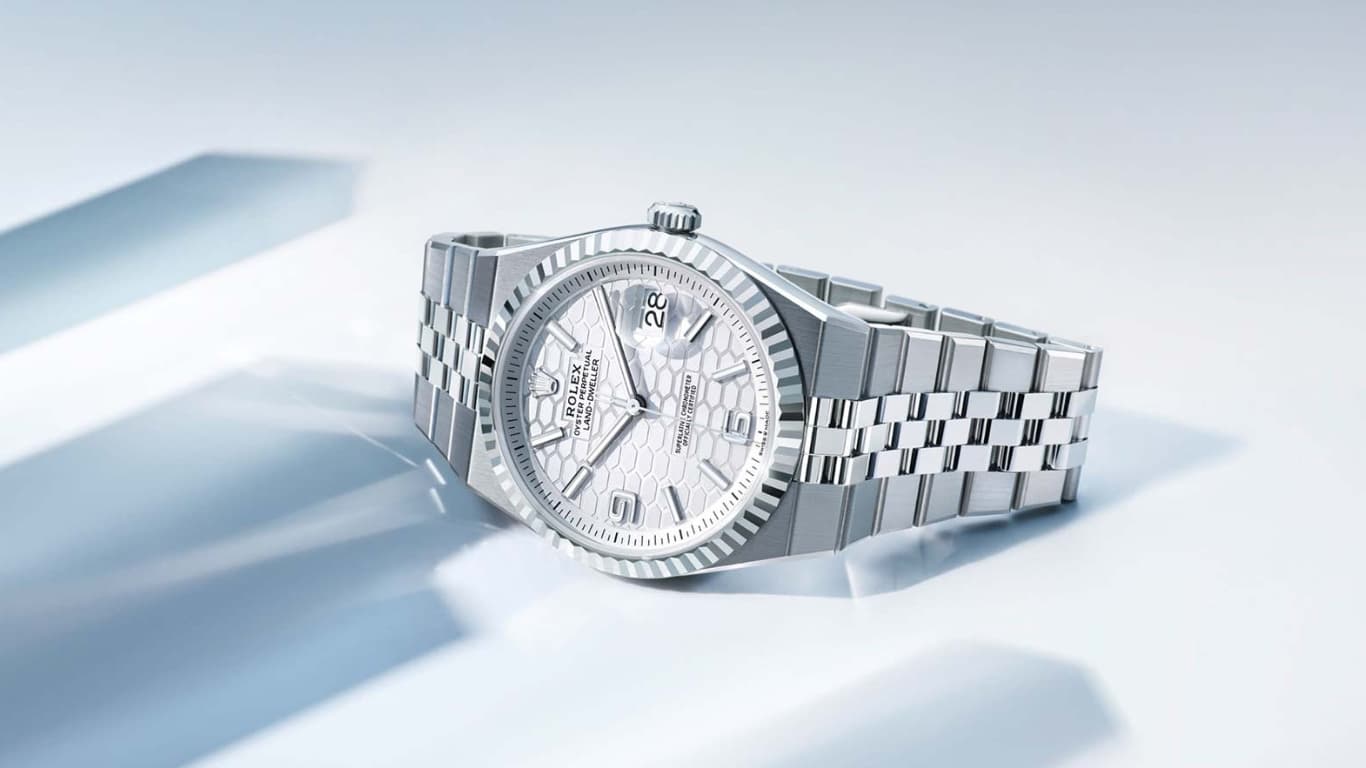
The case integrates into a bracelet design Rolex calls the Flat Jubilee, a recasting of the historical Jubilee bracelet with flatter links and a more contemporary visual register. The geometry reads cleaner with the integrated-bracelet design language than the standard Jubilee would have, and it solves a specific engineering problem the broader integrated-bracelet category has wrestled with for decades.
The dial is the watch's most-discussed feature. The textured Honeycomb pattern on the standard reference, with the Calibre 7135 visible through the display caseback, is the most distinctive Rolex dial geometry of the modern era. Various dial variants extend the line: the standard Honeycomb, the meteorite dial on the precious-metal references, the rare gem-set dial configurations across the upper register.
The Dynapulse escapement and what it changes
The Calibre 7135 with the Dynapulse escapement is the genuinely interesting technical piece. The traditional Swiss lever escapement, the design Abraham-Louis Breguet refined in the late eighteenth century and which has anchored mechanical watchmaking for two centuries, uses a pallet fork that locks and releases the escape wheel. The Dynapulse uses two rotating wheels that deliver impulse directly to the balance wheel, theoretically improving energy transfer efficiency.
The architecture is Rolex's first new escapement design in decades, and it represents the brand's most ambitious movement-engineering project of the contemporary era. The consensus reading from the technical press at launch was that the engineering ambition is real, but the long-term performance characteristics will only be revealed over the first service cycles in the field.
The Calibre 7135 carries a 70-hour power reserve and the Superlative Chronometer certification standard across the modern upper Rolex catalogue. The movement finishing through the display caseback reads at the standard the brand's enthusiasts expect, and the engineering ambition supports the technical case the line's defenders make.
Why the reception has been so divided
The early collector reaction split between two camps. One read the Land-Dweller as the most ambitious new Rolex in a decade, with the brand finally committing to the integrated-bracelet sport-luxury register. The other read it as Rolex stepping deliberately into territory AP's Royal Oak and Patek's Nautilus have defined for fifty years, producing a Royal-Oak-adjacent piece without the design lineage that anchors the AP and Patek references in the category.
The design language sits closer to those references than to anything in Rolex's historical catalogue. The visual proximity is unmistakable; what is at issue is whether the brand should be operating in that register at all. Both readings have weight; the resolution will be visible in five years rather than five months.
The technical case is the strongest evidence for the defenders. The Dynapulse escapement is a genuine engineering ambition; the Flat Jubilee bracelet engineering is exceptional in the metal; the case finishing reads at the standard Rolex sport-watch buyers expect. The watch is not a phone-in, and the in-the-metal experience is, on most reports, more positive than the launch photographs suggested.
What the early secondary market shows
The Land-Dweller launched at retail prices substantially below the integrated-bracelet sport-luxury references it sits adjacent to. The steel 127334 at $14,900 contrasts with the AP Royal Oak Jumbo 16202 at around $35,000 retail and €70,000-plus secondary, and the Patek Nautilus 5811 at around €40,000 retail and substantial secondary premium.
Early secondary-market trading on the Land-Dweller has cleared close to retail. The brand's allocation discipline at the boutique level is keeping the references genuinely supply-constrained, and the broader integrated-bracelet sport-luxury category's secondary correction across 2023 and 2024 has tempered the speculative dynamics that might otherwise have inflated launch-year pricing.
The white-gold and precious-metal Land-Dweller references, particularly the meteorite-dial and the various exotic-dial variants, are the configurations the most active modern Rolex collectors are pursuing. Chrono24, WatchCharts, and the major specialist Rolex dealers all show consistent trading activity across the first year of production. The collector following will sort itself out over years; the early signs suggest the line will hold its place.
What collectors look for
The Land-Dweller's first-year reception is interesting precisely because it doesn't fit the usual modern-Rolex collector pattern. Most new Rolex references arrive into a market that has already decided what it thinks of them; the Land-Dweller arrived into genuine debate.
The collectors paying close attention are reading the watch in person at the boutiques rather than relying on launch coverage. The Honeycomb dial texture in particular reads better in the metal than in catalogue photography, and the case finishing rewards close examination.
Box-and-papers documentation matters at this price point as much as at any tier above; the standard Rolex authorisation discipline applies, and the Calibre 7135 movement service intervals will sort themselves out over the first service cycles.
What this means for collectors
The longer story is whether the Land-Dweller establishes a new pillar of the modern Rolex catalogue alongside the Submariner, GMT-Master II, and Daytona, or whether it remains a one-of-its-line reference without the depth those established references carry. The early evidence runs toward the former; the technical ambition and the design execution both support the case.
The next three to five years of the line's evolution will be decisive. We'd argue the Land-Dweller is the most interesting new Rolex reference in a decade, and the collectors who navigate to it now, particularly those choosing the technical case over the design-debate framing, are likely to be reading the line correctly over the longer arc.
We last reviewed this analysis in May 2026.

Frequently Asked Questions
- What makes the Rolex Land-Dweller different from other Rolex models?
- The Land-Dweller features Rolex's first 5Hz movement (Caliber 7135) with revolutionary Dynapulse escapement, an integrated Flat Jubilee bracelet, distinctive honeycomb-pattern dial, and a sapphire caseback—firsts for Rolex professional models.<br><br>
- Will Rolex Land-Dweller prices increase after 2025?
- Early indicators suggest yes, with reference 127334 already trading at 2.2x to 3.2x retail ($33,800-$49,900) and Platinum/Everose models reaching $130,000+, showing strong upside potential projected over the next 3-5 years as first-platform status solidifies.<br><br>
- Is the Rolex Land-Dweller rare?
- Yes, Rolex's boutique allocation strategy and new platform status make early Land-Dweller models significantly rarer than mass-produced Datejusts or Submariners, with authorized dealer waitlists and immediate secondary market flipping indicating constrained supply.<br><br>
- How much is a Rolex Land-Dweller in 2025?
- Retail prices range from approximately $13,900 for 36mm Oystersteel models to $15,350 for the 40mm white Rolesor ref. 127334, while secondary market prices span $29,000-$55,000 depending on configuration, with platinum versions exceeding $100,000.

Stefanos Moschopoulos
Stefanos Moschopoulos founded The Luxury Playbook in Athens and has spent the better part of a decade following the auction calendar, the en primeur releases, and the watchmakers, gallerists, and shipyards the magazine covers. He writes the field guides and listicles that anchor the Connoisseur section — pieces built on Phillips and Christie's results, Liv-ex movements, and conversations with collectors he has met across Geneva, Bordeaux, Basel, and Monaco. His own collecting habits sit closer to watches and wine than art, and it shows in the level of detail in the magazine's coverage of those categories. Under his direction, The Luxury Playbook now publishes long-form field guides, market-defining year-end listicles, and the Voices interview series with the founders behind the houses and the brands.