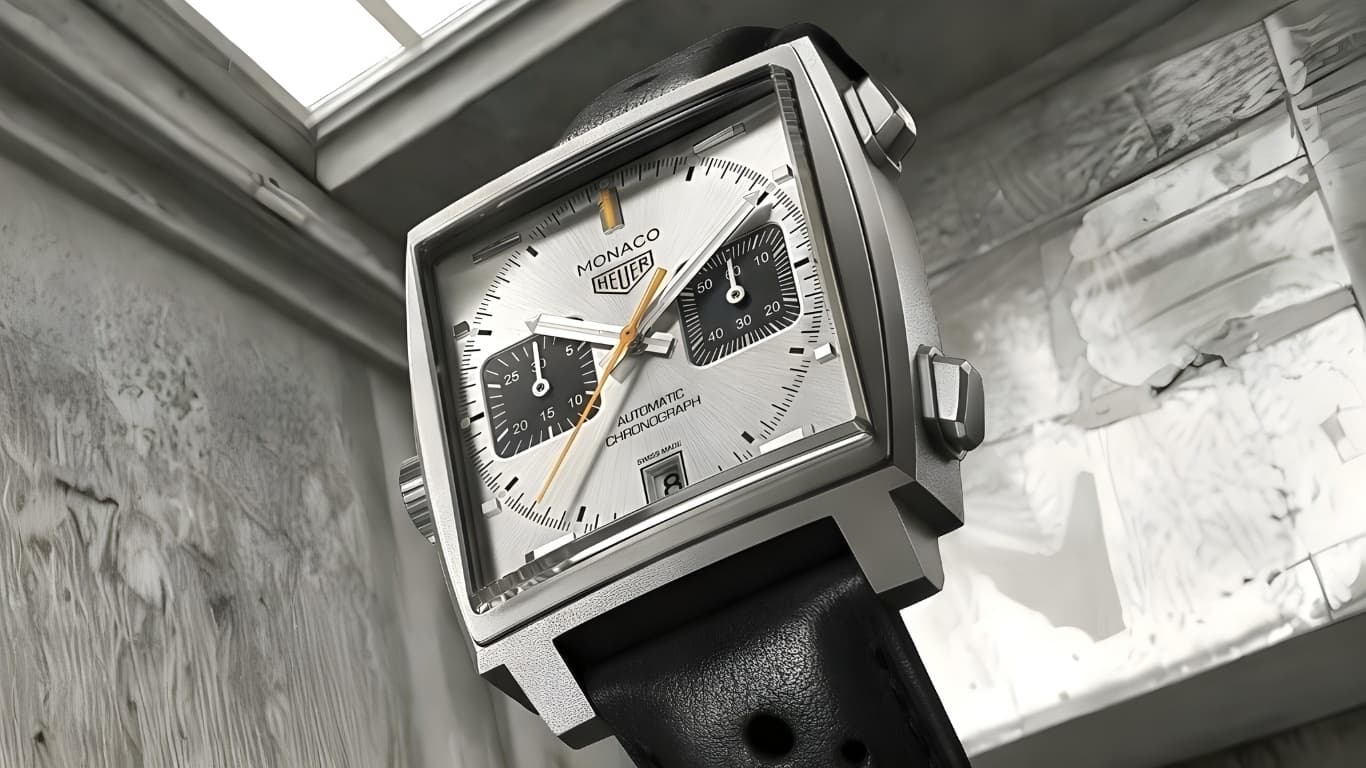
The TAG Heuer Monaco belongs in a serious collection on the Steve McQueen association alone: the watch worn in Le Mans (1971) is one of the few cinematic-watch tie-ins that has held its cultural weight across half a century. But the case for the Monaco is broader. The watch is one of the most distinctive contemporary chronograph designs in production, anchored by a square case that no other major brand really makes seriously, and a movement architecture that has evolved meaningfully across decades.
- The TAG Heuer Monaco carries genuine motorsport heritage and Steve McQueen provenance, anchoring its place in any serious motorsport-anchored watch collection.
- Reference CAW2111 and the Calibre 11 reissues serve different collector audiences, with vintage square-case Monacos commanding meaningful secondary premiums.
- The square case profile remains the Monaco's defining design element, with the asymmetric proportions that no other production chronograph replicates.
- We see the Monaco as the strongest single TAG Heuer purchase for motorsport-anchored collectors, with the design history and brand positioning justifying the asking premiums.
- Vintage 1133B Calibre 11 Monaco references from the 1970s offer serious collector entry points, with original conditions commanding meaningful premiums.
- Limited Monaco editions tied to motorsport milestones continue to outperform the broader TAG Heuer catalogue on the secondary market.
- Who is this for?
- Motorsport-anchored collectors, TAG Heuer enthusiasts, and design-anchored buyers drawn to square-case chronograph references.
- What is happening?
- A grounded case for the TAG Heuer Monaco in a serious collection, covering motorsport heritage, design lineage, and the vintage and modern reference choices.
- When did this emerge?
- The Monaco has anchored TAG Heuer's heritage marketing since the original 1969 release, with vintage references gaining auction visibility through the last decade.
- Where is this happening?
- Authorised TAG Heuer dealers globally stock the current catalogue, while Phillips, Christie's, and specialist auctions handle the vintage market.
- Why does it matter?
- The Monaco combines genuine motorsport heritage with a singular square-case design, which makes it the strongest TAG Heuer purchase for collectors drawn to racing.
Collectors who navigate to the Monaco tend to stay there. The reasons extend well beyond the McQueen story, and reading the line carefully shows why the square chronograph has earned a structural place in modern collecting rather than sitting as a cultural curiosity.
Why the TAG Heuer Monaco belongs in a serious collection
The square case is the visual anchor. The original Monaco reference 1133 launched in March 1969 as one of the world's first automatic chronographs, alongside the Zenith El Primero and the Seiko 6139. The trio competed informally to claim the "first automatic chronograph" title in the late 1960s, with the result effectively a tie among the three.
The Heuer reference used the Calibre 11, developed jointly by Heuer-Léonidas, Breitling, Hamilton-Büren, and Dubois Dépraz, and pioneered the distinctive square case with the blue dial that have defined the line ever since. McQueen wore the Monaco in Le Mans, filmed 1970 and released 1971, at the suggestion of his racing-mechanic technical adviser Jo Siffert. The Heuer-sponsored Siffert was given Monacos to wear, and McQueen, who admired Siffert's racing, chose to wear one on screen.
The cultural anchor stuck. Half a century on, the Monaco remains one of the most recognisable cinematic watches in serious collecting, and the McQueen association has proven structurally more durable than most celebrity-watch associations manage.
From the 1969 Calibre 11 to the modern catalogue
The Monaco line ran through several reference generations across the 1970s before going on hiatus in the 1980s. TAG Heuer, the result of TAG acquiring Heuer in 1985 and being itself acquired by LVMH in 1999, revived the Monaco in 1998 and has produced continuous variants of the line since.
The current production references include the standard Monaco Calibre 11, the contemporary heir to the original automatic chronograph reference, at around $7,000 retail. The various Monaco Calibre 11 anniversary editions extend the line, and the Monaco Calibre Heuer 02 references at higher price points carry the brand's in-house chronograph movement.
The "McQueen" Monaco, the contemporary reference with the blue dial, the red minute hand, and the white sub-counters that most directly references the 1133 McQueen wore on screen, is the line's defining contemporary configuration. The various anniversary editions extend the heritage line: the 50th anniversary 1969 reissue released in 2019, the various Calibre 11 commemorative pieces marking specific Le Mans years, and the recent racing-livery limited editions.
The Monaco V4, the experimental belt-drive movement architecture released across multiple iterations from 2009 onward, and the various Carrera Heritage Monaco crossover references sit at the technical upper end of the catalogue.
The square case and the contemporary execution
The Monaco runs the Calibre 11 movement, a modular chronograph caliber based on the Sellita SW300 with TAG Heuer's chronograph module, in most standard production references. The Calibre Heuer 02, TAG Heuer's in-house chronograph caliber introduced in 2017, sits in the upper-tier variants and gives the contemporary Monaco the kind of in-house mechanical credentials the brand spent the 2010s building toward.
The square case construction is one of the more distinctive case-engineering challenges in modern Swiss watchmaking. Square cases are harder to finish cleanly than round ones; the corners drive harder demands on bevels, polishing transitions, and water resistance. The Monaco's case finishing has been refined steadily across the past two decades, and the contemporary execution reads better in person than catalogue photography typically conveys.
Vintage Monaco: the considered upper tier
Vintage Monaco anchors the upper tier of vintage Heuer collecting. The 1970s reference 1133, the "McQueen" original, sits at the centre. The various 1970s manual-wind variants extend the tier.
Clean 1133 references with original blue dials and credible service history clear $20,000 to $50,000 at Phillips and the established specialist dealers.
Documented McQueen-era pieces with provenance run substantially higher when they surface. The 2012 Phillips Geneva sale of one of the actual screen-worn McQueen Monacos cleared $799,500, which is the headline that confirmed the cultural anchor's full collector weight. That result reshaped how the broader market reads the Monaco at the upper tier.
The various 1970s references anchor the broader vintage Monaco collecting tier. The 1533 with the manual-wind movement, the 73633, the 73655, and the various dial colour variants, including the rare grey "Dark Lord" and the brown "Brown" references, each carry their own following. Originality of dial, hands, and case finish all matter substantially; refinished cases drop value meaningfully.
Phillips and Christie's both handle vintage Monaco at their major sales. The dedicated Heuer specialist dealers in Europe and North America, notably OnTheDash and the Watchprosite Heuer Forum, handle the broader vintage market.
The Dark Lord and the cult Monaco references
The "Dark Lord" Monaco, the grey-dial reference 73655 produced in very small numbers in the late 1970s with the black PVD-coated case, is the line's vintage cult reference. Very few examples surface across decades, and clean specimens regularly clear $50,000 to $100,000 when they reach Phillips or the major specialist dealers.
The combination of low production numbers, the distinctive aesthetic, and the cultural anchor's broader following on the standard McQueen references all support the premium. The "Dark Lord" is the kind of reference where credible Heuer-specialist authentication is essential: the historical Heuer archives are imperfect at this granularity, and the dealer relationships matter more than at the broader vintage tier.
What collectors look for in a Monaco
For modern Monaco, the references that come up most consistently in serious collector conversation are the McQueen-style blue-dial Calibre 11 reference, the various 50th anniversary commemorative pieces from the 2019 launch, the recent racing-livery limited editions, and the higher-tier Calibre Heuer 02 references for collectors weighting the in-house movement case more heavily.
Box-and-papers documentation matters as it does at any price point. The chronograph caliber service intervals are worth budgeting into ownership cost, particularly on the modular Calibre 11 references, where the chronograph module servicing carries its own considerations.
For vintage, the 1970s reference 1133 and the various manual-wind variants from the original Heuer Monaco era are the references serious vintage collectors pursue. The "Dark Lord" grey-dial reference is the line's vintage cult reference; the various rare-dial variants, the brown, the cream, the very rare green, all carry their own collecting following. The Heuer Carrera and Autavia lines from the same 1970s era complement the Monaco at the broader vintage Heuer collecting tier.
What this means for collectors
The Monaco occupies a particular space in modern watch collecting. It's not a Daytona; it's not a Speedmaster. It's the most distinctive square chronograph in modern Swiss watchmaking, anchored by a cultural reference that has held its weight across more than half a century.
The collectors who navigate to the Monaco tend to stay. The line earns its place in serious collections on the cultural and design grounds the cleaner narrative arcs of the broader chronograph category don't quite duplicate. We'd argue the Monaco is the contemporary Heuer reference most likely to read well a generation from now: the cultural anchor isn't going anywhere, and the design language is distinctive enough to age well alongside the broader chronograph catalogue.
We last reviewed this analysis in May 2026.

Frequently Asked Questions
- What is TAG Heuer Monaco famous for?
- The TAG Heuer Monaco is famous for being the world’s first square-cased automatic chronograph and the first water-resistant square watch. It gained global recognition when Steve McQueen wore it in the 1971 film <em>Le Mans</em>.<br><br>
- Does TAG Heuer Monaco hold value?
- Yes, especially limited-edition and heritage reissue models. The Monaco Calibre 11 and rare Gulf Racing editions have shown steady appreciation in the secondary market.<br><br>
- Is the TAG Heuer Monaco discontinued?
- No, the Monaco collection is still in production, with ongoing releases of both classic and modern variations, including special editions.<br><br>
- How rare is the TAG Heuer Monaco?
- Some editions are highly limited—often below 1,000 pieces per model—making them rarer than many competitors in the same price segment.<br><br>
- Can the TAG Heuer Monaco be considered a luxury watch
- Yes. While positioned slightly below ultra-luxury brands, TAG Heuer Monaco qualifies as a Swiss luxury timepiece, known for its design pedigree, mechanical quality, and brand prestige.<br>

Stefanos Moschopoulos
Stefanos Moschopoulos founded The Luxury Playbook in Athens and has spent the better part of a decade following the auction calendar, the en primeur releases, and the watchmakers, gallerists, and shipyards the magazine covers. He writes the field guides and listicles that anchor the Connoisseur section — pieces built on Phillips and Christie's results, Liv-ex movements, and conversations with collectors he has met across Geneva, Bordeaux, Basel, and Monaco. His own collecting habits sit closer to watches and wine than art, and it shows in the level of detail in the magazine's coverage of those categories. Under his direction, The Luxury Playbook now publishes long-form field guides, market-defining year-end listicles, and the Voices interview series with the founders behind the houses and the brands.