Watch collectors are falling for the Tudor Black Bay because it does something almost no Swiss line under $5,000 manages. It pairs in-house movement architecture with restrained, heritage-derived design, and it does so at a price point that doesn't ask for the kind of capital the Rolex sport catalogue now demands. Thirteen years after the 2012 launch, the Black Bay is the reference experienced collectors most often hand to a friend asking where to start.
- The Tudor Black Bay has emerged as the modern accessible-luxury cornerstone, with manufacturer movement architecture and vintage-inspired design anchoring serious collector interest.
- Reference 79030 (Black Bay 58) anchors the collector-favourite position, with 39mm proportions and the MT5402 calibre supporting daily-wear flexibility.
- Master Chronometer certification on recent Black Bay releases has reinforced the technical credentials, closing the manufacturing gap with Rolex sister references.
- We see Black Bay GMT and Black Bay Pro references as the strongest functional alternatives to comparable Rolex references, at meaningfully lower entry prices.
- Limited Black Bay collaborations, including the Hodinkee partnerships, continue to outperform the broader Tudor catalogue on the secondary market.
- The Black Bay 54 has answered long-standing collector requests for a smaller-wrist option, with 37mm proportions opening the line to a broader audience.
- Who is this for?
- Accessible-luxury collectors, Rolex owners exploring Tudor depth, and first-time mechanical watch buyers planning a serious purchase.
- What is happening?
- A grounded explanation of why serious collectors have embraced the Tudor Black Bay, covering MT calibre architecture, design choices, and the collector profile.
- When did this emerge?
- The current Black Bay momentum has built across the last decade, with Master Chronometer certification and limited collaborations reshaping recent conversation.
- Where is this happening?
- Authorised Tudor dealers globally maintain waitlists, while Chrono24, Subdial 50, and specialist auctions handle the secondary and vintage market.
- Why does it matter?
- The Black Bay offers manufacturer-grade Swiss watchmaking at meaningfully accessible price points, which makes it the most credible Rolex alternative in current production.
The line has built the kind of cross-generational following few modern Swiss brands have managed. We've watched buyers cycle in from the Seiko and Hamilton end and stay; we've watched longtime Rolex collectors keep a Black Bay 58 in rotation as a credible everyday tool watch. Tudor's parent relationship with Rolex provides part of the structural credibility, but the line earns its place on its own terms.
Why collectors are falling for the Tudor Black Bay
The simplest answer is that the design discipline has held. Across thirteen years of refinement, the Black Bay catalogue reads as a series of considered evolutions rather than marketing-led reinventions. The bezel inserts, the snowflake hands, the gilt accents, the case proportions: each generation has been refined rather than reimagined.
The in-house movement programme is the second pillar. From 2015 onwards, Tudor's MT5402 calibre and its variants gave the brand mechanical credentials the broader sub-$5,000 Swiss field doesn't really compete on. COSC certification, 70-hour power reserves, silicon balance springs on the upper-tier references: this is movement architecture that, on any honest comparison, sits structurally above the modified ETA and Sellita bases the broader category relies on.
The third pillar is the secondary-market depth. WatchCharts logs over 2,000 documented Black Bay 58 sales annually with median time-to-sell around 17 days. That is liquidity collectors at the accessible tier rarely see, and it lets buyers enter the line with the option to move on without friction.
The Black Bay 58 as the structural reference
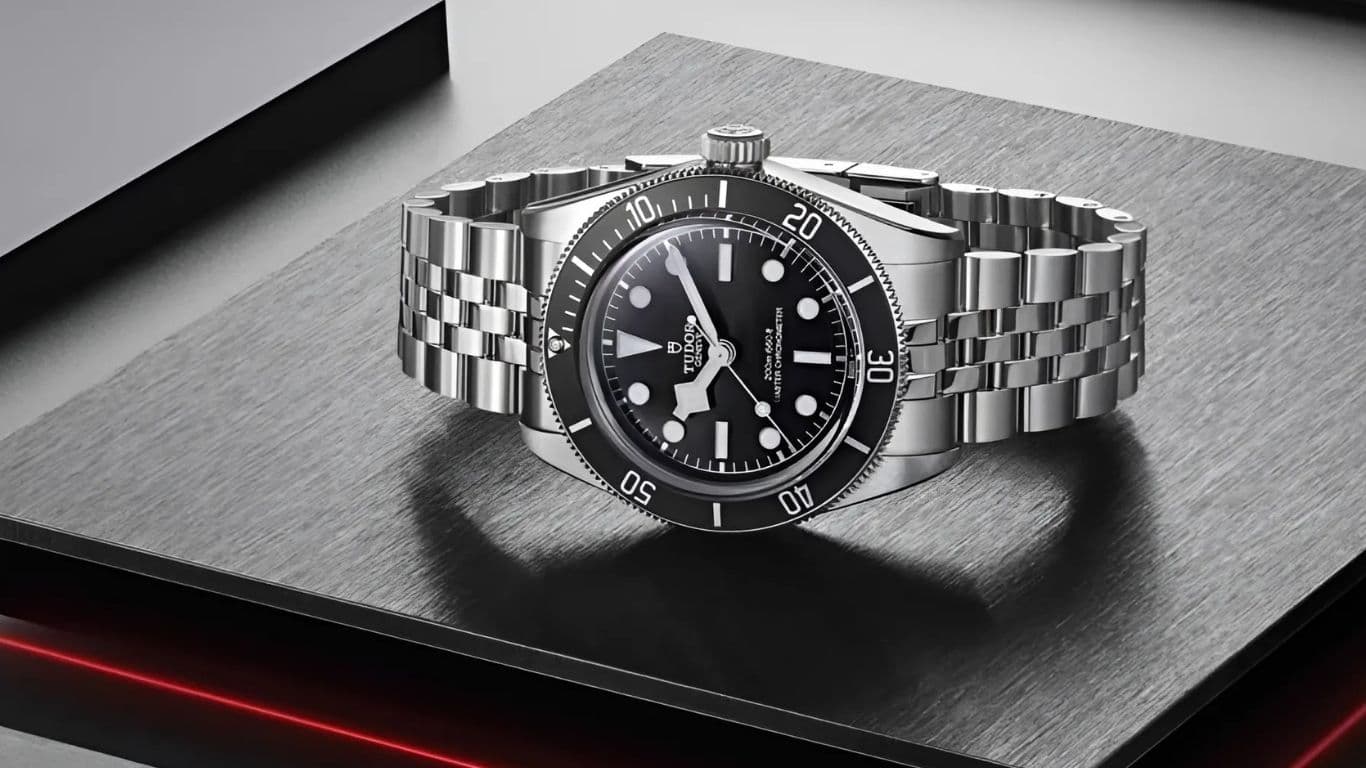
The Black Bay 58 reference 79030N is the watch that defined what modern Tudor means. The 39mm case sits inside the goldilocks band most contemporary buyers actually want: wearable across wrist sizes, slim enough to disappear under a shirt cuff, substantial enough to read as a serious tool watch. Retail sits around $4,000 to $4,500 in steel; secondary trades close to retail on clean full-set examples.
The MT5402 in-house movement with the 70-hour power reserve does the technical heavy lifting. The 200-metre water resistance, the unidirectional bezel with the considered tactile detent, the riveted bracelet that draws on the historical Rolex Submariner construction: the engineering reads as cohesive across every detail.
The various Black Bay 58 dial variants anchor the broader collecting tier. The original black, the burgundy, the navy blue, the silver, and the bronze each carry their own following. Box-and-papers documentation matters at this price point as much as it does at any tier above, and the cleanest examples consistently trade through specialist dealers rather than the broader Chrono24 inventory.
The Black Bay Pro, the 36 and the 41
The Black Bay Pro Opaline, the white-dial variant of the Black Bay GMT with the fixed-bezel GMT execution, has become one of the more discussed contemporary Tudor references. It sits in a particular space the broader GMT category doesn't quite fill, with the white dial reading cleaner under field-watch use than the standard Pepsi configurations most GMT references gravitate toward.
The Black Bay 36 is the line's smaller-diameter heritage diver, and the reference has built its own collector following among buyers preferring proportions under 40mm. The 41mm reference 79230B in steel sits between the 36 and the Pelagos in the catalogue, anchoring contemporary 41mm production for collectors with larger wrists.
The Black Bay Bronze and the Black Bay Chrono extend the catalogue further. Each carries its own collector following without straying from the design language that defines the line. The discipline is what makes the Black Bay catalogue read as cohesive rather than scattered, and it is the discipline collectors are responding to.
What auctions and the secondary market actually show
Phillips and Sotheby's have started including modern Tudor references in their general watch sales with increasing regularity, which is a signal worth reading. The line that ten years ago sat below the major auction houses' attention threshold now consistently passes through Phillips' online sales with cleanly executed reserves and credible clearance rates. The record sales drawing collector attention have been the rarer dial configurations and the discontinued limited editions, where the production-constraint discipline finally produces the auction-room premium the broader category supports.
Hodinkee, Worn & Wound, and the dedicated Tudor specialist sites have given the line consistent serious coverage. WatchCharts and Chrono24 data show steady upward pressure on clean Black Bay 58 examples through the 2023–2025 window, with the burgundy dial in particular consolidating as the most-discussed configuration.
What collectors look for in a Tudor Black Bay
Box-and-papers, original case condition, full sets where available, and credible service history through Tudor's authorised network. The references that come up most consistently in serious Black Bay collector conversation are the Black Bay 58 in the various dial variants, the Black Bay Pro Opaline, the Black Bay 36 for collectors preferring smaller cases, and the various heritage-derived limited editions.
The dealer relationships matter more than they do on broader sub-$5,000 production. Tudor's authorised dealer network is steady, and the boutique-pre-owned channel through Tudor and Rolex retailers handles a meaningful portion of clean secondary inventory. For vintage and limited-edition references, the established Tudor specialist dealers in Europe and North America anchor the considered market.
What this means for collectors
The longer story is whether Tudor maintains the design and production discipline that has, across the past decade, made the Black Bay one of the structural pillars of modern accessible Swiss collecting. So far, the evidence runs in the brand's favour. The catalogue refinements across 2015 to 2026 read as measured rather than aggressive, and the new releases at Watches and Wonders each spring continue to land inside the line's established design language.
So long as that discipline holds, the Black Bay reads as the kind of reference that ages well in a serious collection. It isn't a Submariner and it isn't trying to be; it occupies a tier the broader Swiss field hasn't quite filled, and the collectors who recognise that tend to keep the watch in rotation longer than they planned.
We last reviewed this analysis in May 2026.


Stefanos Moschopoulos
Stefanos Moschopoulos founded The Luxury Playbook in Athens and has spent the better part of a decade following the auction calendar, the en primeur releases, and the watchmakers, gallerists, and shipyards the magazine covers. He writes the field guides and listicles that anchor the Connoisseur section — pieces built on Phillips and Christie's results, Liv-ex movements, and conversations with collectors he has met across Geneva, Bordeaux, Basel, and Monaco. His own collecting habits sit closer to watches and wine than art, and it shows in the level of detail in the magazine's coverage of those categories. Under his direction, The Luxury Playbook now publishes long-form field guides, market-defining year-end listicles, and the Voices interview series with the founders behind the houses and the brands.