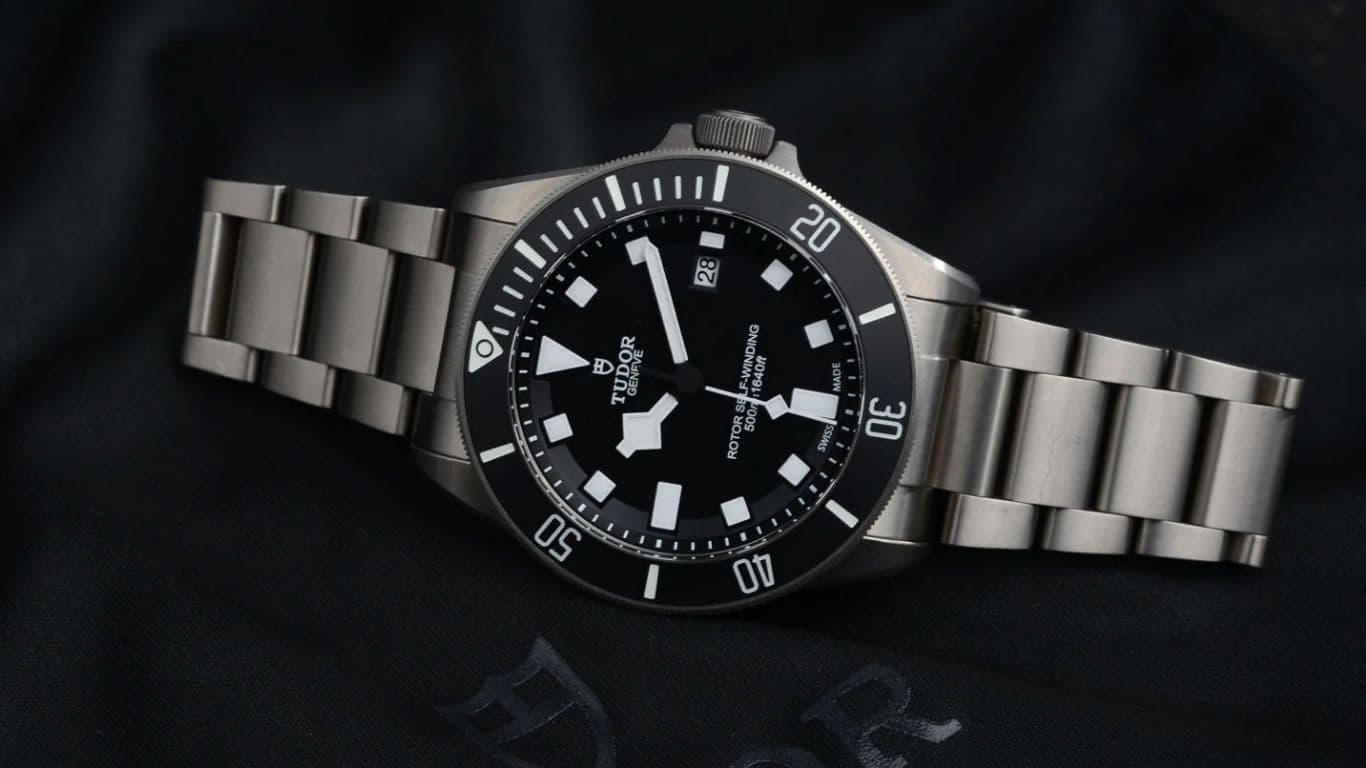
The Tudor Pelagos is loved by wearers but quieter at auction than its Black Bay siblings, and the gap between technical merit and auction-room recognition is the most interesting story in modern accessible-tier collecting.
- The Tudor Pelagos has earned a devoted wearer following through titanium construction, helium escape valve engineering, and the kind of pure tool-watch positioning the category often lacks.
- Auction visibility for the Pelagos remains quieter than the Black Bay, which reflects collector preference for vintage-style design over pure functional engineering.
- The Pelagos FXD line has reshaped Tudor's tool-watch credibility, with French Navy provenance and bespoke configuration anchoring a separate collector segment.
- We see the Pelagos as the strongest single Tudor purchase for serious dive-watch wearers, with build quality and weight balance that competes with much pricier alternatives.
- Secondary-market depth on the Pelagos has grown steadily, though the reference remains less liquid than equivalent Black Bay variants.
- Manufacturer movement and Master Chronometer certification reinforce the technical case, with calibre architecture that matches the most credible Swiss alternatives.
- Who is this for?
- Serious dive-watch wearers, tool-watch collectors, and Tudor enthusiasts exploring the brand's purest functional reference.
- What is happening?
- A grounded read on the Tudor Pelagos, covering the dive-watch engineering, the wearer-versus-collector split, and the FXD line's separate collector segment.
- When did this emerge?
- The current read reflects 2026 collector behaviour, with FXD rollouts and Master Chronometer certification continuing to reshape Pelagos conversation.
- Where is this happening?
- Authorised Tudor dealers globally stock the current catalogue, while Chrono24, Subdial 50, and specialist auctions handle the secondary market.
- Why does it matter?
- The Pelagos offers serious tool-watch engineering for wearers who prioritise function, even if collector interest remains quieter than equivalent vintage-inspired references.
On every reasonable measure of watchmaking ambition, the Pelagos is the more serious watch: titanium construction, helium escape valve, in-house METAS-certified movement, and depth ratings that make it genuinely credible for the working diver rather than the desk-bound enthusiast.
And yet the Pelagos hasn't quite cleared the auction-room recognition the Black Bay siblings now consistently command. The owners we hear from at boutique events tend to wear their Pelagos heavily and praise it specifically, but the Phillips and Sotheby's catalogues continue to lead with Black Bay references when Tudor gets serious page space. That disconnect tells us something about how heritage narratives still anchor modern collecting at the upper end, and the picture is worth reading carefully.
The current Pelagos catalogue
The Pelagos 39 reference 25407N anchors the contemporary range. The 39mm titanium case, the in-house MT5400 movement with METAS Master Chronometer certification, and the considered dial geometry launched in 2022 give the watch the cleanest modern execution Tudor has ever produced. Retail sits around $5,150; the cleaner contemporary case design fits more wrists than the 42mm predecessor managed.
WatchCharts pricing on the broader Pelagos range runs around the mid-three-thousand-euro mark, with steady demand from buyers entering the line through the 39 rather than through the discontinued 42mm earlier reference. Secondary market trades close to retail on clean full-set examples.
The Pelagos Ultra reference 25801CN is the brand's deepest-rated dive watch. Rated to 1,000 metres, with the in-house MT5612-U movement, the helium escape valve, and a 43mm titanium case launched in 2023. Retail around $5,950; secondary close to retail.
The Ultra is the strongest evidence of Tudor's contemporary engineering ambition, and the saturation-diving credentials place the watch in technical territory most accessible-tier brands don't approach.
The vintage Pelagos tier and the LHD
The earlier Pelagos references, the 25600 generation that ran from 2012 onwards before the 2022 Pelagos 39 launch, anchor the established Pelagos collecting tier. Clean examples trade between roughly €2,500 and €3,500 depending on condition; the LHD variants and the various dial-colour limited editions carry their own following.
The LHD configuration, with the crown on the left side of the case rather than the right, originally references the historical French Navy commission pieces. It is the most collected of the 25600 generation, and the cleanest examples consistently trade above the standard right-handed references.
The original Pelagos FXD references made for the French Navy, the 25707B in matte black bronze and the 25717B in titanium, anchor a particular subcategory of contemporary Tudor diving collecting at the more specialist tier. These are the references the most active modern Pelagos collectors pursue, and the supply discipline keeps them genuinely scarce in the secondary market.
Why the Pelagos is loved by wearers
The wearer case is straightforward. Titanium construction means the Pelagos wears substantially lighter than its steel siblings: the case-and-bracelet weight on a Pelagos 39 sits closer to a contemporary GADA tool watch than to a traditional steel Submariner. Buyers who actually wear the watch daily notice this within the first week.
The auto-adjust clasp is one of the most thoughtful contemporary diving-watch engineering details. Tudor's diving extension adjusts case length under water without tools, which is a piece of practical engineering most dive watches at the price band don't offer. The depth rating means the watch is genuinely over-engineered for any actual use it will see on most wrists.
The METAS Master Chronometer certification gives the Pelagos antimagnetic resistance to 15,000 gauss and timing accuracy within -4/+6 seconds per day across the full power reserve. The in-house MT5400 and MT5612-U movement architecture is, by accessible-tier standards, technically interesting in a way the broader category isn't. Collectors who weight technical execution heavily find the Pelagos more rewarding than the secondary-market premium suggests.
Why the auction houses haven't quite caught up
The auction-room profile is quieter than the wearer profile because the Pelagos lacks the heritage-narrative depth the Black Bay carries. The Black Bay references draw on Tudor's vintage Submariner heritage: the snowflake hands tracing back to the 1969 Submariner reference 7016, the gilt dial geometry of the 1958 references, the 1950s and 1960s case proportions reinterpreted for contemporary case sizes.
The Pelagos is a contemporary technical watch without a vintage line behind it. Auction interest tends to follow heritage narratives, and the Pelagos's narrative is the contemporary engineering case rather than the historical one. The watches that combine technical credentials with heritage narrative tend to clear the strongest auction numbers; the watches with technical credentials alone tend to remain the wearer's choice.
Phillips and Christie's both occasionally include Pelagos references in their watch sales, but consistently at numbers below what the technical merit might suggest. The LHD variants and the various limited editions are the references most likely to surface at the major auction houses; the standard contemporary Pelagos references rarely lead a catalogue page.
What collectors look for in a Tudor Pelagos
For modern Pelagos, the references that come up most consistently in serious collector conversation are the Pelagos 39 in titanium, the Pelagos Ultra at the technical upper end, and the discontinued LHD variants for collectors drawn to the rarer dial configurations. Box-and-papers documentation matters; the various coloured-dial limited editions hold modest premiums when they surface.
The Pelagos Ultra's launch reception has been positive but quiet. The watch has the kind of technical depth that earns long-form attention from the established specialist dive-watch press without the broad coverage the Black Bay generates. Worn & Wound and the dedicated Tudor specialist sites gave the Ultra serious attention; the broader watch press treated it more cautiously.
What this means for collectors
The longer story is whether Tudor's continued investment in the Pelagos line eventually builds the kind of historical depth that supports auction-house interest in subsequent decades. The 39 launch in 2022, the Ultra in 2023, and the steady refinement of the broader catalogue all suggest the brand is committed to the line on a longer time horizon than the current auction-room reading credits.
So far, the watch's case is mostly with the wearers. The auction-room recognition is likely to follow on a longer time horizon, and the collectors who recognise the technical case now are buying into references the broader market may catch up to over a five-to-ten-year cycle. We'd argue the Pelagos 39 in particular reads as the kind of reference that ages well in a collection: the case proportions, the titanium construction, the considered design discipline all suggest the watch will sit comfortably alongside heavier-hitting collector references when the moment comes to wear it.
And the watches that most modern dive watches fill as desk-divers, the Pelagos quietly does as an actual tool. That distinction is what its owners keep returning to.
We last reviewed this analysis in May 2026.

Frequently Asked Questions
- Why does the Tudor Pelagos lose value compared to other Tudor watches?
- The Pelagos has limited mainstream appeal compared to the popular Black Bay line. Its tool-watch focus appeals to divers but lacks status symbol appeal for luxury buyers. Tudor also doesn't limit production like Rolex, creating oversupply in secondary markets.<br>
- Should I buy a Tudor Pelagos new or used?
- Buy used since these watches trade below retail anyway. You can find excellent condition models for $3,000-$4,500 versus $4,450-$5,325 retail. This avoids immediate depreciation while getting the same quality and in-house movement.

Stefanos Moschopoulos
Stefanos Moschopoulos founded The Luxury Playbook in Athens and has spent the better part of a decade following the auction calendar, the en primeur releases, and the watchmakers, gallerists, and shipyards the magazine covers. He writes the field guides and listicles that anchor the Connoisseur section — pieces built on Phillips and Christie's results, Liv-ex movements, and conversations with collectors he has met across Geneva, Bordeaux, Basel, and Monaco. His own collecting habits sit closer to watches and wine than art, and it shows in the level of detail in the magazine's coverage of those categories. Under his direction, The Luxury Playbook now publishes long-form field guides, market-defining year-end listicles, and the Voices interview series with the founders behind the houses and the brands.