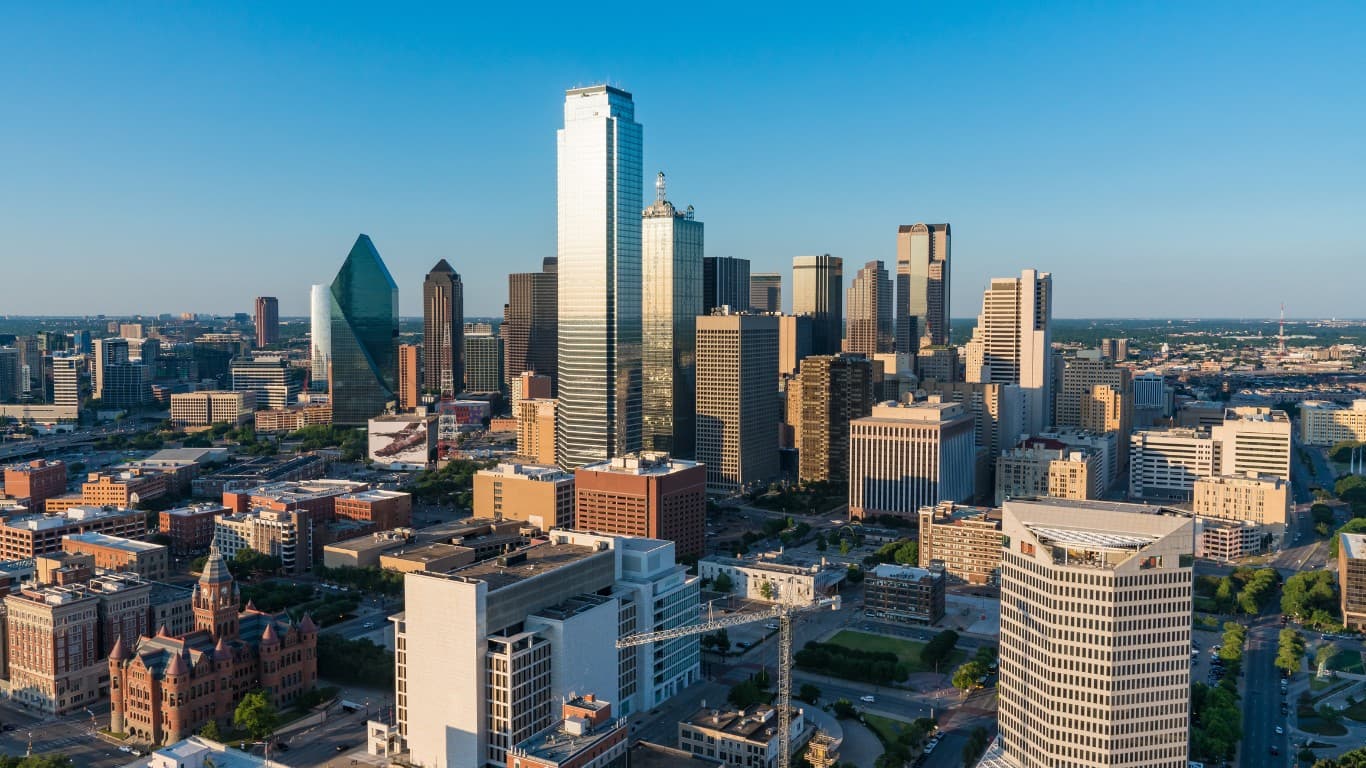
The 2026 Dallas real estate market sits at the center of the Sun Belt's most active large-metro story. The median sale price clears $410,000, up 3. 9 percent year-on-year, with the population continuing to expand at one of the fastest paces in the country.
Knight Frank's 2026 US Cities Prime Index flags Dallas as the standout Texas metro on both depth and absorption.
The North Texas Real Estate Information Systems data and the brokerages tracking the prime side (Allie Beth Allman and Associates, Briggs Freeman Sotheby's International Realty, Compass) describe a market that has stabilized after the 2022 peak while continuing to draw capital. The contrast against gateway coastal metros like San Diego and Los Angeles is the migration story buyers care about.
Inbound corporate relocations (Goldman Sachs' expanding Dallas footprint, the ongoing scale-up at Toyota and JPMorgan Chase in Plano, the Frito-Lay and AT&T headquarters anchors) sustain employment demand. Mansion Global has tracked the Dallas prime corridor as one of the most consistent US large-metro performers through the rate cycle.
- Dallas-Fort Worth continues to lead the country in absolute population growth, with corporate relocations and broader Texas in-migration supporting steady real estate demand through 2026.
- We see median prices having stabilised after the sharp pandemic-era appreciation, with the market now settling into a more sustainable growth trajectory across most price tiers.
- Highland Park, University Park and the broader Park Cities continue to anchor the luxury segment, with new build inventory expanding faster in Frisco, Plano and the northern suburbs.
- Inventory has loosened materially through 2025 and into 2026, with months-of-supply moving closer to balanced conditions across most metropolitan submarkets.
- Property tax burden remains a structural drag on Dallas ownership economics, with combined rates among the highest in the country offsetting some of the no-state-income-tax advantage.
- For most considered buyers we view Dallas-Fort Worth as a structurally attractive long-term hold given the demographic and corporate-relocation tailwinds underpinning demand.
- Who is this for?
- Buyers and investors evaluating Dallas-Fort Worth for primary residence or income property, alongside relocation clients and the brokers, lenders and tax advisers supporting metroplex transactions.
- What is happening?
- A market overview and 2026 forecast for the Dallas real estate market, covering price levels, inventory dynamics, corporate relocation drivers and the property tax considerations.
- When did this emerge?
- The article covers conditions through 2025 and 2026, with reference to the post-pandemic inventory cycle and the latest corporate relocation announcements shaping demand.
- Where is this happening?
- The piece focuses on the Dallas-Fort Worth metropolitan area, including the Park Cities, Frisco, Plano and the broader suburban submarket landscape.
- Why does it matter?
- Dallas-Fort Worth offers some of the strongest demographic tailwinds in the country in 2026, which is why the structural demand case warrants explicit attention from long-term buyers.
The Dallas housing market today
The median sale price of $410,000 splits the wider Sun Belt range, sitting above San Antonio and Houston but materially below Austin. Days on market average 38, with the tightest absorption in Highland Park, University Park and Lakewood. The sale-to-list ratio of 98.
6 percent confirms that quality stock continues to trade close to asking.
Realtor.com's 2026 absorption rankings place Dallas in the top 15 large US metros for buyer activity. Bloomberg's tracking of the Texas Triangle has consistently flagged Dallas as the Sun Belt's most capital-deep large metro for both family-buyer and corporate-relocation demand.
- Median sale price: $410,000, up 3.9 percent YoY
- Median list price: $445,000
- Average days on market: 38
- Sale-to-list price ratio: 98.6 percent
- Strongest demand: Highland Park, University Park, Lakewood, Plano, Frisco
Dallas neighborhoods defining 2026
Dallas operates as two related markets stacked into one. The Park Cities (Highland Park and University Park) form a tight prime tier inside the city, while the northern suburbs (Plano, Frisco, McKinney) absorb the bulk of the corporate-relocation demand. The brokers tracking the prime side flag five neighborhoods carrying the citywide narrative.
Highland Park
Highland Park remains the city's most coveted address. The median home price sits at $2. 85 million, up 3.
8 percent year-on-year. Strong public schools, mature trees and proximity to downtown anchor demand, with Allie Beth Allman tracking it as the most stable prime Dallas submarket. Christie's International Real Estate affiliate Briggs Freeman Sotheby's publishes the cleanest segment data.
University Park
University Park, the smaller enclave adjacent to SMU, runs similarly tight. Median home prices clear $2. 1 million, with inventory limited and absorption fast.
The combination of the SMU footprint, strong public schools and Park Cities zoning rules sustains the scarcity premium.
Lakewood
Lakewood, on White Rock Lake, has become one of the most coveted family-buyer destinations. The median price sits at $1. 05 million, up 4.
2 percent year-on-year. Mature Tudor and Spanish Revival housing stock, the lakefront, and the strong school district anchor demand.
Plano and Frisco
Plano and Frisco, the northern suburbs absorbing the bulk of corporate-relocation demand, run at the broader-metro median. Plano's median sits at $545,000 and Frisco's at $625,000, both up roughly 4 percent year-on-year. Toyota, JPMorgan Chase and Liberty Mutual's campuses sustain employment-driven absorption.
Bishop Arts District
Bishop Arts District, the urban-redevelopment corridor on the southwest side, has been the city's most consistent gentrification story for a decade. The median home price sits at $625,000, up 4. 6 percent year-on-year.
Restored 1920s craftsman stock dominates the activity.
Dallas rental market in 2026
Average rent across the metro sits at $1,685 per month, up 3.4 percent year-on-year. One-bedrooms in Uptown and the Bishop Arts District lease between $1,800 and $2,300, while Plano and Frisco two-bedrooms commonly run from $1,750 to $2,200.
Vacancy stands at 6.1 percent, slightly above the Texas urban average. JLL's 2026 Texas Multifamily Outlook notes that Dallas absorption rates have improved through Q1 2026 as the post-2022 delivery cycle compressed and corporate-relocation demand returned.
What is shaping the Dallas map in 2026
Population growth (the Dallas-Fort Worth metroplex added roughly 175,000 residents in 2024, per US Census Bureau estimates, the largest net gain among US large metros) provides a structural demand floor. Corporate-relocation employment is the second driver, with the Toyota, JPMorgan Chase, Goldman Sachs and McKesson footprints all expanding through 2025.
The third driver is capital reallocation. High-net-worth buyers exiting California and the Northeast continue to redirect into Highland Park, University Park and the prime northern-suburb stock. Bloomberg has tracked the migration of family offices to Dallas as one of the cleaner intra-US wealth flows since 2022.
Mortgage rates in the 6.5 to 7 percent range have rebalanced activity toward the $400K-$650K band, where suburban inventory continues to deliver. The prime tier above $1M continues to clear at its own pace, with cash-buyer share regularly above 30 percent.
What this means for buyers
Dallas in 2026 reads as the deepest, most capital-rich Sun Belt large metro. Home prices are projected to rise 3. 5 to 5 percent through 2026, with the strongest gains in Lakewood, the Bishop Arts District and the northern-suburb prime tier.
Rents are forecast to climb 3 to 4. 5 percent.
For buyers tracking the broader picture in our US Real Estate Market Overview (2026), Dallas continues to read as the most resilient and best-absorbed Sun Belt large metro.
We last reviewed this analysis in May 2026.
Frequently asked questions
Is Dallas a good market to buy in 2026?
Yes. Population growth of around 175,000 residents in 2024 (the largest US net gain), corporate-relocation employment expansion at Toyota, JPMorgan Chase and Goldman Sachs, and a deep prime tier in the Park Cities all sustain demand. Knight Frank's 2026 US Cities Prime Index flags Dallas as the standout Texas metro.
Which Dallas neighborhoods are appreciating fastest?
The Bishop Arts District leads the citywide rate at 4. 6 percent, followed by Lakewood at 4. 2 percent.
The Park Cities (Highland Park, University Park) appreciate more slowly at higher absolute prices and remain the city's prime anchor per Allie Beth Allman and Briggs Freeman Sotheby's.
How does Dallas compare to Austin and Houston?
Dallas sits between Austin (higher) and Houston / San Antonio (lower) on median price. The corporate-relocation depth and the family-office capital inflow give Dallas the most resilient prime tier of the four major Texas metros.
Is Dallas a good rental market?
Yes. Average rent of $1,685 with vacancy at 6. 1 percent gives reasonable rent-to-price ratios.
Uptown, the Bishop Arts District and the corporate-anchored Plano-Frisco corridor have the tightest absorption.


Savvas Agathangelou
Savvas Agathangelou co-founded The Luxury Playbook and has spent years reporting from the prime postcodes the magazine covers — Mayfair, Knightsbridge, the Athens Riviera, Dubai's Palm crescents, and the southern Mediterranean coastlines where the world's wealthy keep coming back. His background is in international hospitality, and that frame shapes how he writes about property: the developer's choices, the architect's signature, the agency's bench of named brokers, the building's service standard once the buyer moves in. He files developer spotlights, agency profiles, and the seasonal "Properties That Defined" listicles, and he hosts the magazine's founder-and-leadership interviews on the Voices side.