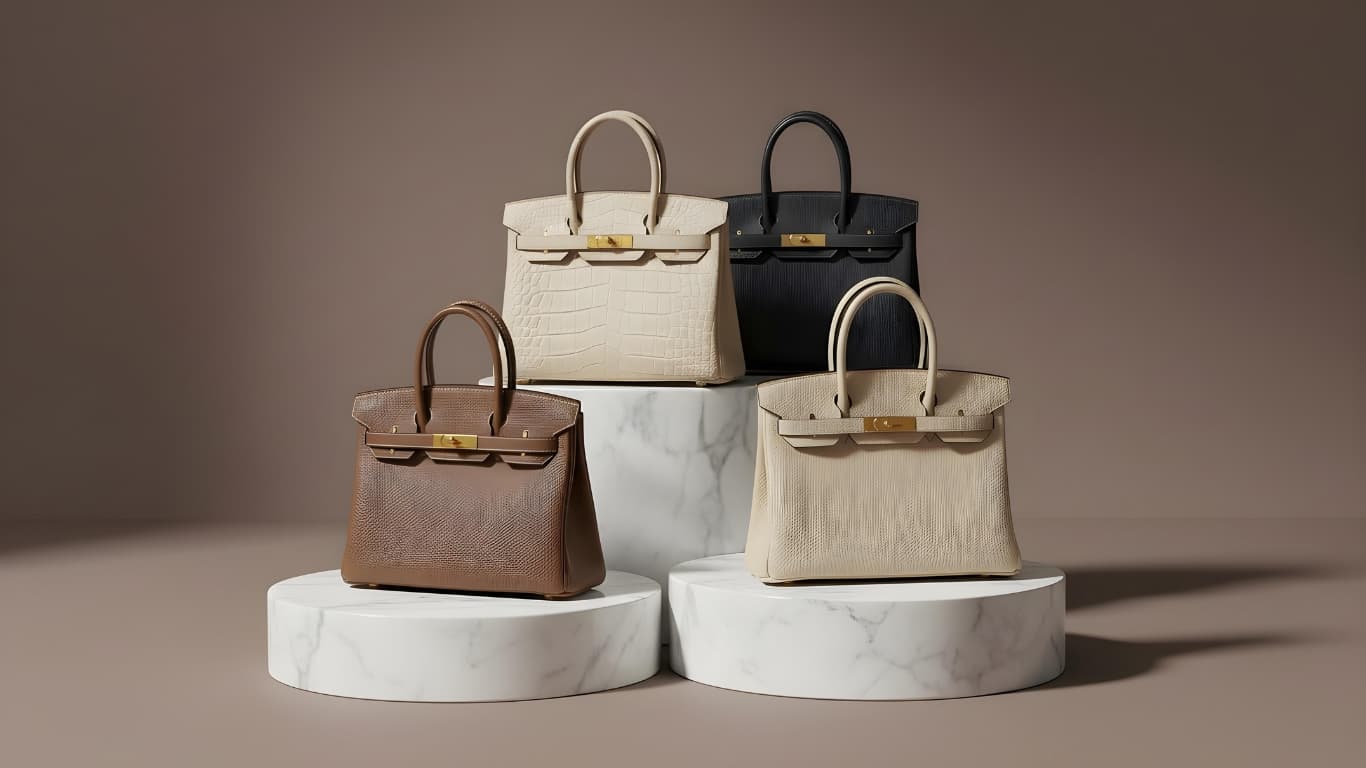
For decades, Hermès Birkin bags have quietly behaved less like fashion accessories and more like a peculiar, high-performing asset class that’s made serious investors sit up and take notice. Analysis…
For decades, Hermès Birkin bags have quietly behaved less like fashion accessories and more like a peculiar, high-performing asset class that’s made serious investors sit up and take notice.
Analysis of secondary market prices by luxury platform Baghunter found that Birkin bags appreciated by about 14.2% per year between 1980 and 2015, while the S&P 500 delivered roughly 8% to 10% annually over similar periods and gold managed only around 2% to 3%.
The numbers get even more striking when you look at current pricing dynamics. A Birkin 30 in Togo leather typically retails for around $12,000 to $15,000 in Hermès boutiques, depending on country, color, and hardware. Yet according to CNBC pricing data, that very same bag can easily command $30,000 or more on the resale market.
In other words, a buyer can walk out of the boutique with an object that’s already trading at a substantial premium to what they just paid, a phenomenon almost unheard of outside distressed luxury goods or deliberately manipulated markets.
What makes this genuinely fascinating from an investment perspective is that a sizable slice of owners now treat these bags as pure financial instruments. Firestein estimates that around 25% of Birkin buyers never carry the bag at all, keeping it in climate-controlled storage purely as an investment, while the remaining 75% actually use theirs.
When a quarter of your market consists of people who never even touch the product and treat it exactly like they’d treat gold bars in a vault, you’re watching a real asset class emerge rather than just a luxury goods category.
Hermès Handbags Have Quietly Became Better Investments Than Gold
Key Takeaways
Navigate between overview and detailed analysis
Hermès Birkin bags have outperformed gold and the S&P 500, compounding roughly 14.2% annually from 1980, 2015, versus about 8, 10% for equities and 2, 3% for gold.
Their value retention exceeds 90%, with some models like the Sellier Birkin reaching 250% resale-to-retail ratios in 2024, reflecting exceptional scarcity-driven demand.
Hermès’ business model, strict supply control, quota systems, and artisan craftsmanship, creates engineered scarcity and predictable secondary-market premiums.
Digital resale platforms like Rebag and The RealReal have transformed handbags into a transparent, data-rich market resembling financial assets.
Despite impressive returns, handbags carry liquidity and trend risks; experts recommend treating them as long-term, satellite portfolio assets rather than substitutes for traditional investments.
Who:
Investors, collectors, and luxury consumers treating Hermès Birkins as financial assets.
What:
A luxury handbag market behaving like an alternative asset class, with stable compounding and high resale premiums.
When:
From the 1980s through 2025, with data showing consistent outperformance and rising institutional interest.
Where:
Primarily in global luxury hubs, Paris, New York, London, and Hong Kong, supported by online resale platforms.
Why:
Hermès’ controlled scarcity and enduring craftsmanship create both emotional and financial value, driving investor confidence and multi-decade appreciation.
How a Leather Bag Started Beating Gold
The starting point for understanding this outperformance is that 14.2% versus roughly 10% edge that Baghunter documented. Their analysis of auction and resale prices suggests Birkins compounded at 14.2% annually between 1980 and 2015, compared with roughly 8% to 10% for U.S. equities and low single digits for gold. If you’re thinking about how elite investors protect and grow their capital, those numbers deserve your full attention.
Auction houses now recognise rare handbags as a standalone collecting field. Christie's dedicates curated sales to Hermès Birkin and Kelly lots. Sotheby's runs comparable handbag and accessories auctions, and the price discovery these events produce gives the wider resale market a credible anchor.
Reporting from Bloomberg has covered how the secondary market for top-grade exotic Birkins continues to behave like a thin but functional alternative asset class. Volume is modest. Headline prices stay sticky even when broader luxury demand softens, which is exactly what investors look for.
If you plug those growth rates into a simple thought experiment, a hypothetical $50,000 kept in a Birkin-equivalent portfolio for 10 years would end up around $190,000, versus roughly $130,000 in an S&P 500 tracker.
Stretch the horizon longer and the gap easily exceeds six figures, purely from the compounding effect of that 4% annual edge.
One of the key differentiators between handbags and most consumer goods, even luxury ones, is value retention that approaches or exceeds 100% of retail. Hermès Birkin and a small group of other top-tier designer bags carry value retention rates approaching 90% or higher of their original retail price.
By contrast, broader analysis from Investopedia points out that most fashion items, especially non-designer clothing, lose 50% to 70% of their value almost immediately after purchase, which underscores just how exceptional Birkin-level retention really is.
Rebag’s 2024 Clair Report drove the point home with numbers that seemed almost impossible. The Hermès Sellier Birkin became 2024’s standout investment piece, achieving around 250% “value retention,” meaning it traded at roughly 2.5 times its retail price on the resale market.
That jump of more than 50 percentage points in a single year would be remarkable for a tech stock. For a leather handbag, it’s almost unheard of.
Knight Frank Luxury Investment Index (KFLII) Q4 2024
Performance of Luxury Alternative Assets as of Q4 2024
The comparison with gold gets even more favorable when you look at risk-adjusted returns rather than just headline performance. A 2022 study on collectible assets by Credit Suisse found that handbags rank among the least volatile collectible categories, with annualized returns in the mid-single digits, roughly 4.5% to 6.5%, but volatility as low as 2.5% to 5%.
That’s lower than most other passion assets like art, classic cars, or fine wine, all of which can swing wildly based on collector sentiment and shifting market conditions.
That same Credit Suisse work flagged luxury handbags as a worthwhile hedge against inflation because their prices tended to rise in periods when traditional financial assets were under pressure. Robb Report’s coverage of the luxury resale market has echoed this view, and Rebag’s 2024 report supported it from a micro perspective, noting that every brand it tracked improved its resale value retention year over year, with several accessibly priced handbag brands seeing standout double-digit growth and signaling exciting investment opportunities across both heritage and more attainable labels.
The Hermès Strategy That Makes Gold Look Ordinary
So why have Birkin and Kelly bags in particular pulled so far ahead of gold and even other luxury brands that should theoretically benefit from similar scarcity dynamics?
A big part of the answer lies in Hermès’ business model, which combines deliberate scarcity, absolute quality control, and a level of craftsmanship that can’t be replicated even by competitors with similar resources.
The scarcity mechanism is engineered rather than natural. A high-profile U.S. class-action lawsuit filed in 2024 alleged that Hermès only allows customers with a sufficient purchase history across other categories to buy Birkin bags, effectively tying access to bags to spending on scarves, shoes, and homeware.
The lawsuit called this anti-competitive. But from an investment perspective, it’s textbook supply restriction that creates and maintains pricing power.
Reporting from Business of Fashion describes how shoppers discuss the Hermès game online, where even loyal clients are typically allowed only a very limited number of so-called quota bags per year, and often cannot choose the exact model, color, or hardware they’ll be offered.
This isn’t like walking into a Tiffany and buying whatever diamond you want if you have the money. It’s a rationing system that makes Soviet bread lines look efficient.
Firestein pointed out that this controlled scarcity is exactly why the resale market has become so powerful. He told Fortune that secondhand platforms actually offer buyers more choice than Hermès boutiques, where customers are allowed one quota bag per year and rarely get to choose the exact model they want.
When the primary market won’t sell you what you want even if you have the cash, you create the conditions for sustained premiums in secondary markets that would normally arbitrage away.
Still, scarcity only works as an investment thesis if the product actually justifies the price, which is where Hermès’ manufacturing approach becomes critical. The company’s activity reports note that most of its production, and leather goods in particular, is carried out in its own workshops in France across dozens of dedicated leather studios and tanneries rather than through outsourced mass production.
Research from collectors emphasizes the extraordinary level of craftsmanship involved. A single Birkin bag can take up to 40 hours to produce, handmade by one artisan who typically spends around five years in training before being entrusted with the work. The bags are stitched using a traditional saddle stitch that’s effectively impossible to replicate by machine and is virtually indestructible according to craftspeople who’ve examined the construction.
And then the explosion of e-commerce and online resale platforms in the 2010s and 2020s created the final piece needed to turn Birkins into a genuine asset class. Platforms like Rebag, The RealReal, and Vestiaire Collective built a transparent global market with price discovery and historical data that simply didn’t exist when these transactions happened only through consignment shops and private sales.
Firestein points out that this digital secondary market is now where many buyers go first, precisely because quota limits and opaque allocations in boutiques push demand into resale channels.
As more inventory and price history accumulates online, it becomes easier to see that certain references like classic sizes, neutral colors, and pristine condition command consistent premiums, reinforcing their reputation as quasi-financial assets with predictable value trajectories. The dynamic mirrors what’s happening with collectors turning to alternative art categories as more transparent pricing data reshapes secondary markets.
What They Don’t Tell You About Investing in Handbags
For all the eye-catching returns that make Birkins look like magic wealth generators, the reality involves risks and frictions that fashion magazines and resale platforms tend to gloss over when they’re trying to move inventory.
While some bags have doubled in value in five years, it’s more common for price doubling to take around a decade based on pristine pieces held long-term. In other words, these are long-horizon assets that require patience and proper care, not short-term trades you can flip for quick profits the way some collectors imagine.
The recent surge in handbag prices is partly structural, driven by scarcity and brand power, but it’s also partly cyclical and trend-driven in ways that create real timing risk.
Firestein himself cautions that not every purchase will be a home run and that chasing hype can be a gamble. When luxury authentication experts who make their living from this market are telling you to be careful about timing, that should give anyone pause about treating Birkins like a sure thing.
Traditional financial planners are often even more direct about the risks of conflating consumption with investment. Certified financial planner Carolyn McClanahan told CNBC that purchases being positioned as investments hits her the wrong way.
Her point is straightforward. Before you start allocating serious money to Birkins, you should already have a conventional diversified portfolio in place with proper emergency funds, retirement savings, and core equity exposure.
And there’s a social dimension that gets obscured when people frame $30,000 handbags as wealth-building tools. Jasmine Tucker, vice president of research at the National Women’s Law Center, points out that to be perceived as belonging in certain professional and social spaces, women are often expected to spend more on grooming and appearance while still earning less on average than men.
Framing a five-figure handbag as an investment can blur the line between genuine wealth building and pressure to consume aspirational luxury on top of an existing pay gap.
From a portfolio construction perspective, that’s an important caveat. The fact that some Birkins have outperformed gold doesn’t mean everyone should, or realistically can, use them as their inflation hedge, particularly when that decision comes at the expense of maxing out retirement accounts or building liquid emergency reserves.
Despite all these caveats, experts broadly agree on a few sensible rules for anyone seriously considering handbags as part of their portfolio rather than just impulse luxury purchases.
Don’t start here. Treat Birkins as a satellite allocation once your core portfolio, including cash reserves, retirement accounts, and diversified funds, is already in good order and performing as expected.
Think in five to ten year holding periods at minimum. Firestein’s own experience suggests that many of the healthiest returns come from bags held for a decade, kept in excellent condition with original packaging and documentation, and resold into a mature global market when timing and demand align favorably.
Finally, enjoy what one analysis calls the utility premium that distinguishes Birkins from gold bars. Unlike bullion sitting in a vault generating storage costs, a Birkin can actually be used and appreciated during the holding period.
For many owners, that combination of aesthetic dividend plus potential capital gain is the real appeal, even if the bag only roughly keeps up with inflation rather than crushing the S&P 500.
Stefanos Moschopoulos founded The Luxury Playbook in Athens and has spent the better part of a decade following the auction calendar, the en primeur releases, and the watchmakers, gallerists, and shipyards the magazine covers.
He writes the field guides and listicles that anchor the Connoisseur section — pieces built on Phillips and Christie's results, Liv-ex movements, and conversations with collectors he has met across Geneva, Bordeaux, Basel, and Monaco. His own collecting habits sit closer to watches and wine than art, and it shows in the level of detail in the magazine's coverage of those categories.
Under his direction, The Luxury Playbook now publishes long-form field guides, market-defining year-end listicles, and the Voices interview series with the founders behind the houses and the brands.