The Rolex Explorer remains the quietest of the major Rolex sport models, and the one most experienced collectors return to. While the Submariner anchors structural collecting, the GMT-Master II anchors travel-watch register, and the Daytona anchors cultural noise, the Explorer occupies a particular space.
- The Rolex Explorer remains one of the brand's best-kept collector secrets, with the modern Reference 124270 offering pure-Rolex tool-watch architecture at accessible price points.
- Reference 124270 in 36mm and Reference 124273 in two-tone anchor the modern catalogue, with the in-house Calibre 3230 supporting daily-wear reliability across decades.
- Vintage Explorer 1016 references from the 1960s and 1970s draw serious collector competition, with original gilt dials and unpolished cases commanding meaningful premiums.
- We see the Explorer as the strongest single tool-watch entry into Rolex collecting, with the kind of design purity and dial simplicity that wears across changing styles.
- The 2021 36mm size return represented a meaningful concession to vintage proportions, with collector response confirming the wisdom of returning to the original Explorer wrist presence.
- Service infrastructure and parts availability remain among the strongest in luxury watchmaking, supporting decades of credible Explorer ownership across multiple generations.
- Who is this for?
- Tool-watch collectors, first-time Rolex buyers, and established collectors building entry-tier Rolex depth.
- What is happening?
- A grounded read on how the Rolex Explorer became one of collectors' best-kept secrets, covering the modern 124270 catalogue and vintage 1016 references.
- When did this emerge?
- The current Explorer conversation reflects the 2021 36mm size return and the persistent collector demand for the vintage 1016 and modern 124270 references.
- Where is this happening?
- Authorised Rolex dealers globally maintain waitlists, while Chrono24, Subdial 50, and specialist auctions handle the vintage 1016 market.
- Why does it matter?
- The Explorer offers pure-Rolex tool-watch architecture and accessible pricing, which makes it one of the strongest single tool-watch purchases in the catalogue.
It is the time-only sport Rolex with the cleanest contemporary design, the most direct historical line back to mountaineering heritage, and the genuine wear-anywhere versatility the broader Rolex sport catalogue doesn't quite duplicate. In our coverage of the past three boutique-allocation cycles, the Explorer has consistently surfaced as the reference most experienced collectors arrive at after the Submariner, GMT-Master II and Daytona have done their work.
The Explorer catalogue in 2026
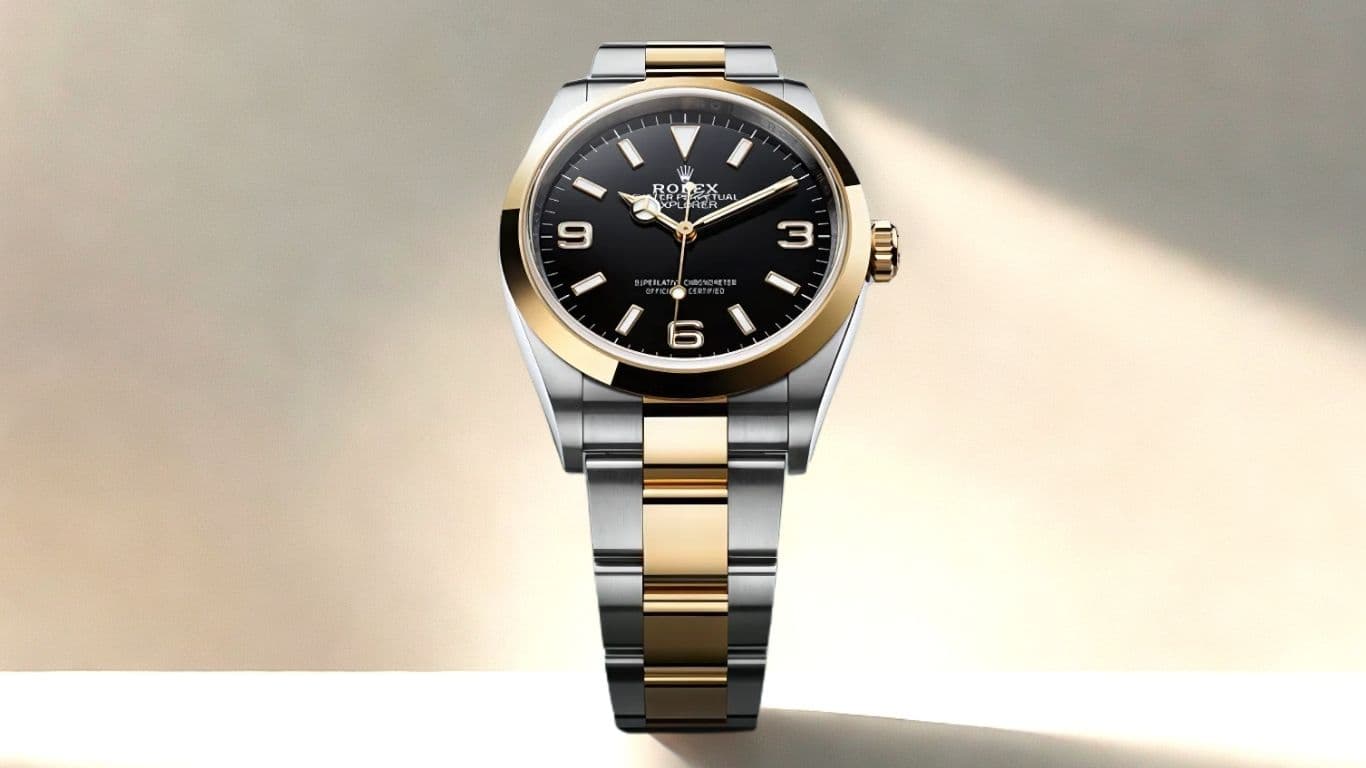
The current Explorer references include the 124270, the 36mm steel reference at around $7,800 retail, and the 124273, the 36mm two-tone steel-and-yellow-gold reference at around $11,500. The 2021 return to the 36mm case (after the 39mm 214270 that ran from 2010 to 2021) restored the Explorer to its historical case-size geometry.
The design discipline of the contemporary references reads cleaner than the 39mm bridge generation. The case proportions feel right in a way the 214270 never quite did, and the trade-press coverage of the 124270 launch acknowledged the case-size reversion as the correct call.
The Explorer II, the dual-time-zone Explorer reference with the fixed 24-hour bezel, sits in its own register. The current 226570 at 42mm and around $9,800 retail and the various coloured-dial variants (the white "Polar" dial in particular) anchor the contemporary Explorer II tier.
Vintage Explorer and the considered upper tier
Vintage Explorer, particularly the reference 1016 (the 1960s and 1970s 36mm Explorer with the Calibre 1570 movement, the gilt or matte dial, and the case proportions that defined the historical Explorer), anchors the upper tier of vintage Explorer collecting. The 1016 ran continuously from 1959 to 1989, one of the longest production runs of any vintage Rolex sport reference.
Clean 1016 references with original gilt dials in unrestored condition trade between $25,000 and $80,000 at Phillips and Christie's, depending on dial variant and condition. The earlier 6610 references (the 1950s pre-1016 Explorer) run higher when they surface in clean condition. The 1016 with the rare "Albino" white dial and the various Mark I, II, III and IV dial variants all anchor their own sub-categories of considered vintage Explorer collecting.
Vintage Explorer II, the 1655 "Steve McQueen" Explorer II from the 1970s with the orange GMT hand and the matte black dial, sits in the upper tier of vintage Explorer II collecting. The McQueen association is, by Rolex historians' read, apocryphal (McQueen actually wore a Submariner), but the nickname has stuck and the reference's collecting status reflects the cultural anchor regardless.
The reference 16550 (the early 1980s Polar-dial Explorer II) and 16570 (the late 1980s through 2010 production) anchor the broader vintage Explorer II tiers. Clean 16550 examples with the original cream "Spider" dial (the rare dial variant where the lume has degraded with characteristic crackle patterns) command meaningful premiums.
Why experienced collectors return to the Explorer
Three reasons. First, the case proportions. The 36mm Explorer wears better across registers than the larger Submariner or GMT-Master II do; the watch fits comfortably under a shirt cuff and reads as proportional rather than statement at the wrist.
Second, the design discipline. The Explorer's 3-6-9 dial geometry has been refined gradually rather than reinvented across nearly seventy years. The current production reads as canonical rather than derivative, and the contemporary references feel like the cleanest expression of the original 1953 design vocabulary.
Third, the understated register. The Explorer doesn't demand attention the way the broader Rolex sport catalogue can. The watch suits the collector who wants Rolex execution without the broader Rolex visibility, and that buyer pattern is one of the structural reasons the line has held its quiet collecting position.
The Explorer's mountaineering heritage
The Explorer references trace their lineage to the 1953 ascent of Mount Everest by Sir Edmund Hillary and Tenzing Norgay. Rolex provided the climbing team with prototype Oyster Perpetual references for the expedition, and the brand's marketing of the Explorer reference 6610 from 1953 onward leveraged the Everest association directly.
The historical anchor is real rather than retroactive. The Explorer reference 6610 launched specifically as the production version of the Everest prototypes, and the brand's archives document the connection in detail. The reference's continuous production from 1953 to the present makes it one of the longest-running model lines in modern watchmaking, alongside the Submariner and the Datejust.
What collectors look for in an Explorer pick
For modern Explorer, the references that come up most consistently in serious collector conversation are the current 124270 in steel as the cleanest contemporary execution, the two-tone 124273 for collectors drawn to the dressier register, and the Explorer II 226570 with the white Polar dial as the contemporary Explorer II reference of choice. Box-and-papers documentation matters; the standard Rolex authorisation discipline applies.
For vintage, the reference 1016 in clean condition with original gilt dial anchors the upper tier; the 1655 "Steve McQueen" Explorer II is the upper-tier vintage Explorer II reference. Originality of dial, hands and case finish all matter substantially, and the dial-variant discipline (Mark I, II, III, IV) is the practical framework for navigating the vintage market.
What this means for collectors
The longer story collectors recognise is that the Explorer's quiet position in the Rolex catalogue is the point rather than the limitation. The collectors who already own a Submariner or a GMT-Master II often eventually add an Explorer; the watch fits a register the more aggressive sport references don't quite cover.
The contemporary 124270 is the cleanest expression of the case geometry the brand has produced in seven decades of refinement, and the case for the Explorer as the considered third or fourth Rolex sport pick is stronger now than at any prior point in the line's history.
We last reviewed this analysis in May 2026.


Stefanos Moschopoulos
Stefanos Moschopoulos founded The Luxury Playbook in Athens and has spent the better part of a decade following the auction calendar, the en primeur releases, and the watchmakers, gallerists, and shipyards the magazine covers. He writes the field guides and listicles that anchor the Connoisseur section — pieces built on Phillips and Christie's results, Liv-ex movements, and conversations with collectors he has met across Geneva, Bordeaux, Basel, and Monaco. His own collecting habits sit closer to watches and wine than art, and it shows in the level of detail in the magazine's coverage of those categories. Under his direction, The Luxury Playbook now publishes long-form field guides, market-defining year-end listicles, and the Voices interview series with the founders behind the houses and the brands.