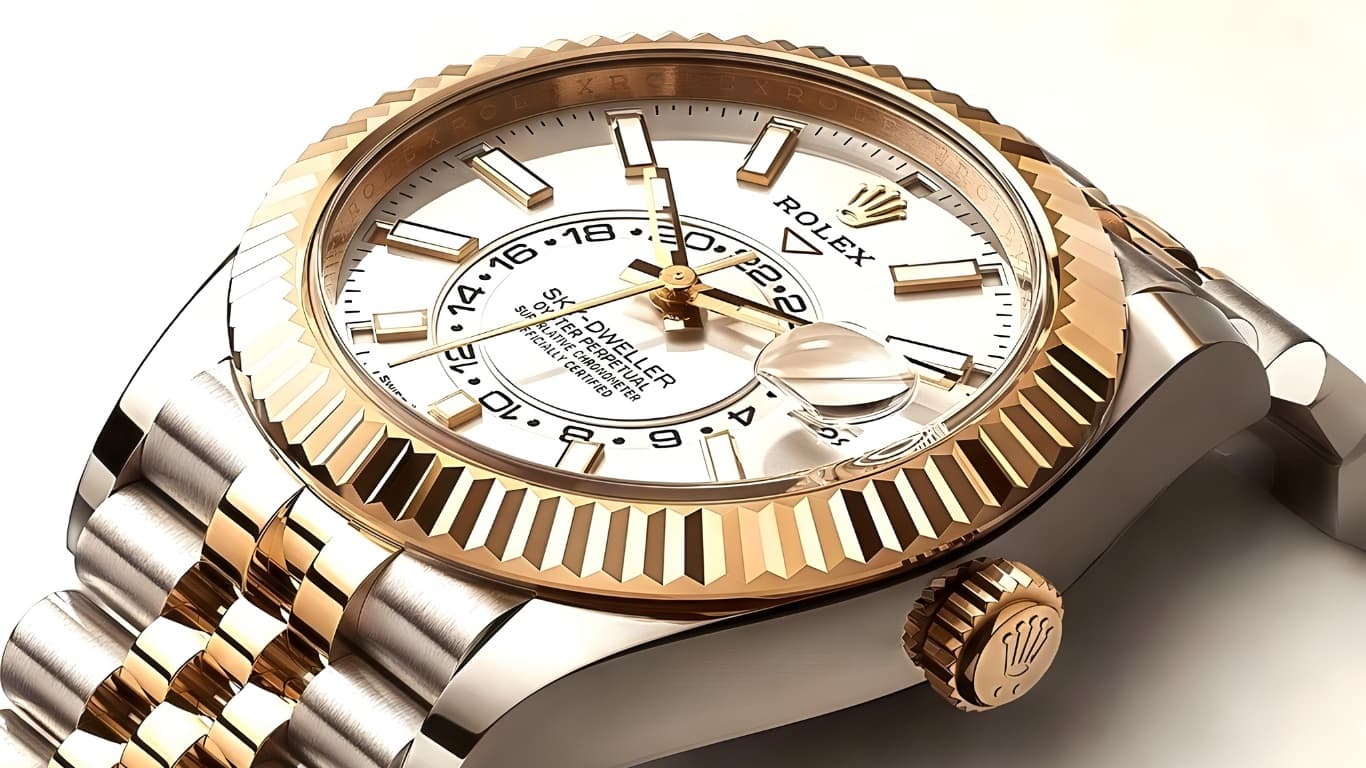
The Rolex Sky-Dweller holds a distinctive position in the luxury watch world. It is Rolex’s most complicated timepiece, pairing dual time zone functionality with an annual calendar inside a refined 42mm case. If you are serious about watches, this is the one that separates casual collectors from those who truly understand mechanical depth.
Most of the market’s attention stays locked on Submariners and Daytonas. But the Sky-Dweller has quietly carved out its own corner among collectors who recognize that mechanical complexity paired with genuine travel utility is a compelling long-term proposition. If you know, you know.
Since its 2012 debut, and especially after the 2017 launch of stainless steel variants, the Sky-Dweller has made a real journey from overlooked complication watch to legitimate investment consideration. The reference 326934 in Oystersteel with a white gold bezel is currently the most liquid and sought-after configuration, with certain dial colors commanding sustained premiums above retail. That shift did not happen by accident.
Rolex keeps production conservative across the entire collection. For you as an investor, that scarcity dynamic means the Sky-Dweller offers genuine exposure to a high-complication Rolex reference without requiring you to venture into vintage collecting territory, where the risks and authentication headaches multiply fast.

Table of Contents
Rolex Sky-Dweller Investment Snapshot (2026)
| Reference | Material / Key Configuration | Typical 2025 Market Range (USD) | Approx. Premium vs Retail | Liquidity (H/M/L) | Investment Profile |
|---|---|---|---|---|---|
| 326934 (Blue Dial) | Oystersteel + white-gold bezel, blue dial, Oyster/Jubilee | ≈ $21,000 – $25,000 | +30% – +50% over retail for full sets | High | Core “blue-chip” Sky-Dweller; strongest demand and global resale depth. |
| 326934 (Other Dials) | Oystersteel + white-gold bezel, black/white/mint/bright black | ≈ $17,000 – $22,000 | ~0% – +30% depending on dial and condition | High | Balanced entry; good upside with lower downside than hype dials. |
| 326933 | Rolesor two-tone (steel + yellow gold), Oyster/Jubilee | ≈ $20,000 – $24,000 | –10% – +10% vs retail | Medium | High wrist presence; slower but steady appreciation if well bought. |
| 326938 | Full yellow gold, typically on Oyster bracelet | ≈ $50,000 – $58,000 | –5% – –15% vs retail | Medium–Low | Thin buyer pool; suits patient, high-net-worth long-hold investors. |
| 326935 | Everose gold on Oyster / Jubilee / Oysterflex | ≈ $45,000 – $56,000 | –5% – –15% vs retail (Oyster); tighter for Oysterflex/Jubilee | Medium | Lifestyle-driven play; strongest interest in Oysterflex + desirable dials. |

Why Is the Rolex Sky-Dweller Valuable?
The Sky-Dweller is valuable because it is Rolex’s most mechanically ambitious model. In a single 42mm watch, you get an annual calendar, a dual time zone display, and the patented Ring Command bezel, all powered by the in-house Caliber 9001. That level of complication is rare anywhere in the Rolex lineup. Stack that on top of what Rolex already does best, robust construction, strong global demand, conservative production, and deep resale channels, and what you have is both genuine horological prestige and the brand liquidity that supports long-term value. For comparison on how complication-led watches perform as investments, see how Jaeger-LeCoultre stacks up.
When Rolex introduced the Sky-Dweller in 2012, it was a rare move for the brand. Launching an entirely new collection with a brand-new complication is not something Rolex does casually. That deliberateness matters when you are evaluating long-term investment credibility.
At the time of launch, the Sky-Dweller was one of the most mechanically complex watches Rolex had ever produced. And while it did not generate the instant frenzy of a Daytona or Submariner, its long-term trajectory tells a very different story. Patience, it turns out, has been well rewarded here.
Rolex Sky-Dweller vs Other Rolex Models: Investment Scorecard
This scorecard shows you how the Sky-Dweller stacks up against core Rolex lines on complexity, hype risk, liquidity, and long-term appreciation potential. Use it to position the Sky-Dweller correctly inside a broader Rolex or watch portfolio. Not every model fits every strategy, and knowing where the Sky-Dweller sits gives you a clearer picture of what you are actually buying.
- Rolex’s most complex movement (Cal. 9001) with dual time and annual calendar.
- Steel/white-gold 326934 (blue/mint/black dials) often ~5–20% above retail after correction.
- Moderate hype, strong fundamentals: appreciation driven by complication and scarcity, not trends.
- Best fit for investors wanting complication-driven ROI in the $15k–$30k band.
- Iconic steel dive watch with deep liquidity and global brand recognition.
- Core steel references typically ~20–40% above retail, with strong long-term track record.
- Higher hype exposure, but also the safest “blue-chip” anchor in most Rolex portfolios.
- Best fit for first-time Rolex investors and conservative watch allocators.
- Chronograph icon with strong cultural cachet and historically high premiums.
- Can show powerful upside but also sharper boom-and-bust cycles than Sky-Dweller.
- Premiums remain rich; entry costs and volatility are both meaningfully higher.
- Best fit for experienced collectors comfortable with hype-cycle risk.
- Datejust: lower-drama, high-liquidity “core Rolex” with steady long-term appreciation.
- GMT-Master II: strong premiums on key colorways (Pepsi/Batman) but more hype sensitive.
- Both lines are less complex mechanically than Sky-Dweller but easier to buy/sell quickly.
- Best fit for investors balancing daily wear, liquidity, and more moderate risk.
The watch houses Caliber 9001, Rolex’s most complex in-house movement. It carries seven proprietary patents and delivers a 72-hour power reserve. The movement integrates a dual time zone display via an off-center 24-hour disc alongside the Saros annual calendar module, which automatically tracks 30 and 31-day months and only needs a single manual correction once a year. That engineering is genuinely impressive.
That level of complication sets the Sky-Dweller apart from Rolex’s predominantly three-hand sports lineup. A Submariner or GMT-Master II delivers proven, battle-tested functionality. But the Sky-Dweller gives you mechanical depth comparable to what independent watchmakers charge a serious premium for, all wrapped in Rolex’s reliability and global service infrastructure. For collectors who care about horological achievement alongside brand recognition, that combination is hard to match anywhere near this price point.
The Ring Command bezel is another innovation that supports long-term value. This rotating bezel mechanically interfaces directly with the movement, letting you independently adjust local time, date, or reference time using a single crown position. That kind of elegance in execution does not happen by accident.
Beyond the technical achievement, the Ring Command system simplifies interaction with multiple complications while delivering tactile feedback you rarely feel in luxury watches at this level. It reflects Rolex’s broader engineering philosophy, where user experience and technical ambition are treated as equally important goals.
Material variety across the collection gives you multiple entry points and holding strategies to consider. Oystersteel references with white gold bezels start around $16,600 at retail, while Rolesor two-tone variants push to roughly $21,850. Full precious metal versions in yellow gold, Everose gold, or white gold retail anywhere from $47,100 to $59,500 depending on bracelet configuration. That range is broader than most Rolex collections.
That pricing spread genuinely accommodates different investment approaches, from accessibility-focused steel buyers who want maximum liquidity to precious metal collectors targeting lower production volumes and long-term scarcity plays.

What Are the Main Rolex Sky-Dweller Models?
All Sky-Dweller models share the same 42mm case and Caliber 9001, but where they diverge is in metals and dial and bracelet configurations. The 326934 in Oystersteel with a white gold fluted bezel is the most liquid reference, particularly with blue or mint-green dials that command clear premiums. The two-tone 326933 in steel and yellow gold offers strong wrist presence at lower premiums. Full-gold references like the 326938 in yellow gold and the 326935 in Everose target lower-production, higher-ticket collectors with a longer investment horizon. Within each reference, specific dial colors and Jubilee or Oysterflex options act as micro-references that drive meaningfully different resale outcomes.
The Sky-Dweller lineup covers a wide range of configurations, and that breadth is part of what makes it strategically interesting for different investor profiles. From conservative steel buyers focused on liquidity to full-gold collectors chasing scarcity, the 42mm platform stays consistent while Rolex differentiates value through material combinations, dial color variations, and bracelet choices. Before committing capital to any watch reference, these are the questions every serious investor should be asking first.
Each reference in the Sky-Dweller lineup has built its own following over time. Specific dial and bracelet pairings command clear resale premiums, and understanding those nuances before you buy is the difference between a smart allocation and an expensive lesson.
- Rolex Sky-Dweller 326934: This is the most in-demand Sky-Dweller model and the only one crafted in Oystersteel. It features a fluted white gold bezel and is available with blue, white, black, mint green, or bright black dials. The blue dial variation is one of the strongest-performing modern Rolex watches.
It consistently trades 30–50% over retail. The mint green and bright black dials, released more recently, are following a similar upward trajectory. - Rolex Sky-Dweller 326933: This two-tone model is available with champagne, black, or white dials and comes on either an Oyster or Jubilee bracelet. While it doesn’t carry the same hype as the steel version, it offers high wrist presence at a lower premium.
Resale premiums are lower than the 326934, but select dial/bracelet pairings—especially the Jubilee/champagne combo—have begun appreciating faster in late 2024 and 2025. - Rolex Sky-Dweller 326938: This full gold version is positioned as a formal, statement-making reference with a clear emphasis on luxury. Available with various dial colors and typically mounted on an Oyster bracelet.
Not as liquid as steel or Rolesor models, but strong upside exists for unworn or full-set examples, especially for discontinued dial variations. Ideal for long-hold investors with appetite for precious metal exposure. - Rolex Sky-Dweller 326935: The Everose variant combines warmth and subtlety with unmistakable presence. It’s typically paired with chocolate, white, or slate dials, and available on Oyster, Jubilee, or Oysterflex rubber strap. The Oysterflex configuration is especially appealing to Middle Eastern and Asian collectors.
Resale premiums on this setup are rising quickly due to lower production numbers and strong demand from lifestyle-focused buyers.
| Reference | Material | Retail Price | Market Range | Key Features |
|---|---|---|---|---|
| 326934 | Steel/White Gold | $16,600 | $17,000–$23,000 | Most liquid, diverse dials |
| 326933 | Rolesor Two‑Tone | $21,850 | $20,000–$24,000 | Gold accents, broader appeal |
| 326938 | Yellow Gold | $55,000–$59,500 | $50,000–$58,000 | Precious metal, formal presence |
| 326935 | Everose Gold | $47,100–$59,500 | $45,000–$56,000 | Rose gold warmth, Oysterflex option |
What Are The Main Features of the Rolex Sky-Dweller?
The Sky-Dweller’s core features come together in a way that few watches at any price point can match. You get the Caliber 9001 automatic movement with roughly 72 hours of power reserve, an off-center 24-hour disc for a second time zone, and the Saros annual calendar that automatically tracks 30 and 31-day months with month indication shown through 12 subtle apertures around the dial. All of it is controlled via the Ring Command bezel, which mechanically selects the function you want to adjust through a single crown position. Add a 42mm Oyster case with 100 metres of water resistance, Chromalight lume, and your choice of Oyster, Jubilee, or Oysterflex bracelets, and you have a genuinely complicated traveller’s watch that is still robust enough for daily wear.
The Sky-Dweller’s defining technical feature is Caliber 9001, Rolex’s most advanced automatic movement. COSC-certified and carrying seven proprietary patents, this caliber delivers a 72-hour power reserve while integrating two independent complications. The architecture behind this movement reflects years of serious development, and it positions the Sky-Dweller as something altogether different from Rolex’s predominantly three-hand sports catalog. A detailed technical breakdown of Caliber 9001 helps illustrate just how much engineering sits inside this movement.
Core Technical Specifications
- Movement: Caliber 9001 automatic with 72‑hour reserve
- Complications: Dual time zone via 24‑hour disc, annual calendar via Saros module
- Case Size: 42mm diameter in Oyster case architecture
- Water Resistance: 100 meters via Twinlock crown system
- Bezel: Ring Command rotating bezel for function selection
- Accuracy: COSC chronometer certified maintaining standard precision
- Bracelet Options: Oyster, Jubilee, or Oysterflex depending on reference
The annual calendar complication automatically tracks month lengths, distinguishing 30 and 31-day months without you ever needing to intervene. Month indication is elegantly integrated through rectangular apertures at each hour marker, with the current month highlighted so you can read it at a glance.
That solution preserves the dial’s visual symmetry while communicating information clearly. It is a good example of Rolex’s design philosophy at its best, where legibility and technical sophistication are treated as complementary rather than competing goals.
Chromalight luminescent markers provide a long-lasting blue glow that keeps the dial readable at night. Applied hour indices and radial or sunburst dial textures work alongside the fixed 24-hour disc to improve time zone readability across different lighting conditions. This attention to visual hierarchy ensures the watch stays genuinely practical despite its complications, which matters if you plan to wear it daily rather than keep it in a box.
The Easylink 5mm extension system on Oyster and Jubilee bracelets lets you adjust the fit throughout the day without tools. For frequent travellers dealing with changing climates, long flights, or shifts in activity level, that kind of micro-adjustment capability keeps the watch comfortable without compromising its professional appearance.
The Oysterflex rubber strap on certain precious metal references takes a different approach. It blends the structural robustness of a metal bracelet with the flexibility of elastomer, making it particularly appealing to active lifestyles without sacrificing the luxury positioning that precious metal references demand.

How Much Does a Rolex Sky-Dweller Cost in 2026? (Retail vs Secondary Market)
In 2026, retail pricing for the Sky-Dweller spans a wide range depending on material. Steel and white gold 326934 references start in the mid-$16,000 range, two-tone 326933 models sit around the low-$20,000 range, and full-gold versions typically list from the high-$40,000s up to the upper-$50,000 band depending on metal and bracelet choice. On the secondary market, desirable steel 326934 dials, especially blue and mint, tend to trade anywhere from a few percent to low double digits above retail. Two-tone pieces hover around retail plus or minus 5%, while most full-gold versions still sell at a 10 to 20% discount to MSRP, with premiums reserved for rare dial and bracelet combinations or unworn full sets.
Sky-Dweller pricing operates across a broader range than most Rolex sports models, which is a direct reflection of the material diversity on offer from Oystersteel all the way to solid precious metals. Retail prices run from $16,600 for steel variants up to $59,500 for full gold references with matching bracelets. That spread is part of what makes the collection strategically interesting across different buyer profiles.
These prices reflect periodic Rolex adjustments averaging 3–7% annually as the brand accounts for inflation and market positioning.
On the secondary market right now, steel references are trading near to slightly above retail depending on dial color and condition. The blue dial 326934 shows the strongest performance, with full-set unworn examples commanding premiums of 5 to 15% above retail. Other dial colors trade closer to retail, and pre-owned pieces showing wear occasionally dip below. WatchCharts provides real-time secondary market tracking for Sky-Dweller references if you want to monitor specific dial movements before committing.
Two-tone references generally trade within 5% of retail in either direction, with Jubilee bracelet configurations showing slight strength over Oyster variants. Precious metal models typically discount 10 to 20% below retail in secondary markets, following the familiar pattern across Rolex’s gold sports models where collector preference strongly favors steel despite the higher material costs embedded in precious metal variants.
Regional dynamics also play a role in your pricing strategy. US markets show the strongest secondary prices for steel configurations, with authorized dealer allocations staying limited enough to sustain real demand pressure. European buyers face VAT implications in total costs, but international buyers can access VAT rebates that make certain European sources genuinely attractive for acquisition if you structure the purchase correctly.
Asian markets, especially Hong Kong and Singapore, show strong demand for Everose models on Oysterflex. Luxury buyers in those markets tend to favor gold tones paired with modern strap technology, which creates a distinct pricing dynamic worth factoring in if you are thinking about where to sell.
Current and Recent Production Models
Current & Recent Production Models
Discontinued and Collectible Rolex Sky-Dweller Models
Discontinued & Collectible Rolex Sky-Dweller Models
Key Factors Driving Rolex Sky-Dweller Pricing
- Dial Scarcity and Preference: Blue and mint green dials consistently command the highest premiums due to limited availability and global demand concentration.
- Movement Complexity: The Caliber 9001 remains Rolex’s most sophisticated in-house caliber, which adds technical value not found in Submariner or GMT models.
- Bracelet Configurations: Jubilee variants outperform Oyster models in resale value due to aesthetic preference and lower production runs.
- Precious Metal Demand: Full gold and Everose references maintain long-term desirability in wealth-heavy markets, especially on rubber or Jubilee combinations.
- Controlled Allocation: Rolex has restricted boutique distribution of Sky-Dwellers, especially new dial launches, pushing up resale pricing in less saturated markets.
In 2026, the Sky-Dweller is delivering some of the strongest fundamentals-driven returns in the Rolex lineup, combining technical prestige with restrained supply and growing global collector recognition. If you are targeting references with rare dial and bracelet pairings, you are well-positioned to benefit from future price growth as those specific configurations become harder to source in unworn condition.
How Does the Rolex Sky-Dweller Perform as an Investment?
As an investment, the Sky-Dweller has behaved like a high-quality, complication-focused Rolex should. Early steel references saw strong premiums during the 2017 to 2022 boom, corrected alongside the broader watch market, and have since stabilized with modest, fundamentals-driven growth. Well-chosen 326934 configurations can realistically target mid single-digit annual appreciation over a multi-year horizon, with asymmetric upside for first-generation or discontinued dials. Most two-tone and full-gold versions carry short-term depreciation risk but long-term scarcity and metal-value support. This is not a flip watch anymore. Think of it as a credible long-hold, complication-based allocation inside a Rolex-heavy portfolio. Understanding how to time your entry versus averaging in over time is worth thinking through before you buy any watch as an investment.
Understanding Sky-Dweller performance requires some historical context, because this is a relatively young reference with a meaningful evolution since launch. The original 2012 gold-only references saw modest initial reception. Real market traction only emerged after Rolex introduced steel models in 2017, and that timing matters when you are analyzing long-term trajectories.
The 326934 in particular showed strong appreciation from 2017 through 2022, with blue dial examples reaching premiums exceeding 50% above retail during the peak of luxury watch speculation. That kind of run does not repeat itself often.
The market correction that ran through 2024 and into 2025 eliminated most of those speculative premiums. Bloomberg’s coverage of the luxury watch market correction frames the broader dynamic well. WatchCharts data shows the 326934 declined 12.3% over five years but gained 2.1% in the most recent year, which points to stabilization after the correction. That pattern mirrors broader luxury watch market behavior where pandemic-era speculation drove pricing to unsustainable levels before the market normalized.
Performance Considerations by Timeframe
- Short‑term holders (1–3 years): Current market shows modest appreciation potential of 3–7% annually for steel references with desirable dial colors
- Medium‑term holders (3–7 years): Historical data suggests 5–10% annual appreciation for well‑chosen configurations as the model matures
- Long‑term collectors (7+ years): Early steel references from 2017–2019 may achieve collectible premiums as first‑generation examples with discontinued dial variants
The Sky-Dweller benefits from being Rolex’s only annual calendar complication, a position that creates unique collector appeal unlikely to be replicated across other references in the lineup. That exclusivity is a genuine long-term value driver for collectors who treat mechanical complexity as a core investment thesis.
That said, the model does not carry the cultural cachet or universal name recognition of a Submariner or Daytona. That gap may limit the maximum appreciation ceiling compared to those icons, and you should factor that into your return expectations before committing.
Two-tone and precious metal references play by different investment rules. These configurations typically depreciate 10 to 20% upon entering the secondary market, following a familiar pattern for gold sports watches across most major luxury brands. Hodinkee’s analysis of Sky-Dweller market dynamics offers useful context on how precious metal references have historically behaved for long-term holders.
But long-term holders in precious metal references do benefit from real intrinsic metal value and lower production volumes. If specific dial variants are discontinued, those lower volumes can create meaningful future scarcity premiums that reward patience over the flip mentality.

Who Should Invest In A Rolex Sky-Dweller In 2026?
The Sky-Dweller is best suited to investors who already understand Rolex sports models and now want to add a complication-led pillar to their portfolio. Frequent travellers who will actually use the dual time zone and annual calendar get the added benefit of wearing a meaningful investment daily. Collectors who care about movement milestones like Caliber 9001 will find it intellectually rewarding as well as financially credible. And long-term investors who are comfortable tying up $15,000 to $50,000 or more in a piece they plan to hold for years will find the fundamentals genuinely supportive. What it is not is a watch for quick flips or first-time speculative buyers on a tight budget. The Sky-Dweller makes far more sense as a deliberate, multi-year allocation than as anyone’s first speculative watch trade.
In 2026, the Sky-Dweller offers you a real opportunity to own a Rolex with built-in complexity, proven market traction, and strong long-hold potential. That combination does not come around often at this price point inside the Rolex ecosystem.
The Sky-Dweller is not trying to compete with the Daytona or Submariner on hype. It does not need to. Its strong price trajectory, sophisticated mechanical architecture, and cross-market demand position it as one of Rolex’s most strategically sound investment watches in the $15,000 to $30,000 segment. If you are thinking about diversifying within a watch portfolio, this deserves serious consideration.
- First-Time Luxury Watch Investors: For new investors entering the Rolex market, the Sky-Dweller provides both utility and upside. Models like the 326934 (blue or mint dial) offer daily wearability, technical credibility, and strong appreciation history. With stainless steel configurations trading well above retail, these references serve as ideal “entry asset” pieces that combine practical function with portfolio-building potential.
- Long-Term Investors Seeking Complication-Based ROI: Buyers looking for multi-year compounding potential will find the Sky-Dweller compelling. Annual calendar and dual time zone features paired with Rolex‘s most complex movement (Caliber 9001) create long-term value that goes beyond design trends. The 326935 and 326938 gold models, especially with rarer dials or Oysterflex straps, are positioned to perform strongly as Rolex continues to restrict full-precious-metal production.
- Collectors Targeting Movement Milestones: The Sky-Dweller is the only Rolex housing the Caliber 9001, making it a mechanical outlier in a brand known for slow evolution. For collectors focused on technical milestones and first-generation references, the Sky-Dweller—especially early models from 2012–2017 and newer Jubilee releases—offers asymmetric upside as these references gain status within the Rolex complication hierarchy.
- Investors Targeting Boutique-Only Scarcity Plays: Mint green, champagne, and Jubilee bracelet Sky-Dwellers have become boutique exclusives, with waitlists at authorized dealers and immediate premiums on resale platforms. These references behave similarly to early ceramic Daytona or Wimbledon Datejust launches—limited access creates an artificially tight market that tends to favor short- to mid-term resale investors.
- Portfolio Diversifiers Rebalancing from Submariner & Daytona: Investors with existing exposure to more saturated Rolex lines like the Submariner or Daytona are beginning to rotate into Sky-Dweller references for technical diversification and collector upside. The Sky-Dweller provides both low production overlap and high functional utility, making it an ideal hedge against over-concentration in sports models.
A genuine blend of real-world complications, restrained production, strong resale demand, and upward pricing behavior makes the Rolex Sky-Dweller a legitimate investment asset in 2026. Not just a tool watch for well-traveled professionals, but a watch that rewards serious collectors who think in years rather than months.
FAQ
Is the Rolex Sky-Dweller a good investment in 2026?
Yes. The Sky-Dweller has shown consistent appreciation, especially in steel references like the 326934 with blue or mint dials. Resale premiums reach 30–50% above retail.
Which Rolex Sky-Dweller model holds value best?
The 326934 in Oystersteel with a blue dial holds value best. It’s one of the most in-demand modern Rolex watches and trades well over MSRP.
How much is a Rolex Sky-Dweller in 2026?
Retail prices range from around $16,150 for steel models to over $44,000 for gold versions. Secondary market prices can reach $55,000+ for popular configurations.
Why is the Sky-Dweller so expensive?
It’s Rolex’s most complex model, featuring an annual calendar, dual time zone, and the advanced Caliber 9001 movement. Its pricing reflects both innovation and exclusivity.
Is the Rolex Sky-Dweller hard to get?
Yes. Most high-demand configurations, especially those with Jubilee bracelets or rare dial colors, are heavily allocated and waitlisted at authorized dealers.
Do Sky-Dweller watches appreciate in value?
Yes. Most modern Sky-Dweller models appreciate 7–15% annually, with higher returns for discontinued or rare dial variants.
What makes the Sky-Dweller unique?
It combines Rolex’s only annual calendar with a second time zone and interactive Ring Command bezel—making it functionally unique in the entire Rolex catalog.
Is the Sky-Dweller suitable for everyday wear?
Yes. Despite its complexity, the Sky-Dweller is durable, water-resistant to 100m, and designed for daily use.