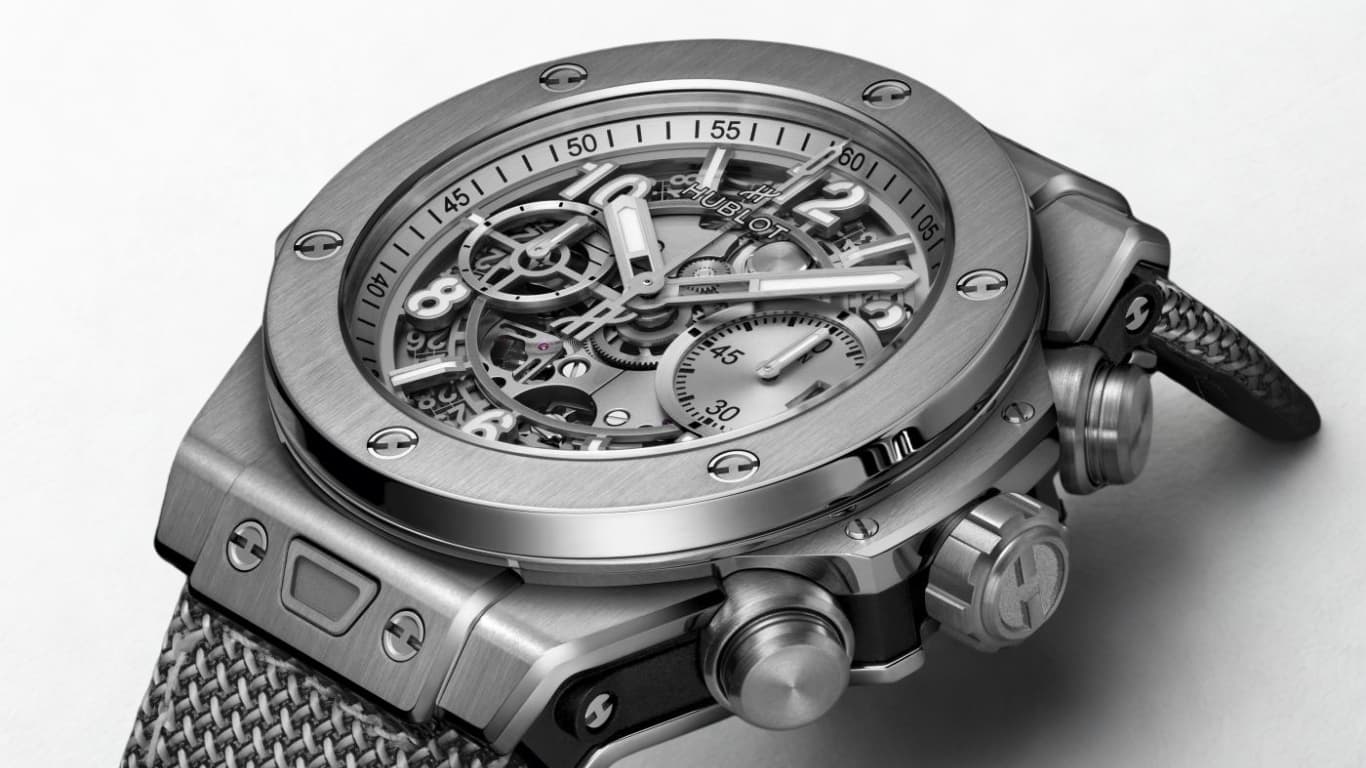
The Hublot Big Bang in 2026 is one of the most divisive references in modern collecting, and an honest read on the line is overdue. The watch has never been built to blend in. Launched in 2005 under Jean-Claude Biver's creative direction, the original chronograph fused gold, ceramic, carbon fibre, and rubber in ways the Swiss watch establishment had quite genuinely never embraced before.
- The Hublot Big Bang in 2026 delivers genuine material innovation and bold design provocation, with carbon, ceramic, and sapphire case work that no other luxury house matches.
- Reference 421.NX.1170.RX and the Unico calibre versions anchor the current catalogue, with in-house movement architecture supporting the brand positioning.
- Limited Big Bang collaborations with motorsport, art, and luxury partners continue to drive collector competition, with secondary premiums on the most-coveted releases.
- We see the Big Bang as a design-anchored purchase rather than a value-retention play, with everyday wearer satisfaction defining the proposition rather than long-term auction trajectory.
- Secondary-market depth on Hublot remains limited relative to Holy Trinity peers, which means buyers should anchor decisions on wearing intent.
- Service infrastructure and parts availability favour Hublot meaningfully, with LVMH Group support sustaining decades of ownership across reference families.
- Who is this for?
- Design-anchored buyers, material innovation enthusiasts, and collectors drawn to bold visual statements rather than understatement.
- What is happening?
- A grounded collector's read on the Hublot Big Bang in 2026, covering material innovation, Unico calibre architecture, limited collaborations, and the realistic value proposition.
- When did this emerge?
- The current read reflects 2026 Hublot programmes, with Unico calibre rollouts and limited collaborations continuing to define the Big Bang catalogue.
- Where is this happening?
- Hublot boutiques globally stock the current catalogue, with limited collaborations concentrated through brand-direct channels and event-driven sales.
- Why does it matter?
- The Big Bang offers material innovation and design provocation that no other luxury house matches, which clarifies its position for collectors who prioritise visual statement.
Two decades on, the same boldness that once made it polarising is what has earned it a place in the contemporary collector conversation. The brand has refined the line considerably across that period: the in-house Unico calibre arrived in 2010 and now sits at the heart of most Big Bang chronographs, limited collaborations with Ferrari, Berluti, and Sang Bleu have built a small-batch collector layer underneath the core production, and LVMH ownership has brought a more measured release strategy. The result is a reference that holds up under serious scrutiny, not because it apes Patek or AP, but because it operates by its own grammar.
How the Hublot Big Bang got here
The Big Bang debuted at Baselworld 2005 with what Hublot called the Art of Fusion: a deliberate mixing of unexpected materials at a moment when most luxury watches leaned heavily on heritage cues. The original chronograph offered a large, technical case with exposed screws, modular construction, and a futuristic profile, aimed not at traditionalists but at a younger, more style-forward buyer.
It won the 2005 Design Prize at the Grand Prix d'Horlogerie de Genève. Within three years it had pushed Hublot's revenues past $200 million. The commercial reception clarified, very quickly, that the design brief had found a buyer the broader Swiss industry had been underserving for decades.
The line evolved from there. Limited Ferrari, Berluti, and Sang Bleu editions in the 2010s established the Big Bang as a collaboration-driven nameplate. High-tech materials (Magic Gold, coloured ceramic, sapphire) kept the design language fresh.
Vertical integration around the in-house Unico calibre brought the kind of mechanical credibility the brand needed to graduate from disruptor to established player. By 2026, the Big Bang has earned its position as one of the most recognisable modern chronographs in production.
The Unico calibre and what changed in 2010
The defining mechanical feature across the chronograph line is the Unico itself: a fully in-house calibre with flyback chronograph capability, 72 to 80 hours of power reserve, and a double-clutch column-wheel mechanism visible through the skeleton dial.
Pair that with the brand's modular case construction, which lets Hublot swap bezels, materials, and dials without rebuilding from scratch, and you get a high turnover of visually distinct configurations across what is, at its core, a single architecture.
The Unico matters because it gives Hublot the kind of manufacture credentials the brand spent the 2000s building toward. Before 2010, the Big Bang ran on modular ETA-derived movements; the in-house calibre brought Hublot into the same conversation as the established manufacture chronograph makers, and the line's collector standing rose accordingly.
The Big Bang materials register
The Big Bang family is wide. Quartz-powered base references sit at one end; sapphire-cased tourbillons sit at the other. The strongest collector demand consistently lands on the Unico-powered chronographs and the collaboration-driven limited editions, where in-house movements and constrained supply combine.
The non-Unico base models read as personal-wear pieces rather than secondary-market plays.
Magic Gold (a scratch-resistant gold alloy), coloured ceramic, sapphire, carbon fibre, and titanium together give the line a depth of finish options most contemporary chronographs can't match. The sapphire and Magic Gold cases are the ones that have done the heaviest lifting on the secondary market. They're rarely produced at scale, and they read as instantly identifiable on the wrist.
What the secondary market says in 2026
The numbers worth knowing, drawn from auction records and dealer trades through 2026, paint a particular picture:
- A Big Bang Sang Bleu II King Gold sold at Christie's Geneva in 2024 for $38,000, a 13 per cent step up from the $33,600 retail in under two years.
- A 2013 Big Bang Ferrari Magic Gold limited edition fetched $36,500 on WatchBox in late 2023, roughly 20 per cent over the original MSRP, as discontinued Ferrari editions become collector targets.
- Limited-production tourbillons like the Big Bang Orange Sapphire trade between $100,000 and $110,000, holding close to or exceeding original pricing, which is a rarity in six-figure watches from younger brands.
- The 2016 Big Bang Unico Berluti Scritto, originally $24,000, regularly commands $27,000 to $30,000 in full-set condition, driven by the cross-brand appeal of the discontinued partnership.
Across secondary dealers, modern Big Bang chronographs with the Unico calibre have averaged 2 to 6 per cent annual gains on the secondary market through 2024 to 2026, with the strongest movement on limited-production drops and the more distinctive case materials. WatchPro's resale tracking has flagged a similar pattern in its periodic surveys.
What is driving the pricing
Five things are doing most of the work. The Unico calibre lets Hublot compete in the high-end chronograph space on mechanical merit rather than just brand. Material experimentation (Magic Gold, coloured sapphire, vibrant ceramics) keeps the line distinctive in a saturated category.
The frequent collaborations with Ferrari, Sang Bleu, Berluti, and various tattoo artists generate small-batch editions that rarely reappear in identical configurations. LVMH ownership has brought tighter production discipline, with the brand pulling back from the volume-led 2010s and consolidating around the configurations that hold collector interest.
And the visual identity (the oversized bezel screws, the layered construction, the multi-material contrast) is unmistakable on the wrist, which matters in a market increasingly driven by visibility.
Where the Big Bang sits in the regional collector conversation
Across regions, the demand patterns vary in interesting ways. In the US and UK, Unico chronographs with skeletonised dials and full box-and-papers are commanding strong resale, with younger collectors increasingly drawn to the Sang Bleu and Ferrari editions. In the Middle East and Southeast Asia, sapphire-cased tourbillons and coloured ceramic references have been gaining ground among ultra-high-net-worth buyers looking for visibility beyond the obvious Rolex and Audemars Piguet alternatives at similar price points.
In France and Italy, the early All Black and Magic Gold references are now treated as neo-vintage and historically important to the Hublot story, a category that didn't really exist for the brand five years ago. The European specialist dealers have started treating the 2007 to 2014 production window as a discrete collecting tier, which is itself a meaningful signal about where the broader market reads the Big Bang's structural place.
What collectors look for in a Big Bang
For modern Big Bang, the references that come up most consistently in serious collector conversation are the Unico-powered standard chronographs in the various case materials, the Sang Bleu limited editions, the Ferrari and Berluti collaborations from the 2010s production window, and the precious-metal tourbillon configurations at the upper tier.
Box-and-papers documentation matters, particularly on the limited and collaboration references where the original packaging often includes branded materials specific to the partnership.
Service-network access through Hublot's authorised facilities is the practical baseline. The brand's service infrastructure handles the modular case construction and the in-house Unico calibre cleanly, and the dealer relationships at the authorised retailer network anchor the considered secondary inventory.
What this means for collectors
The Big Bang reads, increasingly, as the most mechanically credible watch in its price band whose visual language doesn't ask for approval from the heritage establishment. That distinction is what has been pulling collectors toward it: the boldness of the design married to the seriousness of the mechanics, in a configuration that doesn't really exist anywhere else.
We'd argue the Big Bang is the contemporary reference where reading the watch on its own terms matters most. Held against the traditional chronograph category, it disappoints; held against the design and material brief it actually set itself, it executes cleanly. The collectors who navigate to the line tend to read it correctly, and the broader market is gradually catching up.
We last reviewed this analysis in May 2026.

Frequently Asked Questions
- Which Hublot Big Bang models hold their value best?
- Sang Bleu editions, Ferrari collaborations, and Big Bang Tourbillon Sapphire models typically hold or exceed their original retail value on the resale market.<br><br>
- How much does a Hublot Big Bang cost in 2025?
- Retail prices in 2025 range from $15,000 for entry models to over $100,000 for sapphire-cased tourbillons and MP complications.<br><br>
- Does the Hublot Big Bang have an in-house movement?
- Yes. Most chronograph models use the Unico calibre, which is fully developed and manufactured by Hublot with a 72–80 hour power reserve.<br><br>
- Do Hublot Big Bang watches appreciate in value?
- Some do. Limited editions and models with unique materials or complications (like the Sang Bleu or Orange Sapphire) have appreciated 10–25% over MSRP within 1–3 years.<br><br>
- Is the Hublot Big Bang a luxury watch?
- Absolutely. It’s a Swiss-made luxury chronograph with premium materials, in-house movements, and a strong brand under LVMH.<br>

Stefanos Moschopoulos
Stefanos Moschopoulos founded The Luxury Playbook in Athens and has spent the better part of a decade following the auction calendar, the en primeur releases, and the watchmakers, gallerists, and shipyards the magazine covers. He writes the field guides and listicles that anchor the Connoisseur section — pieces built on Phillips and Christie's results, Liv-ex movements, and conversations with collectors he has met across Geneva, Bordeaux, Basel, and Monaco. His own collecting habits sit closer to watches and wine than art, and it shows in the level of detail in the magazine's coverage of those categories. Under his direction, The Luxury Playbook now publishes long-form field guides, market-defining year-end listicles, and the Voices interview series with the founders behind the houses and the brands.