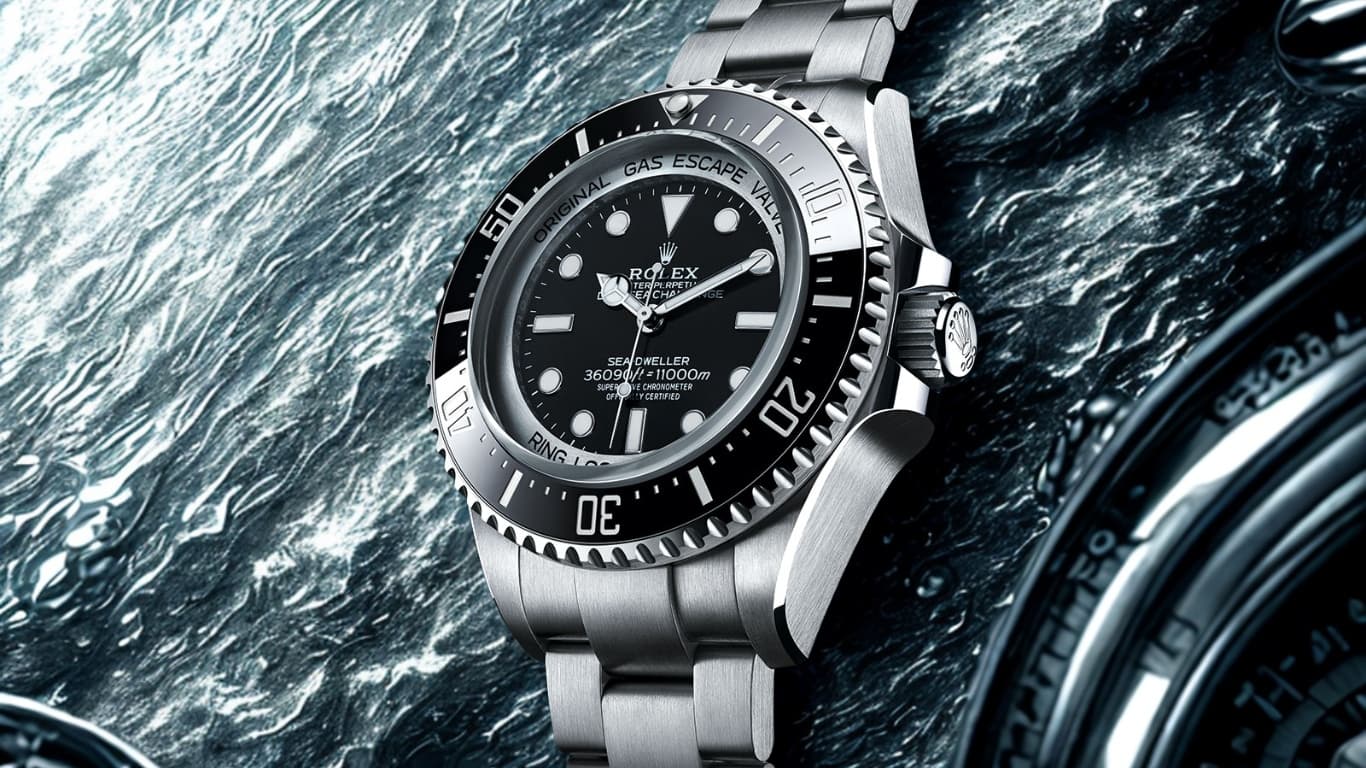
The Rolex Deepsea has become a cult reference among serious collectors. The Sea-Dweller's deeper-rated technical sibling carries a 3,900m water-resistance rating, the Ringlock System case construction with the titanium back, and a high-pressure-rated sapphire crystal that no other contemporary Rolex matches.
- The Rolex Deepsea earns its collector obsession through extreme depth engineering, with the Ring Lock system supporting genuine professional dive credentials.
- Reference 136668LB in 18-karat yellow gold and Reference 136660 in steel anchor the modern catalogue, with the in-house Calibre 3235 supporting daily wearability.
- The James Cameron edition, with its blue-to-black gradient dial, transformed the Deepsea from professional tool to genuine collector trophy through the last decade.
- We see the Deepsea Challenge in titanium as the most ambitious dive reference Rolex has ever shipped, with a 11,000-metre depth rating that no peer can match.
- Secondary market pricing on the Deepsea has stabilised after the post-2022 reset, with collector demand validating the Ring Lock engineering and design ambition.
- Service infrastructure and dive certification remain among the strongest in luxury watchmaking, supporting decades of credible deep-water use for collectors who actually dive.
- Who is this for?
- Dive-watch enthusiasts, Rolex collectors building tool-watch depth, and engineering-minded buyers drawn to extreme-depth references.
- What is happening?
- A grounded read on collector obsession with the Rolex Deepsea, covering Ring Lock engineering, the James Cameron edition, and the Deepsea Challenge.
- When did this emerge?
- The current obsession reflects the 2022 Deepsea Challenge release and the persistent collector demand for the James Cameron and modern 136660 references.
- Where is this happening?
- Authorised Rolex dealers globally maintain waitlists, while Chrono24, Subdial 50, and specialist auctions handle the broader Deepsea pre-owned market.
- Why does it matter?
- The Deepsea offers genuine extreme-depth engineering and the kind of design ambition that justifies the obsession at every level of dive-watch collecting.
The watch is the brand's clearest statement that contemporary Rolex still does over-engineering when the brief calls for it. In our coverage of recent auction-house catalogues, the Deepsea appears with increasing regularity in the dive-watch sections, and the collector base for the reference has consolidated noticeably since the James Cameron association entered the broader public conversation.
The Deepsea catalogue in 2026
The current Deepsea reference 126660, the standard black-dial steel piece, retails around $14,500 with secondary $13,500 to $16,000. The "James Cameron" Deepsea reference 126660 with the deep blue dial commemorates Cameron's 2012 Mariana Trench dive in the DEEPSEA CHALLENGER submarine, and it is the reference most contemporary Deepsea collectors gravitate toward.
The Deepsea Challenge reference 126067, the experimental titanium piece rated to 11,000 metres at around $26,000 retail, sits at the technical upper end. The reference is one of the more genuinely engineered watches in contemporary Rolex production and reads as a working dive instrument rather than styling exercise.
The earlier Sea-Dweller Deepsea reference 116660, produced 2008-2018 with the original Cameron blue and standard black dial configurations, anchors the recently-discontinued Deepsea collecting tier. Clean examples trade $12,000 to $16,000 depending on dial variant, condition and box-and-papers documentation.
The Sea-Dweller distinction and the Submariner relationship
The standard Sea-Dweller reference 126600, the 1,220m-rated reference at around $13,500 retail, sits below the Deepsea in the catalogue but above the Submariner. The 43mm case, the absence of the Cyclops magnifier on the early references (current production restored it), and the helium escape valve all carry the Sea-Dweller's particular technical identity.
The various recent reference iterations have consolidated the Sea-Dweller's place between the Submariner and the Deepsea. Hodinkee's coverage of the most recent generation framed the Sea-Dweller as the considered alternative for buyers who want Submariner-adjacent dimensions with substantially more depth-rating engineering.
Why the Deepsea generates the cult following
Three reasons drive the collector enthusiasm. First, the technical case. The Ringlock System case construction, the 3,900m depth rating, and the visible engineering ambition that the rest of the contemporary Rolex sport catalogue doesn't really attempt all give the Deepsea a distinctive identity.
Second, the Cameron association. The connection to the Mariana Trench dive and the Deepsea Challenger submarine that completed it provides cultural anchor no other contemporary Rolex reference matches. The actual watch that accompanied Cameron's dive (a one-off experimental piece) sits at the National Geographic offices in Washington; the production D-Blue dial is the consumer reference that connects to that lineage.
Third, the size and presence. The 44mm case sits substantially larger than any other current Rolex sport reference. Collectors who want a Rolex with genuine wrist presence have one option that fits cleanly into the contemporary catalogue, and the Deepsea fills the gap the rest of the sport range deliberately avoids.
What collectors look for in a Deepsea pick
For modern Deepsea, the references that come up most consistently in serious collector conversation are the current 126660 in the standard black dial (the cleanest contemporary execution), the 126660 D-Blue "Cameron" with the deep blue dial (the reference with the strongest cultural anchor), and the Deepsea Challenge for collectors operating at the upper tier with serious case-size tolerance.
Box-and-papers documentation matters; the standard Rolex authorisation discipline applies. The Cameron D-Blue dial in unblemished condition commands meaningful premiums on the secondary market, and the early 116660 D-Blue from the original 2014 release is the discontinued reference collectors track most consistently at the major auction houses.
The Deepsea against the broader Rolex sport catalogue
The Deepsea against the rest of the Rolex sport range is genuinely distinct. The Submariner is the structural diving anchor in dimensions most owners will actually wear; the GMT-Master II is the travel watch; the Daytona is the cultural noise reference; the Yacht-Master sits between sport-luxury and dive register. The Deepsea is the over-engineered statement, and that niche is the entire reason for its existence.
Phillips and Christie's have both treated the Cameron D-Blue references with measured catalogue attention over the past three years. The hammer prices for the discontinued 116660 D-Blue examples in clean condition have firmed noticeably since 2023, and the collector base has broadened beyond the original deep-end enthusiasts.
What this means for collectors
The longer story collectors recognise is that the Deepsea occupies a particular niche in contemporary Rolex collecting. It's not a Submariner; it's not a GMT-Master II.
It is the brand's serious over-engineered diving reference, with a particular following among collectors who weight technical execution and visible engineering ambition more heavily than the broader Rolex sport-watch register naturally rewards. That niche has held its place across a decade and a half of continuous production, and the cult following has built rather than diminished.
We'd argue the case for the Deepsea as the Rolex collector's third or fourth piece is stronger now than at any prior point in the reference's history.
For collectors weighing a Deepsea pick in 2026, the practical sequencing is straightforward: the current 126660 in standard black for the cleanest contemporary execution, the Cameron D-Blue for the strongest cultural anchor, and the Deepsea Challenge for the upper-tier engineering statement. The discontinued 116660 references provide the vintage-tier alternative for collectors who want the earlier case proportions.
Box-and-papers documentation and the original Rolex service records anchor the resale dynamics, and the Ringlock System engineering carries the technical credentials through any future ownership transfer.
We last reviewed this analysis in May 2026.

Frequently Asked Questions
- Is the Rolex Deepsea hard to get in 2025?
- Yes. The Rolex Deepsea, especially the D-Blue and the newer Titanium Deepsea Challenge, remains difficult to find at authorized dealers. Waitlists can stretch from 6 months to over a year depending on location. This scarcity helps support its strong resale values.<br><br>
- Is a Rolex Deepsea too big for daily wear?
- It depends on your wrist. The Deepsea is 44mm wide and 17.7mm thick, making it one of Rolex’s largest models. For many collectors, it’s more of a statement or weekend watch. That said, it wears slightly smaller than its specs suggest due to clever lug design.<br><br>
- What’s the most collectible Rolex Deepsea model right now?
- The D-Blue “James Cameron” edition and the new Titanium Deepsea Challenge (Ref. 126067) are the hottest on the secondary market. The D-Blue trades 5–12% over retail, while early Titanium pieces are seeing 10–14% annual appreciation, driven by limited availability.<br><br>

Stefanos Moschopoulos
Stefanos Moschopoulos founded The Luxury Playbook in Athens and has spent the better part of a decade following the auction calendar, the en primeur releases, and the watchmakers, gallerists, and shipyards the magazine covers. He writes the field guides and listicles that anchor the Connoisseur section — pieces built on Phillips and Christie's results, Liv-ex movements, and conversations with collectors he has met across Geneva, Bordeaux, Basel, and Monaco. His own collecting habits sit closer to watches and wine than art, and it shows in the level of detail in the magazine's coverage of those categories. Under his direction, The Luxury Playbook now publishes long-form field guides, market-defining year-end listicles, and the Voices interview series with the founders behind the houses and the brands.