

Your investment options have never been broader. Real estate, gold, stocks, and bonds have built fortunes for generations, and they still deserve a place at the table. But fine wine is quietly earning a seat of its own, combining financial resilience with the kind of tangible, sensory appeal that a stock certificate simply cannot offer. If you’ve dismissed it as a hobby rather than a strategy, it’s worth a second look.
By walking through average ROI, historical performance, and the real trade-offs of each asset class, this guide gives you everything you need to understand where fine wine fits, whether as a complement to your existing holdings or as a genuine outperformer against more familiar choices.
Table of Contents
Why Invest in Fine Wine?
Fine wine brings something to the table that most assets cannot match. Its value is shaped by scarcity, a growing base of global buyers, and the natural aging process that makes a great bottle more desirable with every passing year. You’re looking at a finite, tangible asset whose supply only ever shrinks as bottles are opened and collections are consumed. That dynamic alone sets it apart from the vast majority of traditional investments.
Unique Benefits of Fine Wine Investment
- Low Correlation with Traditional Markets: Fine wine has a low correlation with equities and other traditional assets, making it a strong hedge against market volatility.
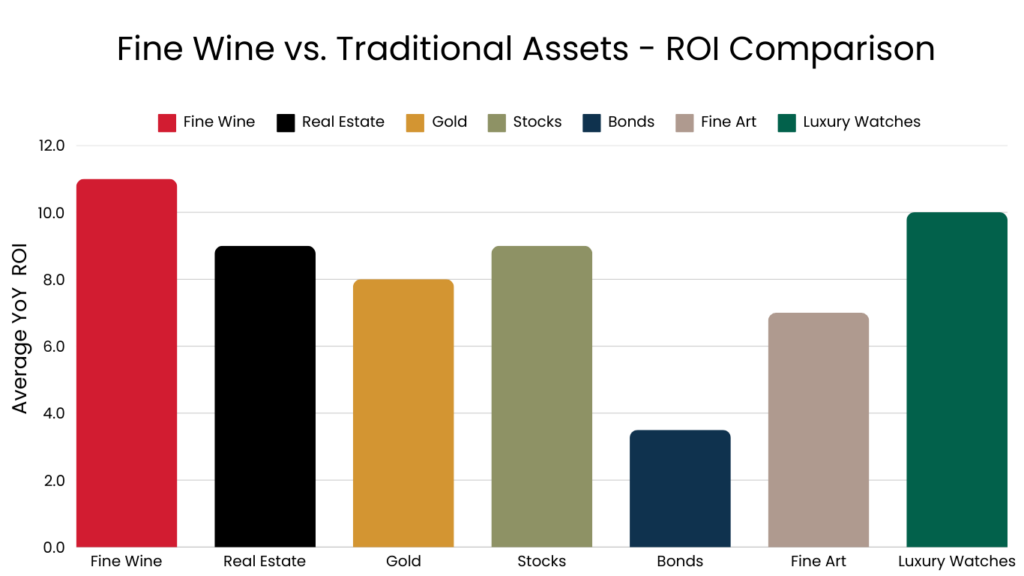
- Historical Stability: Over the past decade, the Liv-ex Fine Wine 100 Index has delivered average annual returns of 10%, consistently outperforming many traditional markets during economic downturns.
- Tax Advantages: In many regions, fine wine is classified as a “wasting asset,” often exempting it from capital gains taxes.
- Cultural and Emotional Appeal: Fine wine is both a financial asset and a luxury product, allowing investors to combine their passion for wine with wealth-building strategies.
Challenges to Consider
- Illiquidity: Unlike stocks or gold, fine wine is not immediately tradable, often requiring time to find the right buyer.
- Storage Costs: Proper storage in climate-controlled conditions adds to the overall investment cost.
- Knowledge Barrier: Fine wine investment requires a deep understanding of vintages, producers, and market trends.
Fine wine is not a perfect investment, and no honest advisor would tell you it is. But the combination of financial upside and genuine personal enjoyment makes it one of the more compelling portfolio diversifiers available to you right now.

Fine Wine vs Real Estate
Real estate has built more personal wealth than almost any other asset class in modern history. It offers something physical, something you can see and touch, along with the potential for rental income and long-term appreciation. But fine wine deserves a direct comparison, because once you look at the numbers and the trade-offs side by side, the picture gets more interesting than most people expect.
Average ROI Comparison
- Fine Wine: Over the past decade, the Liv-ex Fine Wine 100 Index has delivered an average annual return of approximately 10%, with top-performing regions like Burgundy and Champagne often exceeding 12–15% per year.
- Real Estate: According to global property data, real estate typically generates annual returns of 8–10%, with higher returns in booming markets such as the U.S. and Asia. However, these returns often fluctuate based on location, interest rates, and economic cycles.
Pros of Real Estate Investment
- Income Generation: Real estate can provide consistent rental income, which fine wine lacks.
- Leverage Opportunities: Investors can use mortgages to amplify returns, allowing for greater portfolio expansion with limited initial capital.
- Tangible Utility: Real estate serves functional purposes, such as housing or commercial use, adding intrinsic value.
Cons of Real Estate Investment
- Market Sensitivity: Real estate prices are heavily influenced by macroeconomic factors, such as interest rates, inflation, and government policies.
- High Entry Costs: Acquiring property requires significant upfront capital, making it less accessible to smaller investors.
- Management Burden: Real estate ownership involves ongoing maintenance, tenant management, and legal responsibilities.
Pros of Fine Wine Investment
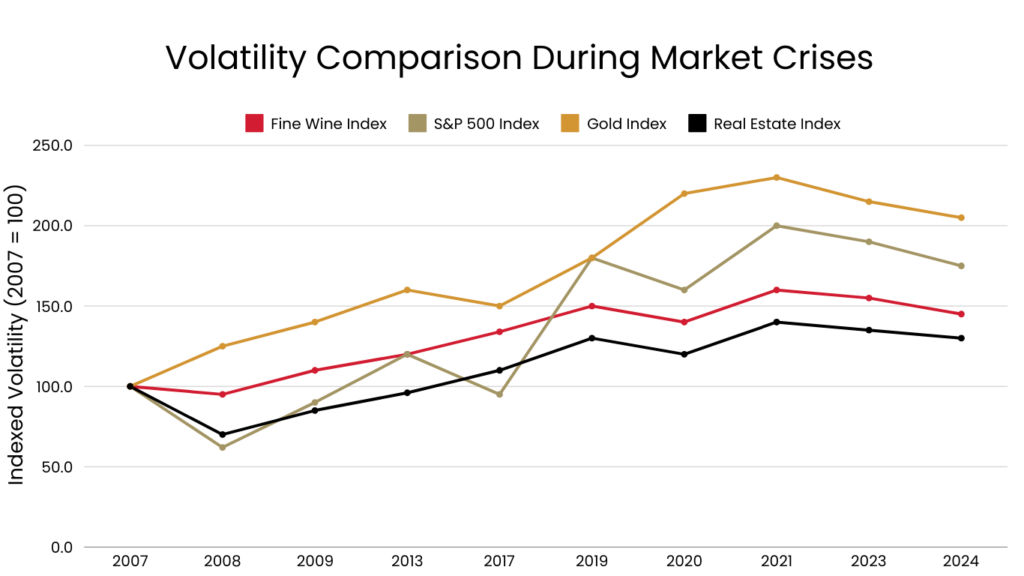
- Lower Volatility: Fine wine’s value is less affected by macroeconomic shocks, offering greater stability during financial crises.
- Accessibility: With fractional ownership platforms and wine funds, fine wine investment is now accessible to investors with smaller budgets.
- Ease of Storage: Professional bonded storage facilities handle the logistics and maintenance of wine collections, reducing management responsibilities.
Cons of Fine Wine Investment
- No Income Yield: Unlike real estate, fine wine does not generate recurring income.
- Illiquidity: Selling fine wine often requires time and finding the right buyer, compared to real estate’s more established markets.
Historical Performance
Cast your mind back to 2008. Global property markets collapsed, with some regions posting declines of over 30%. Fine wine prices barely flinched by comparison, dipping only marginally before recovering ahead of real estate in most markets. Then in 2020, while the pandemic threw property markets into chaos across major cities, certain wine vintages appreciated by over 20%, rewarding patient collectors who stayed the course.
The right choice between fine wine and real estate really comes down to what you want your money to do. If rental income and a hands-on asset are your priority, real estate makes sense. But if you want long-term capital appreciation, genuine portfolio diversification, and lower sensitivity to economic swings, fine wine makes a compelling case that is hard to dismiss. You can also explore common mistakes in real estate investing before committing capital to property.

Fine Wine vs Gold
Gold has been the default safe haven for centuries. When economies wobble, investors pile in. But gold’s role as a crisis hedge comes with some real limitations, and fine wine has quietly built a track record that challenges gold’s dominance as the go-to alternative asset. The comparison is sharper than most people realise.
Average ROI Comparison
- Fine Wine: Historically, the Liv-ex Fine Wine 100 Index has delivered average annual returns of 10%, with certain regions and vintages outperforming this benchmark. Burgundy wines, for instance, saw growth rates exceeding 15% annually in recent years.
- Gold: Over the past decade, gold has achieved average annual returns of approximately 7–9%. While it remains a safe haven during economic uncertainty, its price can stagnate during periods of market stability.
Pros of Gold Investment
- High Liquidity: Gold can be bought or sold quickly through established markets, making it one of the most liquid investments.
- Safe Haven Asset: During economic downturns or geopolitical crises, gold often experiences price spikes as investors flock to its perceived stability.
- Tangible and Durable: Gold’s physical nature and resistance to degradation make it a reliable store of value.
Cons of Gold Investment
- Limited Growth Potential: Gold’s returns are often driven by external events, such as inflation or currency devaluation, rather than intrinsic value creation.
- Storage and Security Costs: Holding physical gold requires secure storage, which adds to investment costs.
- Lack of Yield: Like fine wine, gold does not generate income, making it reliant solely on capital appreciation.
Pros of Fine Wine Investment
- Higher Growth Potential: Fine wine’s value appreciates as it ages and becomes scarcer, driven by a combination of quality, demand, and prestige.
- Cultural and Emotional Appeal: Beyond its financial returns, fine wine allows investors to own a piece of history and luxury, adding an experiential element to the investment.
- Tax Advantages: In many jurisdictions, fine wine is exempt from capital gains tax, unlike gold, which is often taxed as a collectible.
Cons of Fine Wine Investment
- Illiquidity: Fine wine markets require time to find the right buyer, making it less liquid than gold.
- Storage Dependency: Proper storage conditions are critical for preserving a wine’s value, adding logistical and financial complexity.
Historical Performance
Gold’s performance has always been cyclical. During the 2008 financial crisis, gold prices jumped 25% as panic drove investors toward safety. But in calmer periods, gold tends to stagnate. Fine wine tells a different story. During that same 2008 crisis, Burgundy wines gained nearly 15% in value, and unlike gold, fine wine’s appreciation didn’t require a market catastrophe to materialise. Understanding how commodities behave across different cycles helps put gold’s volatility in proper context.
If short-term liquidity and a quick hedge against economic panic are what you need, gold still does that job well. But if you’re playing a longer game and want higher returns alongside genuine diversification benefits, fine wine offers more growth potential and a far more enjoyable ownership experience along the way.

Fine Wine vs Stocks
Stocks are where most investors start and where the majority of retail wealth gets deployed. The liquidity is unmatched, the entry point is low, and the upside can be extraordinary. But the volatility is real, and after a few market corrections, the appeal of a less correlated asset starts to look very attractive. Fine wine sits at the opposite end of the emotional spectrum to equities, and that contrast is worth understanding.
Average ROI Comparison
- Fine Wine: Over the past decade, the Liv-ex Fine Wine 100 Index has delivered annual returns of around 10%. Specific regions, such as Burgundy and Champagne, have seen even higher growth rates of 12–15%.
- Stocks: The S&P 500, one of the most widely tracked equity indices, has delivered an average annual return of 10–11% over the same period. However, stock returns are often more volatile, with significant year-to-year fluctuations.
Pros of Stock Investment
- High Liquidity: Stocks can be bought or sold instantly through established exchanges, making them one of the most liquid investments available.
- Income Potential: Dividend-paying stocks provide regular income in addition to capital appreciation.
- Wide Range of Options: Stocks offer exposure to various industries, sectors, and geographies, allowing for tailored portfolio diversification.
Cons of Stock Investment
- Market Volatility: Stocks are highly sensitive to macroeconomic factors, political events, and market sentiment, leading to frequent price swings.
- Correlation with Broader Markets: During economic downturns, stock prices often decline in tandem, reducing the effectiveness of portfolio diversification.
- Complex Analysis Required: Successful stock investing often requires extensive research and monitoring of market trends and company performance.
Pros of Fine Wine Investment
- Low Correlation with Equities: Fine wine is largely insulated from stock market volatility, providing stability during economic downturns.
- Consistent Growth: The fine wine market experiences steady, incremental growth driven by factors like scarcity, global demand, and aging potential.
- Cultural and Emotional Value: Fine wine combines financial returns with the prestige and enjoyment of owning a tangible luxury asset.
Cons of Fine Wine Investment
- Illiquidity: Unlike stocks, fine wine requires time to sell and often depends on finding the right buyer.
- No Income Yield: Fine wine investments rely solely on capital appreciation, lacking the dividend income stocks can offer.
- Knowledge Barrier: Investing in fine wine requires expertise in vintages, regions, and market trends, which may be daunting for newcomers.
Historical Performance
The 2008 financial crisis wiped out 38% of the S&P 500’s value. The Liv-ex Fine Wine 100 Index fell by just 12% over the same period and clawed back its losses far faster than equities. During the COVID-19 disruptions of 2020, fine wine values held steady while global stock markets swung wildly in both directions, sometimes within the same trading week.
Stocks are still the right tool for liquidity, dividend income, and short-term opportunity. But if your goal is to balance out that volatility, protect your portfolio from sharp drawdowns, and build wealth more consistently over time, fine wine earns its place as a diversifier that genuinely pulls in a different direction to your equity holdings. For those looking to sharpen their equity strategy alongside alternative assets, finding the right stock market investing tools is a smart first step.

Fine Wine vs Bonds
Bonds are the quiet cornerstone of conservative portfolios, offering predictable income and capital preservation when markets turn rough. They do their job reliably. But in a world where inflation regularly outpaces fixed yields, the argument for higher-growth alternatives like fine wine becomes harder to ignore. Here’s how the two stack up.
Average ROI Comparison
- Fine Wine: Historically, fine wine has delivered average annual returns of around 10%, with top-performing regions exceeding 12–15%.
- Bonds: Bonds typically offer annual yields of 2–5%, depending on the type (government or corporate) and market conditions. High-yield corporate bonds may reach 8–10% but come with higher risks.
Pros of Bond Investment
- Predictable Income: Bonds provide regular interest payments, making them ideal for investors seeking steady income.
- Capital Preservation: Government bonds, such as U.S. Treasury bonds, are considered virtually risk-free, offering guaranteed returns upon maturity.
- Lower Volatility: Bonds are generally less volatile than equities or alternative investments, providing stability to portfolios.
Cons of Bond Investment
- Limited Growth Potential: Bonds offer lower returns compared to other asset classes like fine wine or stocks.
- Inflation Risk: Fixed-income bonds may lose purchasing power during periods of high inflation, reducing their real returns.
- Interest Rate Sensitivity: Rising interest rates can devalue existing bonds, leading to capital losses if sold before maturity.
Pros of Fine Wine Investment
- Higher Returns: Fine wine consistently outperforms bonds in terms of capital appreciation, making it a better choice for long-term growth.
- Inflation Hedge: Fine wine retains its value during inflationary periods due to its tangible nature and global demand.
- Diversification Benefits: Fine wine’s low correlation with bonds and other traditional assets reduces overall portfolio risk.
Cons of Fine Wine Investment
- No Income Stream: Unlike bonds, fine wine does not provide regular income, relying solely on capital appreciation.
- Storage Costs: Proper storage is essential for fine wine, adding an extra layer of expense compared to bonds.
- Illiquidity: Selling fine wine requires time and effort, making it less liquid than bonds.
Historical Performance
Government bonds are as close to a sure thing as investing gets, and during the 2008 crisis, U.S. Treasuries actually gained value as capital flooded toward safety. But their ceiling is low. Throughout the 2010s, high-quality bonds yielded around 3% to 5% annually. Fine wine delivered 10% to 12% over the same period, and it did so without requiring you to time the market or pick the right sector. The Financial Times has tracked the growing interest in alternative assets among wealth managers seeking to close exactly this kind of yield gap.
Bonds are the right choice if capital preservation and predictable income are your primary objectives. Fine wine suits a different mindset, one where you want your portfolio working harder over the long run and you’re comfortable with a less liquid but historically more rewarding asset class.
Fine Wine vs Fine Art
Fine art occupies a similar cultural space to fine wine in the world of alternative investments. Both reward expertise, both carry prestige, and both attract serious collectors who genuinely love what they own. But as investment vehicles, they behave quite differently, and understanding those differences can save you from some expensive surprises.
Average ROI Comparison
- Fine Wine: The Liv-ex Fine Wine 100 Index has delivered consistent annual returns of approximately 10% over the past decade, with top regions like Burgundy achieving even higher rates.
- Fine Art: According to the Artprice Global Index, fine art delivers average annual returns of 6–8%, though blue-chip artists like Picasso and Warhol can see higher appreciation rates.
Pros of Fine Art Investment
- Cultural and Aesthetic Appeal: Fine art carries intrinsic value as a cultural and visual masterpiece, offering personal enjoyment alongside financial returns.
- High Prestige: Owning renowned pieces by iconic artists is a symbol of status and exclusivity.
- Portfolio Diversification: Art investments often have a low correlation with financial markets, making them a useful hedge.
Cons of Fine Art Investment
- Market Volatility: The art market can be unpredictable, with prices heavily influenced by trends, artist popularity, and economic conditions.
- Liquidity Challenges: Selling fine art often requires auctions or private buyers, which can take months or years.
- High Transaction Costs: Auction house fees, restoration, and storage can significantly reduce net returns.
Pros of Fine Wine Investment
- Consistent Growth: Fine wine offers steady appreciation due to its finite supply and increasing global demand.
- Lower Volatility: Wine prices tend to be more stable than fine art, especially for sought-after regions like Bordeaux and Burgundy.
- Accessibility: Fine wine investment platforms and fractional ownership models make it easier for smaller investors to participate.
Cons of Fine Wine Investment
- Knowledge Barrier: Both fine wine and art require expertise, but the wine market has more variables, such as vintage quality and aging potential.
- Storage Costs: Proper storage is essential for fine wine, adding recurring expenses not seen with art.
Historical Performance
Both asset classes have shown resilience during downturns, but fine wine has been the more consistent performer. When the 2008 financial crisis hit, the fine art market contracted sharply, with some segments losing up to 30% of their value. Fine wine barely moved, recovering faster than almost every other alternative asset class. The latest auction results from Christie’s, Sotheby’s, and Phillips offer a useful window into where art market sentiment stands today.
Liquidity is where fine wine pulls clearly ahead. Platforms like Liv-ex give you a functioning secondary market with real price transparency, while selling a significant artwork can take months, require specialist brokers, and eat into your returns through steep commissions. Fine wine also opens up through fractional ownership and platforms like Vinovest, making entry more accessible than the high-ticket world of serious art collecting.
If you have a genuine passion for culture and the patience to ride out longer holding periods, fine art can absolutely reward you. Fine wine, though, offers a more consistent and accessible route to portfolio diversification, and you get to enjoy the journey in a way that a canvas on a wall simply cannot match.

Fine Wine vs Watches
Luxury watches have become one of the more talked-about alternative investments of the past decade. The craftsmanship is extraordinary, the rarity of the best pieces is real, and the collector community is deeply engaged. But watches and fine wine behave differently as financial assets, and knowing those differences helps you decide which deserves space in your portfolio.
Average ROI Comparison
- Fine Wine: Over the past decade, fine wine has delivered average annual returns of approximately 10%, with top-performing regions such as Burgundy achieving even higher growth rates.
- Watches: Luxury watches, particularly models from brands like Rolex and Patek Philippe, have experienced strong returns, with certain models appreciating by 7–12% annually, depending on demand and rarity.
Pros of Watch Investment
- High Liquidity: Luxury watches can be quickly sold through platforms like Chrono24, specialized retailers, or auctions, making them relatively liquid compared to fine wine.
- Wearability: Unlike fine wine, watches can be used and displayed, adding functional and aesthetic value to the investment.
- Strong Demand: Iconic models like the Rolex Daytona or Patek Philippe Nautilus consistently attract global buyers, ensuring stable demand.
Cons of Watch Investment
- Maintenance Costs: Regular servicing is required to preserve a watch’s functionality and market value, adding to ownership expenses.
- Market Saturation: The growing popularity of watch investment has led to increased production, which may limit the appreciation potential for newer models.
- Counterfeit Risk: High-value watches are frequent targets for counterfeiters, requiring diligent verification of authenticity.
Pros of Fine Wine Investment
- Intrinsic Value Appreciation: Fine wine naturally appreciates as it ages, with its quality and scarcity increasing over time.
- Cultural and Emotional Appeal: Fine wine combines financial returns with the prestige of owning a piece of history and luxury.
- Market Stability: Fine wine prices are less volatile than those of watches, providing a more stable investment.
Cons of Fine Wine Investment
- Illiquidity: Selling fine wine requires time and often depends on finding the right buyer.
- Storage Costs: Maintaining optimal storage conditions is essential, adding recurring expenses.
Historical Performance
The right watch can deliver extraordinary returns. The Rolex Daytona Paul Newman, originally priced under $1,000 in the 1960s, sold for $17.8 million at auction in 2017. That kind of outcome captures the imagination. But those results are exceptional, and the broader watch market can be volatile, with newer references and hyped releases often appreciating slowly or not at all after an initial spike. If you want to understand which timepieces have the strongest investment track record, the best tourbillon watches for investment is a solid place to start.
Fine wine tells a steadier story. During the 2008 financial crisis, fine wine prices dipped only slightly before recovering quickly, while the watch market stalled for a period as discretionary spending dried up. Consistency is fine wine’s edge, and that matters when you’re thinking in decades rather than years.
Luxury watches are a strong fit if you want an asset that doubles as a daily object of desire, offers decent liquidity through specialist platforms, and carries real prestige. Fine wine wins on stability, lower volatility, and more predictable long-term growth. Pair them together in a broader alternative allocation and you get the best of both worlds. You can also read more about why luxury watches are becoming a favourite inflation hedge for the next generation of investors.
How to Choose Which Asset Is Best for You
No single asset class wins for every investor. Fine wine, real estate, gold, stocks, bonds, fine art, and watches all bring something different to the table. The right choice depends on your financial goals, your appetite for risk, and how involved you want to be in managing what you own. Work through these factors honestly before committing.
1. Financial Goals
- Long-Term Growth: Fine wine, real estate, and stocks are excellent choices for investors seeking steady capital appreciation over time.
- Income Generation: Real estate and bonds provide regular income through rent and interest payments, making them ideal for those prioritizing cash flow.
- Wealth Preservation: Gold and fine art are better suited for preserving wealth during economic uncertainty, offering a hedge against inflation.
2. Risk Tolerance
- Low Risk: Bonds and gold are safe havens with lower returns but reduced exposure to volatility.
- Moderate Risk: Fine wine and real estate balance stability with growth potential, making them suitable for risk-averse investors seeking diversification.
- High Risk: Stocks and certain collectible watches carry greater volatility, requiring a higher risk appetite for potentially higher rewards.
3. Liquidity Needs
- High Liquidity: Stocks, gold, and luxury watches can be quickly sold, making them ideal for investors who may need to access funds rapidly.
- Low Liquidity: Fine wine, real estate, and fine art require more time to sell, necessitating a long-term investment horizon.
4. Knowledge and Expertise
- Complex Assets: Fine wine, fine art, and luxury watches demand specialized knowledge to identify valuable assets and avoid pitfalls like counterfeits or overpricing.
- Accessible Assets: Stocks, bonds, and gold are easier to understand and trade, with abundant resources for beginners.
5. Entry Costs
- Affordable Entry: Fine wine and stocks offer lower barriers to entry, with fractional ownership platforms and investment funds enabling smaller-scale investments.
- High Entry Costs: Real estate, fine art, and luxury watches often require substantial capital, limiting accessibility for smaller investors.
6. Market Correlation
- Low Correlation: Fine wine and gold are ideal for diversifying portfolios due to their low correlation with traditional markets.
- High Correlation: Stocks and real estate tend to mirror broader economic trends, increasing risk during downturns.
Tips for Building a Balanced Portfolio
- Diversify Across Asset Classes: A well-balanced portfolio may include a mix of fine wine, stocks, real estate, and gold to optimize returns and mitigate risks.
- Align Investments with Goals: Prioritize assets that align with your financial objectives, whether it’s growth, income, or preservation.
- Stay Informed: Regularly monitor market trends, economic conditions, and asset-specific developments to make informed decisions.
- Seek Expert Guidance: Work with advisors specializing in alternative investments, such as fine wine or fine art, to navigate complex markets.
FAQ
Is fine wine a better investment than traditional assets like stocks or real estate?
Fine wine can be a better choice for diversification due to its low correlation with traditional markets and consistent long-term returns. However, it lacks liquidity and income generation compared to stocks or real estate. The best choice depends on your financial goals, risk tolerance, and investment horizon.
What is the average ROI for fine wine compared to other assets?
Fine wine has delivered an average annual ROI of around 10%, comparable to stocks and outperforming bonds and gold over the past decade. Real estate typically offers similar returns but with higher entry costs and market volatility.
Is fine wine a liquid asset?
No, fine wine is considered illiquid. Selling fine wine often requires finding the right buyer, which can take time. Platforms like Liv-ex have improved market access, but liquidity remains lower than stocks or gold.
What are the risks of fine wine investment compared to traditional assets?
Fine wine carries risks like illiquidity, storage costs, and counterfeit potential. In contrast, stocks are more volatile, and real estate comes with management burdens and high entry costs. Understanding and mitigating these risks is key to successful investment.
Can fine wine outperform gold as a hedge against inflation?
Yes, fine wine often retains or increases its value during inflationary periods, making it a strong hedge. Its consistent demand and finite supply contribute to its resilience, often surpassing gold in returns over the long term.
What is the minimum investment required for fine wine?
The minimum investment varies but can start as low as $1,000 on platforms offering fractional ownership. For direct purchases of top-tier wines, initial costs may range from $5,000 to $10,000.
Should I invest in fine wine if I’m new to alternative assets?
Yes, fine wine can be a great entry point for diversifying your portfolio. Platforms that offer fractional ownership or managed wine funds simplify the process, making it accessible even to beginners.