The most coveted wines of 2026 are the bottles where demand from serious collectors most cleanly outpaces structural supply. The Liv-ex 100 has spent most of the past year tracking sideways, but the names at the top of the heap have continued to clear at strong levels regardless of where the broader index sits.
- The most coveted wines of 2026 are the bottles where demand from serious collectors most cleanly outpaces structural supply across the market.
- The Liv-ex 100 has spent most of the past year tracking sideways, but the names at the top of the heap have continued to clear at apex levels.
- Romanee-Conti, La Tache, and the broader DRC monopoles remain the structural apex of the international fine-wine market.
- Petrus and Le Pin anchor the Pomerol apex, with the broader Right Bank Bordeaux tier providing structural depth.
- Screaming Eagle, Harlan Estate, and the Napa cult tier continue to clear at apex prices regardless of broader market softness.
- For collectors the most-coveted list defines the structural top of the market, and understanding it is foundational for serious cellar architecture.
- Who is this for?
- Active collectors building or pruning apex-tier positions, and new collectors trying to understand the structural top of the international market.
- What is happening?
- We list the most coveted wines of 2026, with the producers, vintages, and structural variables that anchor the apex tier of the international market.
- When did this emerge?
- The piece reads the early 2026 market, with the post-2022 Burgundy correction and the recent Bordeaux softness as live context.
- Where is this happening?
- Burgundy's Cote d'Or, Pomerol and the Right Bank, the Napa apex cluster, and the broader international apex tier that anchors the Liv-ex 100.
- Why does it matter?
- The most-coveted wines define the structural ceiling of the market, and serious cellars are built with awareness of where the apex tier actually clears.
Below the headline numbers, a recognizable pattern persists. The most coveted names share three traits: tiny production, deep critical pedigree, and demand that arrives from multiple collector geographies at once.
This is our editorial read on the wines collectors are working hardest to secure as we move through 2026, with the public benchmarks that frame why.
What "most coveted" actually means in 2026
Coveted is a function of three measurable variables. Allocation difficulty, defined as how hard a wine is to acquire through legitimate channels at release. Secondary-market strength, defined as how the wine trades against its release price over time.
Critical consensus, defined as the durability of the wine's score profile across the major publications.
The wines that score on all three are the wines that anchor serious cellars across decades. They are also the wines most likely to clear at major auction with cushion above estimate.
The Liv-ex Fine Wine 1000 sub-indices give the structural map. The Bordeaux Legends 40, Burgundy 150, Champagne 50, and Italy 100 sub-indices all behave differently and together describe the contemporary fine-wine market.
Domaine de la Romanée-Conti
Domaine de la Romanée-Conti remains the most coveted name in fine wine. The domaine produces roughly 7,000 cases across its six grand crus per vintage, with the monopoles (Romanée-Conti, La Tâche) running smaller volumes. Allocation pressure is structural rather than cyclical.
The 2018 vintage cleared release at unprecedented prices, and recent secondary-market activity at Sotheby's, Acker, and Christie's has continued the pattern. The 1945 Romanée-Conti sold for $558,000 at Sotheby's New York in 2018, a result that remains the canonical reference for the apex of the category.
For collectors entering the name today, the Échezeaux and Grands-Échezeaux bottles remain the more attainable entry points within the lineup.
Pétrus
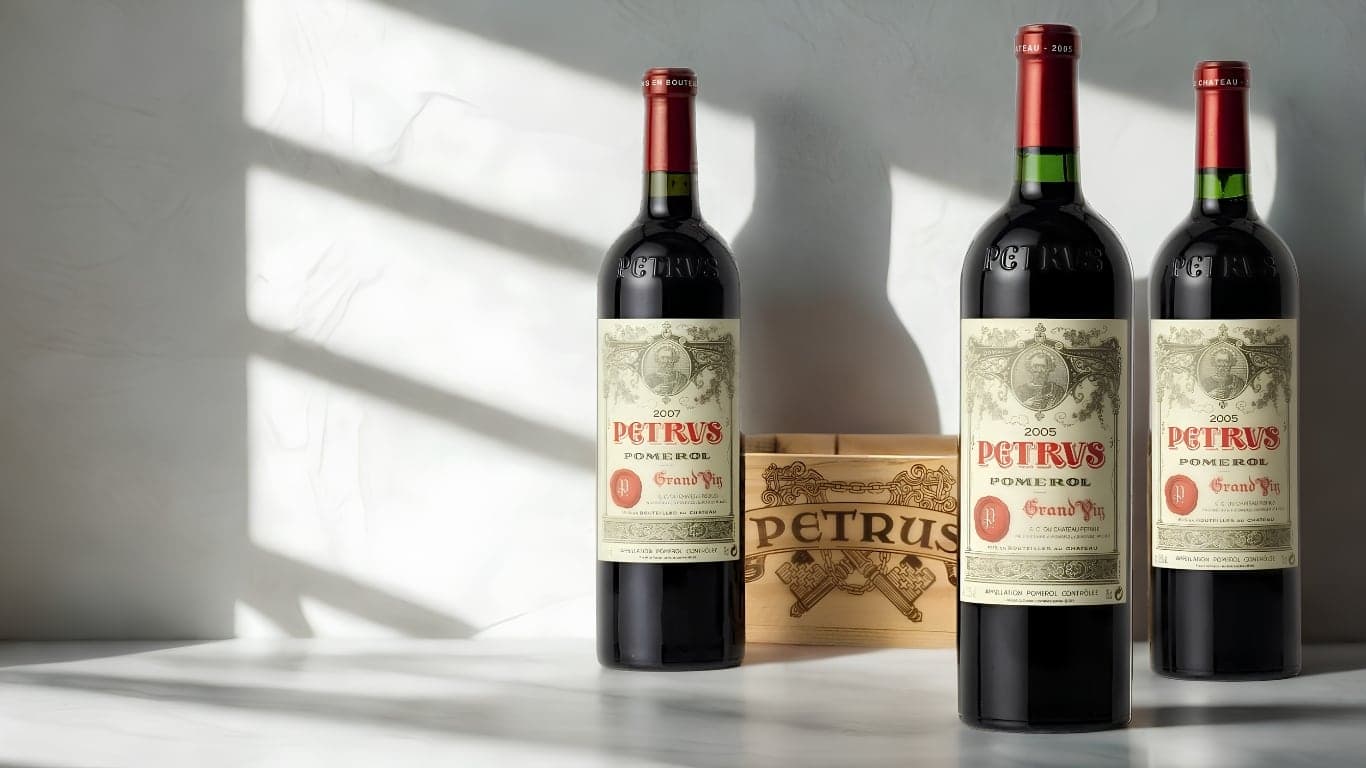
Pétrus, the Pomerol icon produced by the Moueix family, runs at roughly 2,500 cases per vintage from a 28-acre vineyard. The wine is Merlot-led (typically 95 to 100 percent), the 1947 and 1961 vintages remain benchmark lots at major auction, and the 1989, 1990, 2000, and 2010 have all built secondary-market strength.
The 2009 release, which Robert Parker scored 100, remains a reference for modern Pétrus. The wine trades at a structural premium to most other Pomerol names and has held that premium across the Liv-ex Bordeaux 500's recent correction.
The wine's small production and the Moueix family's allocation discipline make it one of the harder names to secure through legitimate channels.
Screaming Eagle
Screaming Eagle from Oakville, Napa Valley, produces between 500 and 850 cases per vintage of its Cabernet Sauvignon-led wine. The waitlist for the mailing list is multi-year, the wine is allocated rather than sold openly, and secondary-market prices have built across the past two decades.
The 2019 vintage cleared release at structural levels, and the wine continues to define the apex of the Californian cult category. The 1992 release, which earned Parker's first Napa 100-point score for the name, established the trajectory.
Our deeper analysis of why Screaming Eagle has never been harder to acquire walks through the allocation dynamics in detail.
Coche-Dury Corton-Charlemagne
Jean-François Coche-Dury produces roughly 300 cases per vintage of his Corton-Charlemagne. The wine trades at the apex of Burgundian white-wine pricing, alongside Domaine Leflaive Le Montrachet and Domaine d'Auvenay's holdings.
The 1996 and 1999 vintages remain benchmark releases, and the wine has continued to clear at strong levels at Sotheby's Burgundy sales across the past decade. The Liv-ex Burgundy 150's white-wine component has tracked the broader Burgundy outperformance since 2018.
The wine is one of the harder allocations to secure in the entire category, and the secondary market is the practical entry route for most collectors.
Henri Jayer's library releases
Henri Jayer, the late Vosne-Romanée producer whose career anchored the modernist case for low-yield Burgundy, died in 2006. His remaining bottles, including the canonical Cros Parantoux and Échezeaux, continue to clear at extraordinary levels at major auction.
The Hart Davis Hart Jayer sales in Chicago and the major Burgundy sales at Sotheby's New York have set the benchmarks for the category. A single bottle of 1985 Cros Parantoux cleared above $30,000 at HDH in 2018, and the trajectory has continued.
The supply is finite and shrinking, which is the structural argument for the category's continued price strength.
Krug Clos du Mesnil and Salon Le Mesnil
Champagne's apex producers cluster in Le Mesnil-sur-Oger, where Krug's Clos du Mesnil (a single-vineyard, single-vintage, single-variety bottling from a 1.85-hectare walled vineyard) and Salon's Le Mesnil (a single-vintage Blanc de Blancs released only in years deemed great) define the category.
The Liv-ex Champagne 50 has outperformed the broader Liv-ex 100 across most of the post-2018 window, and Krug and Salon have been the names anchoring that strength. The 2002 Salon release sits at the apex of contemporary collecting, and the 2004 and 2006 Clos du Mesnil have built credible secondary-market depth.
The category's structural advantage is that great Champagne ages longer than the conventional wisdom assumes, which collectors have priced in.
Sassicaia and the Super Tuscan apex
Sassicaia, the Bolgheri estate that effectively created the Super Tuscan category, has built decades of secondary-market depth alongside Ornellaia, Masseto, and Tignanello. The 1985 vintage anchors the lineage, and recent vintages including the 2015 and 2016 have cleared at structural levels.
The Italy 100 sub-index of the Liv-ex Fine Wine 1000 has been one of the steadier performers across the past three years, and Super Tuscans have been the anchor of that stability.
Our coverage of the Left Bank versus Right Bank Bordeaux distinction sets a useful frame for how Super Tuscans operate against their Bordeaux reference points.
Egon Müller Scharzhofberger Trockenbeerenauslese
Egon Müller's Scharzhofberger Trockenbeerenauslese, produced in tiny volumes from the Saar's most-coveted vineyard, sits at the apex of German white-wine pricing. Recent vintages have cleared at five-figure-per-bottle levels at Sotheby's, Christie's, and at the Bad Kreuznach charity auction.
The 2003 and 2010 vintages remain benchmark releases. The category's structural strength rests on tiny production, multi-decade ageability, and a critical pedigree that runs through Jancis Robinson, the Wine Advocate, and Vinous.
This is the most underweighted category in serious international cellars relative to its long-term ageing performance, in our view.
Côte-Rôtie La Landonne, La Mouline, and La Turque
Guigal's three single-vineyard Côte-Rôties (La Landonne, La Mouline, La Turque) define the apex of northern Rhône Syrah. Each runs at small production, each carries Parker 100-point vintages across the past three decades, and each has built secondary-market depth that rivals the more-fashionable categories.
The 1985, 1988, 1999, 2003, and 2009 vintages remain the benchmark releases. The Liv-ex Rhône index has tracked the category's structural strength even as broader French wine has consolidated.
For collectors building serious depth in Syrah, these are the structural anchors.
Burgundy's deepening lead and the Bordeaux opportunity
The Liv-ex Burgundy 150 outperformed the Bordeaux 500 across most of the 2018 to 2023 window. The structural shift in collector geography (Asia-led demand concentrated on Burgundy and Champagne) and the relative supply economics (Burgundy's tinier production base) have driven the move, as our coverage of Burgundy's record Liv-ex share tracks in detail.
Bordeaux's relative correction has created the inverse opportunity. The First Growths, the Right Bank icons, and the second-wine tier are all trading at multi-year lows against their release prices.
Whether the gap narrows in 2026 is the open question, and the answer will shape the most-coveted list a year from now.
What this means for collectors
The most coveted names share the structural variables we've described above. Small production, deep critical pedigree, and multi-geography demand are the three durable signals.
The collector building a serious cellar in 2026 should treat these names as the structural anchors rather than chasing whichever sub-index ran hottest in the past twelve months.
What we'll watch next
Three signals will tell us how the most-coveted list looks in 2027. Whether the Liv-ex Burgundy 150 continues to outperform the Bordeaux 500, whether Champagne's run extends or normalizes, and whether the cult Napa category absorbs the recent Liv-ex Napa adjustment.
The names above have weathered worse corrections than the current one. We don't expect 2026 to dislodge them.
We last reviewed this analysis in May 2026.


Stefanos Moschopoulos
Stefanos Moschopoulos founded The Luxury Playbook in Athens and has spent the better part of a decade following the auction calendar, the en primeur releases, and the watchmakers, gallerists, and shipyards the magazine covers. He writes the field guides and listicles that anchor the Connoisseur section — pieces built on Phillips and Christie's results, Liv-ex movements, and conversations with collectors he has met across Geneva, Bordeaux, Basel, and Monaco. His own collecting habits sit closer to watches and wine than art, and it shows in the level of detail in the magazine's coverage of those categories. Under his direction, The Luxury Playbook now publishes long-form field guides, market-defining year-end listicles, and the Voices interview series with the founders behind the houses and the brands.