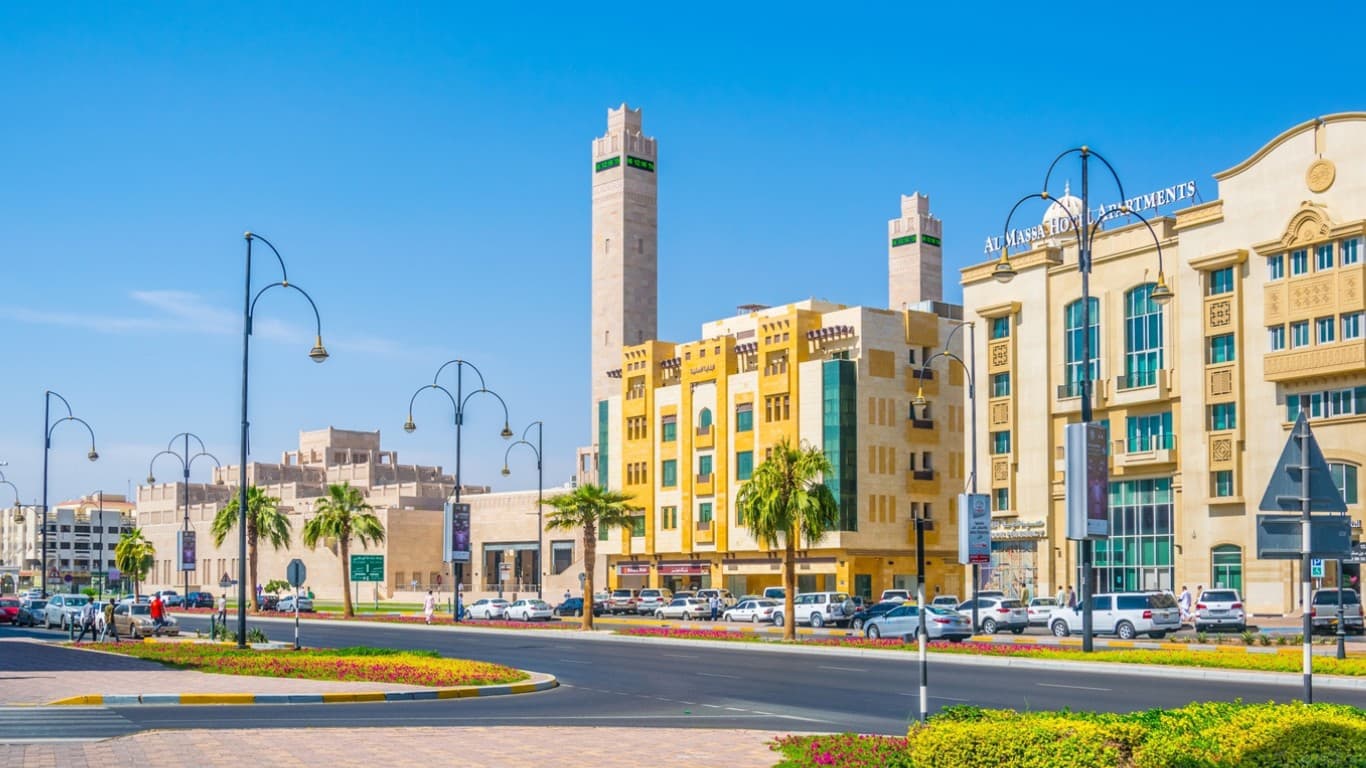
The Al Ain real estate market remains the most distinctive of the UAE's principal urban centres. The country's fourth-largest city is the one that has most carefully preserved its traditional architectural and cultural character. Often overshadowed by Abu Dhabi and Dubai in international property coverage, Al Ain is now drawing renewed attention for its measured pace, owner-occupier-driven demand profile, and the steady buildout of family-oriented villa communities.
As of early 2026, the median listing price for residential properties sits at approximately AED 970,000, with median sold prices averaging AED 940,000. Mansion Global's UAE coverage and Knight Frank's Middle East property work have both started to give Al Ain meaningful attention as one of the more interesting Gulf secondary stories of recent years.
The architectural register that defines Al Ain's residential offer is unusual within the UAE: low-density, villa-based, family-oriented, with the city's UNESCO World Heritage-listed cultural sites (the Al Ain Oasis with its centuries-old falaj irrigation system, Al Jahili Fort, the Hili Archaeological Park dating to the third millennium BCE, the Bidaa Bint Saud archaeological area) anchoring the historic core.
Capital values grew approximately 4 percent year on year in 2025, outpacing early-year forecasts. Government-driven housing programmes and enhanced inter-emirate transport have continued to support steady demand.
- Al Ain represents the quieter inland counterpart to coastal UAE markets, with cultural depth, established residential neighbourhoods and a different buyer profile than Dubai or Abu Dhabi.
- We see Al Ain attracting predominantly local Emirati buyers and long-term resident families, with international buyer flows materially lower than the coastal emirate equivalents.
- Property pricing in Al Ain typically runs well below comparable Dubai and Abu Dhabi stock, with the trade-off being a different lifestyle profile rather than headline appreciation potential.
- Yields on well-located Al Ain rental stock remain attractive given the entry pricing, although the rental pool is more locally focused than the international demand driving coastal cities.
- Infrastructure investment, including the road network and the university anchor at UAEU, supports continued residential demand from the institutional and educational sectors.
- For most considered investors we view Al Ain as offering a distinct UAE property profile, with appreciation tied to long-term residential demand rather than international flows.
- Who is this for?
- Investors evaluating Al Ain as an alternative UAE property market, alongside the advisers, brokers and family office staff framing those decisions across the emirate complex.
- What is happening?
- A market overview and forecast for Al Ain, covering the local buyer profile, pricing, yields, infrastructure context and the comparison to coastal UAE markets.
- When did this emerge?
- The article reflects 2026 market conditions across the UAE property complex alongside our own observations on the Al Ain market.
- Where is this happening?
- The piece focuses on Al Ain in the eastern Abu Dhabi region, with reference to the broader UAE property complex.
- Why does it matter?
- Al Ain offers a distinctive property profile within the UAE complex, which is why understanding the inland dynamics matters for any comprehensive Gulf allocation conversation.
The Al Ain housing market today
The narrow gap between asking and closing prices points to a healthy, balanced market. Demand has stayed firm for family villas in Al Hili, Al Yahar and Al Jimi, where new infrastructure and planned community developments are taking shape. Homes are selling within 45 days on average, a slight acceleration from the 50-day benchmark observed in Q2 2024.
The average price per square metre sits at AED 6,740 (US$1,840). Apartments in central zones like Al Mutaredh price around AED 6,000 per sqm; villas in suburban areas range AED 7,200 to 8,000 per sqm.
The senior Emirates brokerages (Allsopp and Allsopp Al Ain, Engel and Volkers Abu Dhabi, the broader Abu Dhabi-anchored brokerage networks operating across the emirate) all describe a market structurally weighted toward owner-occupier and government-supported buyer activity rather than international transactional flows.
- Median listing price: AED 970,000
- Median sold price: AED 940,000
- Average days on market: 45 (down from 50)
- Average price per sqm: AED 6,740
- Demand concentrated in Al Hili, Al Yahar, Al Jimi
Al Ain neighborhoods defining 2026
Al Hili
Al Hili stands out as one of Al Ain's most sought-after residential areas, with spacious villas, proximity to leading schools and well-developed infrastructure. The median home price sits at approximately AED 1. 4 million, up 4.
2 percent year on year. Al Hili's archaeological heritage (the Hili Archaeological Park, a UNESCO World Heritage Site, dates the area's significance to the third millennium BCE Bronze Age, with the surviving tombs and the Hili Grand Tomb anchoring the historical conversation) gives the neighborhood unusual cultural depth among UAE residential addresses.
Al Jimi
Al Jimi remains one of Al Ain's most established residential districts, drawing established families and long-term residents. The area's mature infrastructure, the established schools network (the British International School Al Jimi, the various Arabic-language schools), and the proximity to the city's central commercial corridor have made Al Jimi one of the more durable family-buyer neighborhoods in the emirate.
Zakher
Zakher has been one of the quieter but more architecturally distinctive submarkets in the city. The area's combination of mature tree canopy (the broader Al Ain "oasis city" character is most visible in Zakher's neighborhood layout), the established villa stock and the considered residential pace has made it one of the more discreet prime addresses in the emirate.
Al Mutaredh
Al Mutaredh sits closer to the city centre, with apartment-led housing stock priced around AED 6,000 per sqm. The area's role in providing accessibly priced central-Al-Ain residential inventory anchors the broader city's demographic base.
Al Yahar
Al Yahar represents the south-westerly residential corridor with the broader buildout of contemporary villa communities. The area's planned-community character (master-planned residential developments with the contemporary villa typologies the Gulf has consolidated around) anchors much of the city's recent growth.
The Al Ain rental landscape
Demand is largely driven by long-term residents and government-supported tenants. The rental market is structurally stable rather than dynamic, supported by the limited speculative building character of the city. Unlike Dubai's structurally seasonal short-term rental market, Al Ain's rental dynamics are weighted toward long-tenure tenancies and government-administered housing programmes.
The market behaves more like a domestic residential market than like a Gulf-luxury speculative one.
What is shaping the Al Ain real estate market in 2026
Several structural forces define the market. Government-driven housing programmes continue to support steady demand. Inter-emirate transport investments (the Etihad Rail network bringing Al Ain into closer connection with Abu Dhabi and Dubai, road improvements between Al Ain and Abu Dhabi, the broader Abu Dhabi-Al Ain corridor infrastructure works) are reshaping connectivity.
UNESCO World Heritage cultural assets (Al Ain Oasis with its falaj irrigation system, Al Jahili Fort, Hili Archaeological Park, Bidaa Bint Saud) sustain the city's distinctive cultural and tourism character. The continued investment in the city's academic and research infrastructure (the United Arab Emirates University, the broader academic and government-research presence anchoring Al Ain) supports the demographic stability that anchors the broader market.
The architectural and cultural context
Al Ain's role as the "oasis city", the historic settlement that pre-dates modern UAE statehood by millennia, gives it a structurally different cultural character. The falaj irrigation system, the date-palm cultivation tradition, the protected oasis tracts, and the broader historical anchor distinguish the city from the more recently built Gulf emirates.
The Sheikh Zayed Palace Museum, the Al Ain Palace Museum (the original family home of the founding president of the UAE), and the broader cultural infrastructure tied to the founding of the nation make Al Ain one of the most culturally consequential Emirati addresses.
Where the Al Ain real estate market reads now
Prices are projected to climb 3 to 5 percent through the back half of 2026. Growth is expected to concentrate in family villa submarkets, particularly Al Hili, Al Jimi and Zakher. The rental market is forecast to remain stable, with the government-administered housing programmes and the academic and research infrastructure continuing to anchor demand.
What this means for buyers
For the buyer who values architectural restraint, owner-occupier-driven market dynamics, and the cultural foundation built on UNESCO World Heritage sites and the broader Emirati national-heritage anchor, the Al Ain real estate market reads as a structurally distinctive proposition within the UAE.
Not in the league of Dubai or Abu Dhabi for international transaction volume, but offering a pace, character and demographic stability that the larger emirates simply cannot replicate. We last reviewed this analysis in May 2026.
Frequently asked
How is the Al Ain property market evolving in 2026?
Prices are projected to climb 3 to 5 percent through 2026, supported by government housing programmes and steady owner-occupier demand. Knight Frank's Middle East property work flags Al Ain as one of the more interesting Gulf secondary stories.
Which Al Ain areas are seeing the most buyer attention?
Al Hili, Al Jimi, Zakher, Al Mutaredh and Al Yahar are drawing the most consistent demand from family buyers and long-term residents.
What distinguishes Al Ain from Abu Dhabi and Dubai?
Al Ain's market is owner-occupier-driven, low-density, villa-led, and culturally anchored by UNESCO World Heritage sites and the broader Emirati national-heritage tradition. A meaningfully different character than the speculative or high-rise dynamics of the larger emirates.
How fast are homes selling?
The average is 45 days, with the strongest competition in the Al Hili and Al Jimi family villa segments.
What cultural anchors define Al Ain?
The Al Ain Oasis with its centuries-old falaj irrigation system, Al Jahili Fort, the Hili Archaeological Park dating to the third millennium BCE Bronze Age, the Sheikh Zayed Palace Museum, and the broader UNESCO World Heritage Site cluster that anchors the city's cultural conversation.


Savvas Agathangelou
Savvas Agathangelou co-founded The Luxury Playbook and has spent years reporting from the prime postcodes the magazine covers — Mayfair, Knightsbridge, the Athens Riviera, Dubai's Palm crescents, and the southern Mediterranean coastlines where the world's wealthy keep coming back. His background is in international hospitality, and that frame shapes how he writes about property: the developer's choices, the architect's signature, the agency's bench of named brokers, the building's service standard once the buyer moves in. He files developer spotlights, agency profiles, and the seasonal "Properties That Defined" listicles, and he hosts the magazine's founder-and-leadership interviews on the Voices side.