Detroit in 2026 is doing something the rest of the American Midwest has not quite managed: building a real second act. The city's downtown is denser than at any point since the late 1990s. The Eastern Market, Corktown, Midtown and the West Village have absorbed a generation of restoration work.
The architectural texture through the early-twentieth-century skyscrapers, the Albert Kahn industrial buildings and the bungalow-and-brick residential streets has emerged from a long period of neglect into something genuinely interesting. Below, our editorial read of where the city sits.
- Detroit's property market continues its long recovery story, with downtown and Midtown revitalisation supporting a meaningful shift in the urban core narrative across recent years.
- We see Bedrock, Olympia Development and the broader Quicken-affiliated investment having reshaped the downtown landscape, with new build inventory and renovated stock supporting demand.
- Median prices remain materially below most peer Midwestern metros, with the value case continuing to attract domestic and selectively international investor capital.
- Suburban Birmingham, Bloomfield Hills and Grosse Pointe continue to anchor the upper end of the Greater Detroit luxury market with the most desirable inventory.
- Property tax structure carries among the highest effective rates in the country at the Detroit city level, with significant variation across the surrounding suburban municipalities.
- For most considered buyers we view Detroit as a complex market warranting careful submarket and tax structure analysis, with the recovery story creating both opportunities and risks.
- Who is this for?
- Buyers, investors and advisers evaluating Detroit property, alongside the brokers, lawyers and out-of-state investors supporting Greater Detroit and Wayne County transactions.
- What is happening?
- A market analysis of Detroit's property market in 2026, covering the downtown recovery, Midtown revitalisation, suburban luxury submarkets and the property tax considerations.
- When did this emerge?
- The article covers conditions through 2025 and 2026, with reference to the Bedrock and Olympia Development build-out and the latest property tax framework developments.
- Where is this happening?
- The piece focuses on Detroit and the surrounding metropolitan area, including downtown, Midtown, Birmingham, Bloomfield Hills, Grosse Pointe and the broader region.
- Why does it matter?
- Detroit's recovery story creates both opportunities and risks in 2026, which is why careful submarket and tax structure analysis matters more here than in most US metros.
The arc, briefly
Detroit's bankruptcy in 2013 was the low point of a 60-year decline. The 2014 emergency-manager exit and the post-2014 rebuilding has been led by a coalition. The Ford Foundation's Grand Bargain, Dan Gilbert's Bedrock Detroit (the developer behind the Hudson's tower and the QLine streetcar route), the Ilitch family's investment in The District Detroit and a quieter Detroit Future City planning effort have between them reshaped the residential side of the conversation.
Mansion Global covered Detroit's resurgence in a 2024 dispatch noting the rise of design-led restorations across the city's character neighbourhoods. Knight Frank's North American desk and Christie's International Real Estate have both added regional coverage in the past two years, a signal that the institutional brokerage layer treats the city as a serious prime conversation rather than an asterisk.
Downtown and the skyscraper restoration
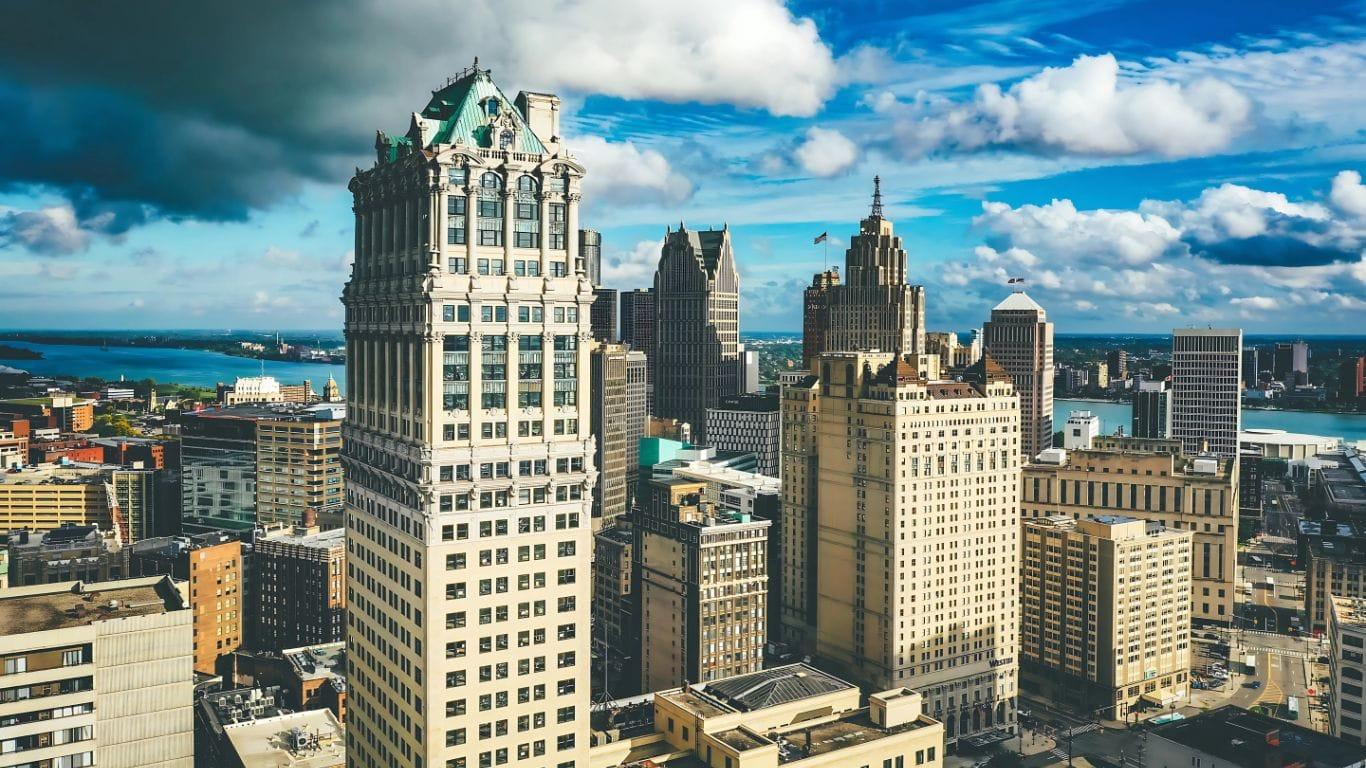
The historic core through Campus Martius, the Penobscot Building, the Guardian Building and the Fisher Building holds some of the most architecturally significant early-twentieth-century work in the United States. Albert Kahn, Wirt Rowland and the firm of Smith, Hinchman & Grylls (now SmithGroup) defined the city's skyscraper register. The Hudson's redevelopment, designed by SHoP Architects, replaced the demolished J.L.
Hudson department store site with a mixed-use tower delivering in 2025-2026.
The Book Tower restoration, led by Bedrock with interiors by Studio Italia, opened in 2024. Residential conversion has been the through-line of the downtown story. Albert Kahn's industrial and commercial buildings have been progressively converted to apartments and condominiums by Bedrock, the Ilitch family's Olympia Development and a roster of smaller developers.
The pre-war office stock that had sat empty for decades has been brought back into use as a residential layer that the city had effectively lost. The texture of the conversions tends to favour generous floor plates and tall ceilings, which has attracted owner-occupier buyers willing to commission interior architects on top of the developer shell.
Corktown and the Michigan Central anchor
The Corktown neighbourhood, west of downtown, has become the most architecturally interesting Detroit residential address. The Michigan Central Station (the 1913 Beaux-Arts Daniel Burnham building) was restored by Ford Motor Company in a $950 million project completed in 2024. The restoration anchors a planned 30-acre mobility innovation district.
The Ford Foundation's investment has spilled out into the surrounding Corktown streets. Restored brick rowhouses, converted industrial buildings and a new generation of design studios have repositioned the neighbourhood. The architectural register is part rowhouse Detroit, part adaptive-reuse industrial.
Midtown, the cultural axis and Brush Park
Midtown holds the cultural anchors. The Detroit Institute of Arts (where Diego Rivera's "Detroit Industry" murals sit), the Michigan Science Center, the College for Creative Studies and Wayne State University all cluster on the Woodward axis. The Cass Corridor portion has been an art-and-music scene since the 1970s.
The Brush Park quarter has absorbed a generation of restored Victorian-era mansions, with new infill from Lorcan O'Herlihy Architects and the Detroit-based Christian Hurttienne Architects. The Whitney Mansion on Woodward Avenue, the Garrick Theatre's restoration and the new David Adjaye-designed Charles H. Wright Museum addition are the named cultural projects shaping Midtown's prime adjacency.
Engel & Völkers' Detroit desk now lists regularly in Brush Park, a marker of how the city's prime brokerage layer has thickened.
The West Village, Indian Village and the Eastern Market
The West Village holds Tudor-revival mansions, Arts and Crafts bungalows and the kind of pedestrian-scale architecture that defined Detroit's Gold Coast era. Indian Village, sitting east, holds the largest concentration of early-twentieth-century mansions in the city, with work by Albert Kahn, Louis Kamper and George D. Mason. Both neighbourhoods have absorbed serious restoration capital in the past decade.
The buyer profile is owner-occupier-led, with a meaningful share of out-of-state buyers landing for the architectural texture. The Eastern Market, the 6-block historic public market dating to 1841, anchors a creative-class district with restored brick warehouses and a generation of food-and-design tenants. The Detroit RiverWalk, which now extends three miles along the riverfront, has reshaped the city's edge.
The new Joe Louis Greenway connects Corktown to the riverfront via a landscape-architecture corridor designed by SmithGroup and Reed Hilderbrand. The pedestrian connectivity is starting to look like a coherent prime-adjacent infrastructure rather than a series of disconnected projects.
The architectural depth and the honest caveats
What is distinctive about Detroit's prime is the depth of the architectural infrastructure. The city has the Albert Kahn legacy (the Fisher Building, the Detroit Athletic Club, the General Motors Building), the Saarinen-and-Cranbrook architectural lineage in nearby Bloomfield Hills (Cranbrook Academy, the Saarinen House) and a contemporary practice scene anchored by SmithGroup, Lorcan O'Herlihy Architects and Detroit-based studios like Christian Hurttienne, Studio:M Architects and Patrick Thompson Design. Owners commissioning work in the city have access to architects who understand the regional vernacular at price points well below comparable Northeast or West Coast addresses.
Detroit is not every prime market. Many of the city's neighbourhoods remain in the post-2008 restoration cycle. Public-school infrastructure is still uneven, which shapes where families with school-age children land.
Some of the architectural showpieces sit in blocks where the surrounding restoration is incomplete. Owners landing in Detroit do so with eyes open about which neighbourhoods have absorbed the rebuilding and which are still in the middle of it. Cushman & Wakefield's local desk publishes a quarterly review that maps the restoration progress block by block, which is the best public source we have seen.
What this means for buyers
Further reading: Detroit sits alongside our reads on the U.S. property markets defining 2026, Chicago's 2026 picture and the end of easy house restoration in America.
For buyers willing to look past the headline narrative of mid-2010s Detroit, the city in 2026 offers genuine architectural texture, a coherent cultural infrastructure and a stretch of neighbourhoods (Corktown, Midtown, West Village, Indian Village, Brush Park) doing serious restoration work. The city will not be the right answer for buyers who need a pre-built operational layer of the kind New York or Chicago provides. It will be the right answer for owners who care about Albert Kahn's industrial architecture, who want to be part of a city in genuine renewal and who are willing to commission their own work.
That is a specific buyer, but it is a real one. We last reviewed this analysis in May 2026.