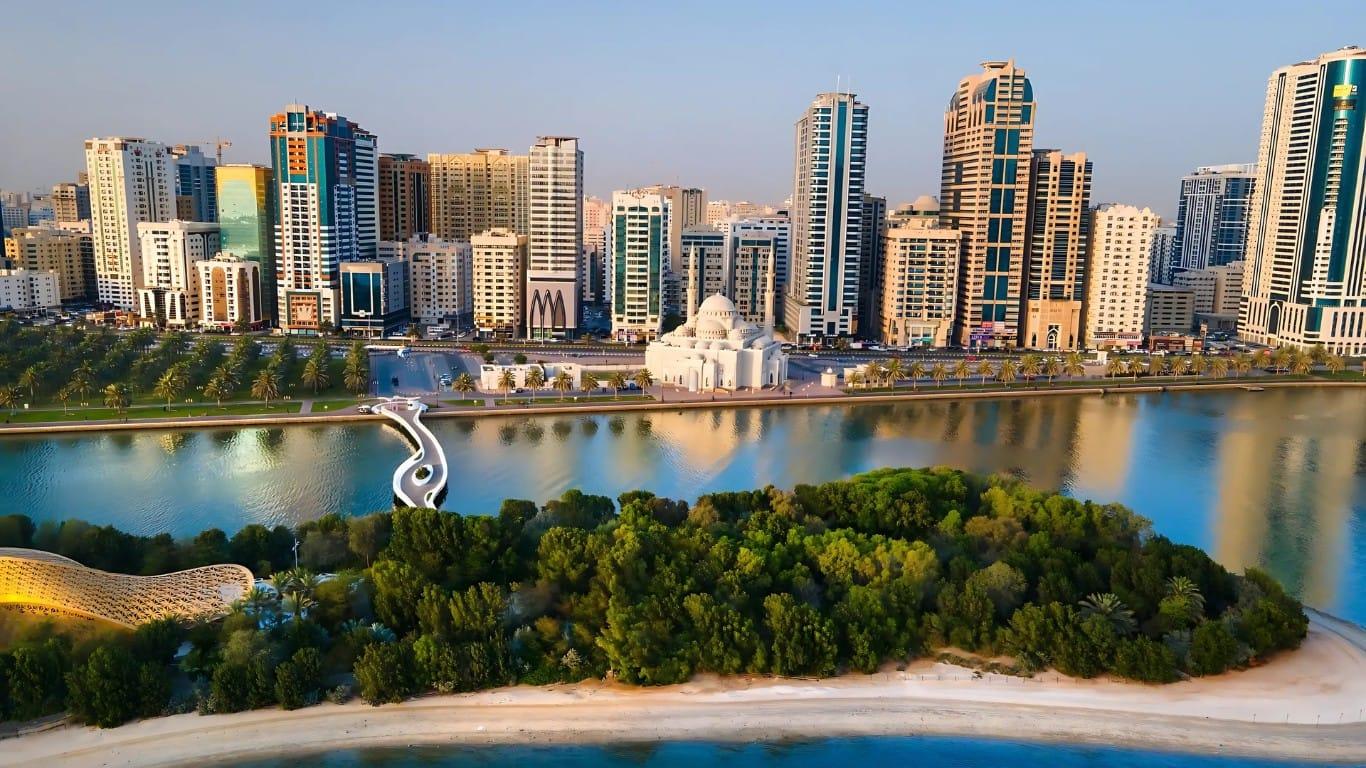
The Sharjah property market has spent the past three years quietly transforming from a secondary UAE market into one of the more interesting structural property stories in the Gulf. Once seen primarily as a commuter alternative to Dubai, the third-largest emirate has emerged as a market in its own right. The shift is supported by progressive freehold ownership reforms, the steady buildout of master-planned communities like Aljada (developed by Arada with a master-plan by Zaha Hadid Architects), and a buyer demographic increasingly composed of long-term residents rather than purely transactional buyers.
Knight Frank's UAE coverage and Mansion Global's Gulf property work have both started giving Sharjah substantially more editorial attention than the emirate received a decade ago. As of Q2 2026, the median listing price for residential units in Sharjah sits at AED 891,000, with median sale prices averaging around AED 850,000. The narrow gap between asking and closing tells the structural story: durable demand, supported by population growth and Dubai-cost migration.
Sharjah recorded over AED 8.4 billion in real estate transactions in Q2 2026, a double-digit increase year on year.
The architectural ambition that defines the most consequential developments (Arada's Aljada master-plan with the late Dame Zaha Hadid's posthumous design legacy, Eagle Hills' Maryam Island, the Sharjah Sustainable City, the broader Aljada's continuing buildout) places the emirate's prime-residential conversation alongside the more thoughtful contemporary urban-design work in the region.
- Sharjah has emerged as the entry-level UAE property market, with materially lower pricing than Dubai and Abu Dhabi alongside continued infrastructure investment supporting steady demand.
- We see the Aljada, Tilal City and Maryam Island developments anchoring the institutional pipeline, with the freehold zones supporting international buyer access.
- Sharjah property typically trades at fifty to seventy percent of comparable Dubai stock, reflecting the different supply dynamics and the more local buyer mix.
- Yields on well-located Sharjah rental stock remain attractive, particularly given the lower entry pricing relative to comparable Dubai properties.
- Proximity to Dubai, with road access supporting commuter populations, has supported steady demand for Sharjah residential stock from professionals working in the neighbouring emirate.
- For most considered international investors we view Sharjah as offering an entry-level UAE property exposure, with appreciation tied to broader cross-emirate economic integration.
- Who is this for?
- International investors evaluating Sharjah as a UAE entry-level property market, alongside the advisers, brokers and family office staff framing those decisions.
- What is happening?
- A market read of Sharjah property in 2026, covering Aljada, Tilal City, Maryam Island, the freehold zones, yields and the cross-emirate commuter dynamic.
- When did this emerge?
- The article reflects 2026 market conditions through UAE-wide property data alongside our own observations across the emirates.
- Where is this happening?
- The piece focuses on Sharjah, with reference to the broader UAE property complex including Dubai and the cross-emirate dynamics.
- Why does it matter?
- Sharjah offers a distinctive value proposition within the UAE complex, which is why understanding the entry-level dynamics matters for any cross-emirate allocation conversation.
The Sharjah housing market today
Properties are moving faster, averaging 39 days on market against 47 days in early 2024. About 36 percent of residential properties are selling at or above asking, with the strongest competition concentrated in the mid-market villa and townhouse segments. The average price per square metre sits at approximately AED 10,420 (around US$2,855).
Prime areas like Al Majaz and Al Khan reach up to AED 12,500 per sqm; outer areas like Al Suyoh and Tilal City sit under AED 6,000 per sqm. The senior Emirates brokerages (Allsopp and Allsopp's Sharjah operations, Engel and Volkers Sharjah, D and B Properties' Sharjah desk) all describe a structurally stable market with rapidly improving liquidity and consistent international interest.
- Median listing price: AED 891,000
- Median sold price: AED 850,000
- Q2 2026 transactions: AED 8.4 billion+
- Average days on market: 39
- 36 percent of properties selling at or above asking
Sharjah neighborhoods defining the prime tier in 2026
Aljada
Aljada, the Arada-developed master-planned community with a master-plan by Zaha Hadid Architects, has become one of the most consequential contemporary residential developments in the Northern Emirates. The mix of apartments, townhouses and villa stock has drawn a young professional and family buyer base.
The Madar at Aljada cultural hub (designed by Zaha Hadid Architects as the master-plan's central public landmark, with its characteristically fluid parametric architecture), the integrated schools and healthcare infrastructure, and the broader 24-million-square-foot master-planned community make Aljada one of the most-watched contemporary Middle East residential developments.
Muwaileh
Muwaileh has grown into one of Sharjah's most active residential communities, supported by proximity to the University City of Sharjah (the academic cluster that includes the American University of Sharjah and several other higher-education institutions) and continuing infrastructure works.
The area's combination of accessible pricing, academic-driven demographic stability and the steady buildout of the University City corridor has consolidated Muwaileh as one of the more active Sharjah residential addresses.
Al Khan
Al Khan represents the prime waterfront end of the Sharjah map. Maryam Island (developed by Eagle Hills, the Abu Dhabi-based development arm operating across multiple Middle Eastern and European markets) and the Lagoons frontage draw the most consistent waterfront buyer attention. The combination of waterfront positioning, contemporary residential typologies and the broader cultural infrastructure (the Sharjah Maritime Museum, the various waterfront cultural anchors) supports Al Khan's prime-tier positioning.
Al Majaz
Al Majaz remains one of the city's most established residential neighborhoods, with mature infrastructure and dependable buyer demand. The Al Majaz Waterfront, the corniche-style public-space redevelopment along the Khalid Lagoon, anchors the area's cultural and lifestyle infrastructure. The established schools, restaurants and broader residential character distinguish Al Majaz from the newer master-planned communities elsewhere in the emirate.
Tilal City and the outer corridors
The Tilal City development (a master-planned community in the city's outer corridor with mixed-use residential and commercial inventory at meaningfully more accessible pricing than the central districts) anchors the broader Sharjah's accessible-tier inventory. The outer corridors continue to receive the bulk of master-planned development activity.
The architectural and cultural context
Sharjah's UNESCO Creative City designation (granted in 2014 for the emirate's cultural and craft heritage) and the structural commitment to cultural infrastructure that has anchored the emirate's positioning over the past two decades distinguish Sharjah from the more commercially driven Gulf neighbours.
The Sharjah Art Foundation (under the leadership of Sheikha Hoor Al Qasimi, one of the most internationally cited cultural curators operating from the Gulf), the Sharjah Biennale (one of the most consequential contemporary art biennales in the Middle East), and the Sharjah Architecture Triennial all support the emirate's structurally different cultural positioning.
The contemporary architectural commissioning in Sharjah, anchored by Zaha Hadid Architects' Aljada work, the various Eagle Hills developments, the Sharjah Sustainable City master-plan by Diamond Developers, and the broader cohort of UAE-based architectural studios operating across the emirate, places the contemporary residential conversation at the centre of the Gulf's most thoughtful urban-design work.
The Sharjah rental landscape
The Sharjah rental market continues to perform well. Districts like Aljada, Muwaileh and Al Khan have seen rental increases of 4 to 6 percent year on year. Demand is particularly strong from professionals and families seeking accessibility to Dubai while paying meaningfully lower rents.
What is shaping the Sharjah property market in 2026
Several forces are reshaping the market. The freehold ownership framework, substantially expanded over the past three years to allow non-GCC nationals to purchase in designated zones, has structurally repositioned the emirate. Population growth from Dubai-cost migration continues, with rental clearances in Aljada and Muwaileh now consistently above the broader Sharjah average.
Continuing infrastructure works around the Sharjah-Dubai border, the Sharjah International Airport expansion, and the Sharjah Sustainable City buildout are reshaping demand corridors. The cultural and academic infrastructure (the Sharjah Art Foundation, the University City of Sharjah, the broader cultural anchor) supports the structural demographic stability that distinguishes the emirate from the more transactional Gulf markets.
Where the Sharjah property market reads now
Prices are projected to climb 4 to 6 percent through the back half of 2026. Growth is expected to concentrate in Aljada, Muwaileh and the waterfront submarkets along Al Khan. Rents are forecast to climb 4 to 6 percent.
What this means for buyers
For the buyer who values one of the most thoughtfully master-planned contemporary residential offers in the Gulf, accessibility to Dubai at a meaningfully lower price point, and an emirate where the cultural foundation (Sharjah's UNESCO Creative City designation, the Sharjah Art Foundation, the Sharjah Architecture Triennial) has shaped the buyer composition, Sharjah continues to read as a structurally important property market.
The neighborhoods responding most distinctly to the design-led buyer shift, namely Aljada, Maryam Island and Al Khan, are quietly outperforming the headline averages. We last reviewed this analysis in May 2026.
Frequently asked
How is the Sharjah property market evolving in 2026?
Prices are projected to climb 4 to 6 percent through 2026, supported by the freehold framework expansion and Dubai-cost migration. Knight Frank's UAE coverage and Mansion Global's Gulf property work have both started giving Sharjah substantially more editorial attention.
Which Sharjah areas are seeing the most buyer attention?
Aljada, Muwaileh, Al Khan, Al Majaz and Tilal City are drawing the most consistent buyer demand.
Can foreign nationals buy property in Sharjah?
The freehold framework has been substantially expanded over the past three years to allow non-GCC nationals to purchase in designated zones, with Aljada and Maryam Island among the most-watched freehold addresses for international buyers.
How does Sharjah compare against Dubai?
Sharjah remains meaningfully more accessible than Dubai while offering proximity, an architecturally distinctive master-planned offer, and the cultural foundation built around the Sharjah Art Foundation. Prime Sharjah pricing at AED 10,420 per sqm sits well below the AED 16,924 per sqm Dubai average.
What architects are working in Sharjah?
Zaha Hadid Architects (the Aljada master-plan and Madar cultural hub), Eagle Hills' development partners on Maryam Island, Diamond Developers on the Sharjah Sustainable City, and the broader cohort of UAE-based studios operating across the emirate's master-planned developments.