The Rolex Datejust isn't a contrarian pick. Eighty years on, it remains the reference experienced collectors keep coming back to: the watch most likely to appear on the wrist of someone who has owned dozens of more aggressive references and quietly returned to the one that does the most things well. Introduced in 1945 as the first wristwatch with an automatic date function, it has been refined gradually rather than reinvented across decades.
- The Datejust remains the cornerstone Rolex reference for most serious collectors, with versatility, condition durability, and secondary liquidity that no rival can match.
- Reference 126334 and 126331 anchor the modern catalogue, with fluted bezels and a wide dial colour range supporting daily-wear flexibility across decades.
- Vintage four-digit Datejust references, including the 1601 and 16013, offer entry points into Rolex collecting at price points that have proven stable through cycles.
- We see the Datejust 41 as the strongest single first-Rolex recommendation, covering dress and casual wear with a piece that wears well across changing styles.
- Two-tone and full gold Datejust configurations have outperformed expectations through the cycle, with collector demand validating the design ambition.
- Jubilee versus Oyster bracelet choice shapes wearing experience meaningfully, and both options have distinct collector followings that justify the secondary-market depth.
- Who is this for?
- First-time Rolex buyers, established collectors building depth, and inheritors taking custody of vintage family Datejust pieces.
- What is happening?
- A grounded case for the Rolex Datejust as a cornerstone collection reference, covering modern catalogue, vintage entry points, and configuration choices.
- When did this emerge?
- The case has held across the last six decades, with modern 126334 and 126331 references continuing to anchor the cornerstone position into 2026.
- Where is this happening?
- Authorised Rolex dealers globally stock the modern catalogue, while Chrono24, Subdial 50, and specialist auctions handle the vintage and transitional market.
- Why does it matter?
- The Datejust offers cornerstone versatility at sensible money, making it the most reliably useful Rolex for collectors at any stage of their development.
The result is a piece that wears across registers (suit, weekend, formal) without reading as out of place anywhere. We'd argue the case for the Rolex Datejust as a daily wear is stronger now than it has been in a decade. The references that anchor the contemporary catalogue make the argument naturally.
The Datejust reference family in detail
The Datejust catalogue spans more variants than any other Rolex line. Current production references (126200 at 36mm, 126300 at 41mm, 126233 in 36mm two-tone, 126331 in 41mm Everose two-tone, 278243 at 31mm) define the contemporary catalogue across case sizes from the 28mm Lady-Datejust through the 41mm Datejust 41. Pricing runs from around $7,500 at the entry tier through $14,000 in the more elaborate two-tone references, considerably higher in precious metals.
The Calibre 3235 movement with the Chronergy escapement provides 70-hour power reserve and the technical platform that's now standard across the upper Rolex catalogue. The Calibre 3235 was introduced in 2015 with the Day-Date 40 and rolled out across the Datejust line through subsequent production years, replacing the long-running Calibre 3135 family.
The vintage Datejust catalogue is broader still. The 1601 (36mm steel-and-gold pie-pan dial reference from the 1960s and 1970s, with the historical Calibre 1570 movement) is the reference that defines vintage Datejust collecting at the working tier. The 16013, 16234 and 116234 references each anchor different generations of Datejust collecting through the 1980s, 1990s and early 2000s.
The vintage 1601: the working entry to vintage Rolex
The vintage 1601 in steel-and-gold with the original pie-pan dial is the entry point most considered Datejust collectors gravitate toward. Clean examples trade between $4,500 and $8,000 depending on dial colour, condition and box-and-papers.
The 1601 was produced from 1960 to 1977 across multiple dial variants, with the various dial textures (the linen-textured "tropical" dials that have aged to chocolate brown, the matte-black dials, the various silver and champagne configurations) carrying different collector following.
The reference is one of the most credible entry points to vintage Rolex collecting at accessible price levels. The rarer dial variants (the linen-textured dials, the various Stella enamel dials in precious-metal cases, the Florentine engraved dials, the Buckley Roman-numeral dials produced for the British market) command meaningful premiums when they surface. Phillips and Christie's have both produced detailed condition reports on rare-dial 1601 references.
The dealer ecosystem (Bob's Watches, Hodinkee's vintage operation, the European specialist dealers like Lunar Oyster and Davidoff Brothers) handles the trading patterns with the kind of discipline that makes the broader vintage Rolex framework learnable through the reference. We've watched collectors with no prior vintage experience build credible working knowledge across a year or two of paying attention to the 1601 market.
The modern 41mm Datejust references
The modern 41mm Datejust references, particularly the 126300 with the silver or champagne dial on the Oyster bracelet, have become one of the more considered modern Rolex collecting tiers. The case proportions update the historical Datejust geometry without abandoning it. The Calibre 3235 movement with the Chronergy escapement provides 70-hour power reserve and the technical platform that's now standard across the upper Rolex catalogue.
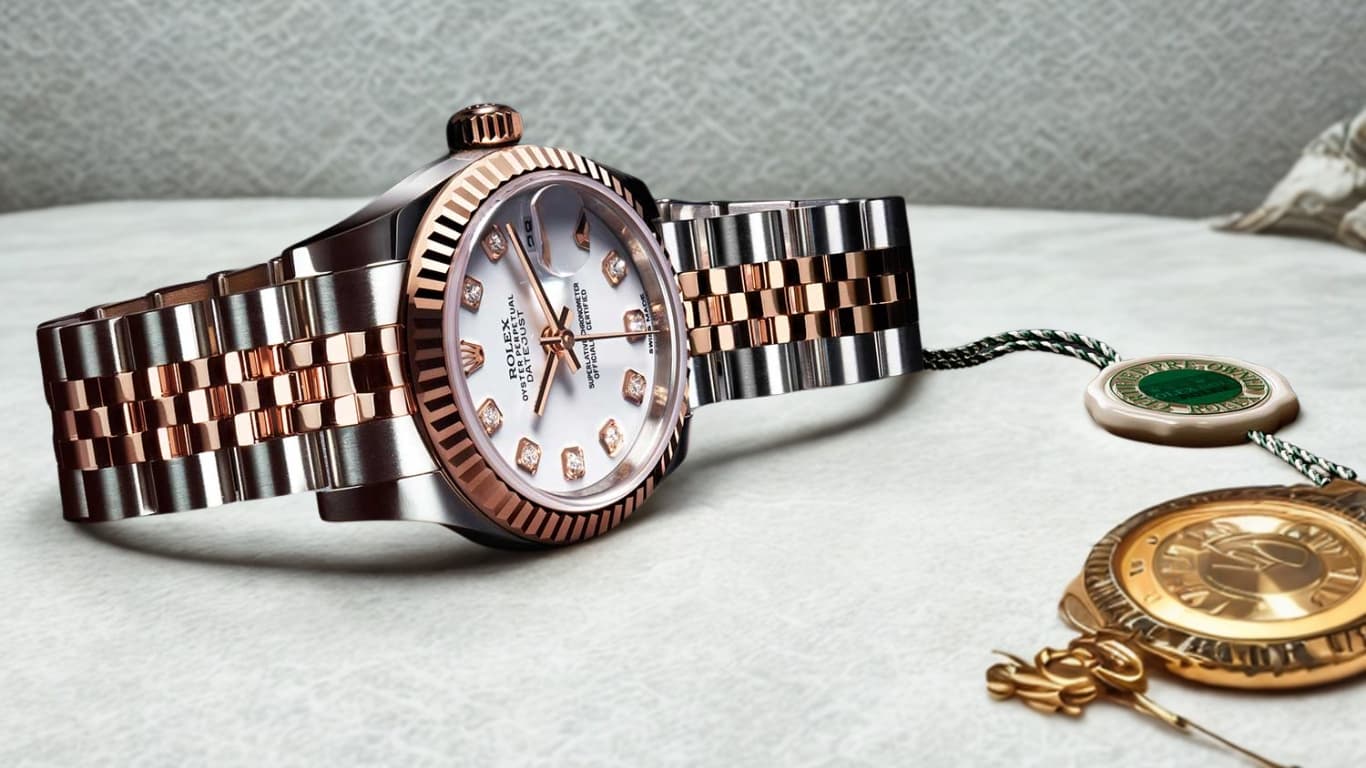
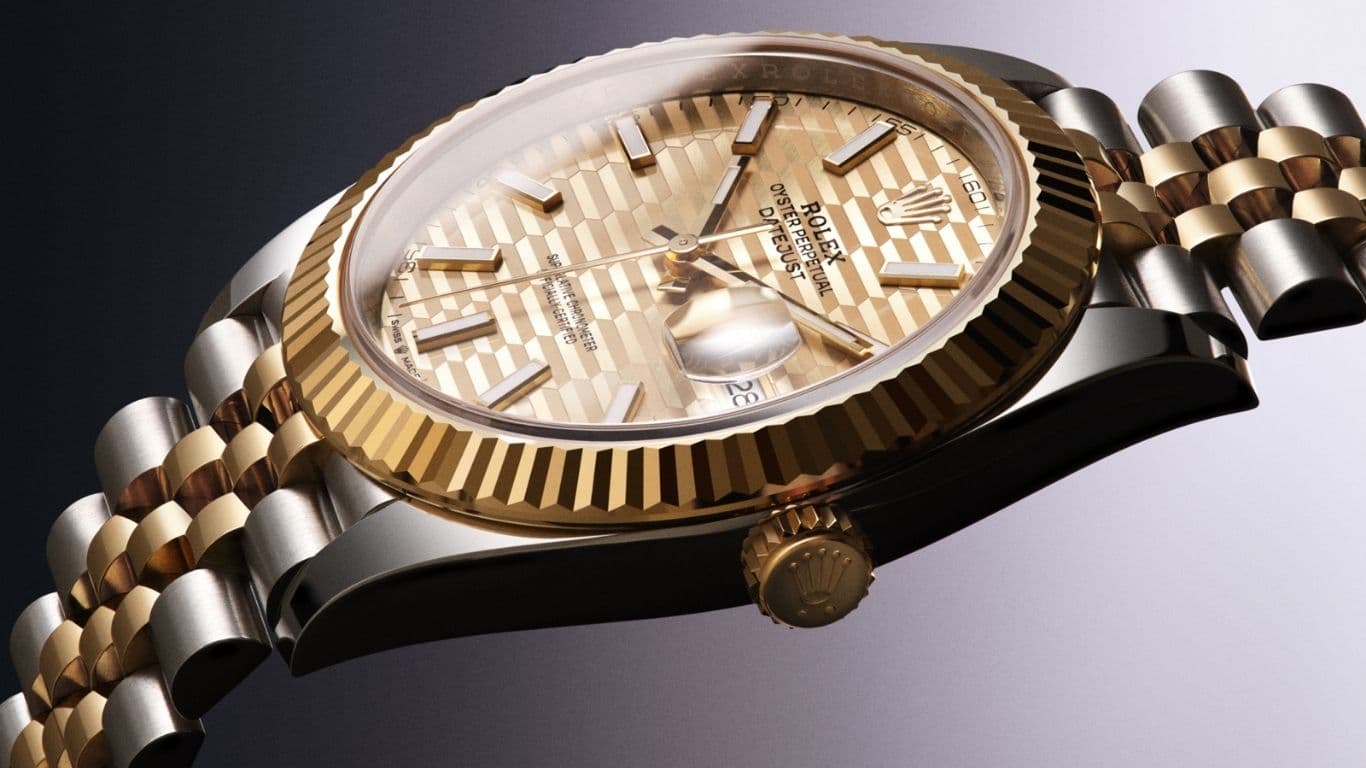
The two-tone references (steel and yellow gold, steel and Everose, steel and white gold) anchor a particular register of Datejust collecting: the working dress watch that doesn't apologise for being recognisably Rolex. The 126233 in steel-and-yellow-gold with the champagne dial and the fluted bezel is the reference most cited as the defining contemporary two-tone Datejust.
The Datejust 41 with the wimbledon dial (the slate-gray dial with the green Roman numerals, named for the Rolex sponsorship of The Championships, Wimbledon) and the various other contemporary dial configurations extend the line.
Hodinkee, GQ and the established specialist Rolex dealers consistently identify the Datejust as the most considered Rolex daily-wear reference. The reading holds because the design discipline does.
The dial-and-bezel decision
The Datejust catalogue's combinatorial depth means the choice of specific reference matters substantially more than for most Rolex sport pieces. Case size, case material, bezel type (fluted, smooth, gem-set), dial colour, dial style, marker style, bracelet type (Oyster, Jubilee, President-style on the Day-Date) all combine into a working catalogue. Two Datejusts with the same model number but different dial-and-bezel configurations can read very differently on the wrist.
The considered collector tends to handle several configurations in person at boutiques and specialist dealers before committing. The dial-and-bezel decision is the central design choice of any Datejust acquisition, and the secondary market reflects the consequences materially. We've watched the same buyer cycle through three configurations before settling on the one that actually fit how they live.
The fluted bezel is the Datejust's defining design element, originally designed to grip when winding the watch through the case (before the screw-down crown made manual winding less of an everyday activity). The smooth bezel reads more contemporary; the gem-set bezels run into the precious-metal upper tier. The dial choice (silver sunray, champagne, slate, blue, the rare Stella enamels in vintage, the contemporary wimbledon and palm-pattern dials) is the second-largest aesthetic decision.
The hour-marker style (Roman numerals, baton indices, diamond-set indices) is the third.
Why collectors keep coming back to the Datejust
The case for the Datejust as the most considered contemporary Rolex isn't really about pricing or secondary-market dynamics. Modern Datejust trades steadily but rarely climbs significantly above retail in the manner of the Daytona or the Submariner. The case is about register and wearability.
The Datejust does the most things well of any single reference Rolex produces. It works with a suit; it works on a weekend; it works in formal settings; it doesn't read as ostentatious where a sport Rolex would; it doesn't read as underdressed where a dress watch is expected. The historical anchor matters too.
The Datejust's role as the first wristwatch with an automatic date function (introduced 1945 to mark Rolex's 40th anniversary) gives the line a structural place in twentieth-century watchmaking. The reference's continuous production across eighty years, refined gradually rather than reinvented, is one of the longest-running design-continuity arcs in modern watchmaking. For collectors deciding where to enter Rolex, the Datejust is the reference we keep coming back to.
What this means for collectors building toward a Datejust
The longer story collectors come to recognise is that the most-worn watch in a serious collection tends not to be the most expensive or the most aggressive. It tends to be the one that earns its place across the broadest range of how the collector actually lives. For experienced collectors, that watch is more often than not a Datejust.
Our pick: the modern 126300 in steel with the silver dial on the Oyster bracelet. The reference is the contemporary one most likely to read as the most considered modern Rolex a decade from now. Design discipline is intact, case proportions sit well, and the watch earns its place across the broadest range of how it will actually be worn.
We last reviewed this analysis in May 2026.

Frequently Asked Questions
- Will a Rolex Datejust hold its value if I wear it daily?
- Normal, careful daily wear should not destroy value, especially if you service the watch properly and keep the box and papers. You might not achieve the same price as an unworn example, but a Datejust in good condition still sells easily and often at a healthy profit over long holding periods.<br><br>
- Is the Datejust harder to buy than sport models like the Submariner or Daytona?
- Usually no. Many authorised dealers still have waitlists for the most popular Datejust configurations, but they are typically shorter and more manageable than for flagship sport references. On the secondary market, there is much more choice and better pricing transparency.<br><br>
- Is a Datejust safer than buying a hype watch at a big premium?
- For most buyers, yes. Because Datejust prices are less inflated by speculation, you are paying more for the watch itself and less for hype. That reduces the risk of sharp price drops if sentiment cools, while still giving you exposure to Rolex’s brand strength and long-term demand.

Stefanos Moschopoulos
Stefanos Moschopoulos founded The Luxury Playbook in Athens and has spent the better part of a decade following the auction calendar, the en primeur releases, and the watchmakers, gallerists, and shipyards the magazine covers. He writes the field guides and listicles that anchor the Connoisseur section — pieces built on Phillips and Christie's results, Liv-ex movements, and conversations with collectors he has met across Geneva, Bordeaux, Basel, and Monaco. His own collecting habits sit closer to watches and wine than art, and it shows in the level of detail in the magazine's coverage of those categories. Under his direction, The Luxury Playbook now publishes long-form field guides, market-defining year-end listicles, and the Voices interview series with the founders behind the houses and the brands.