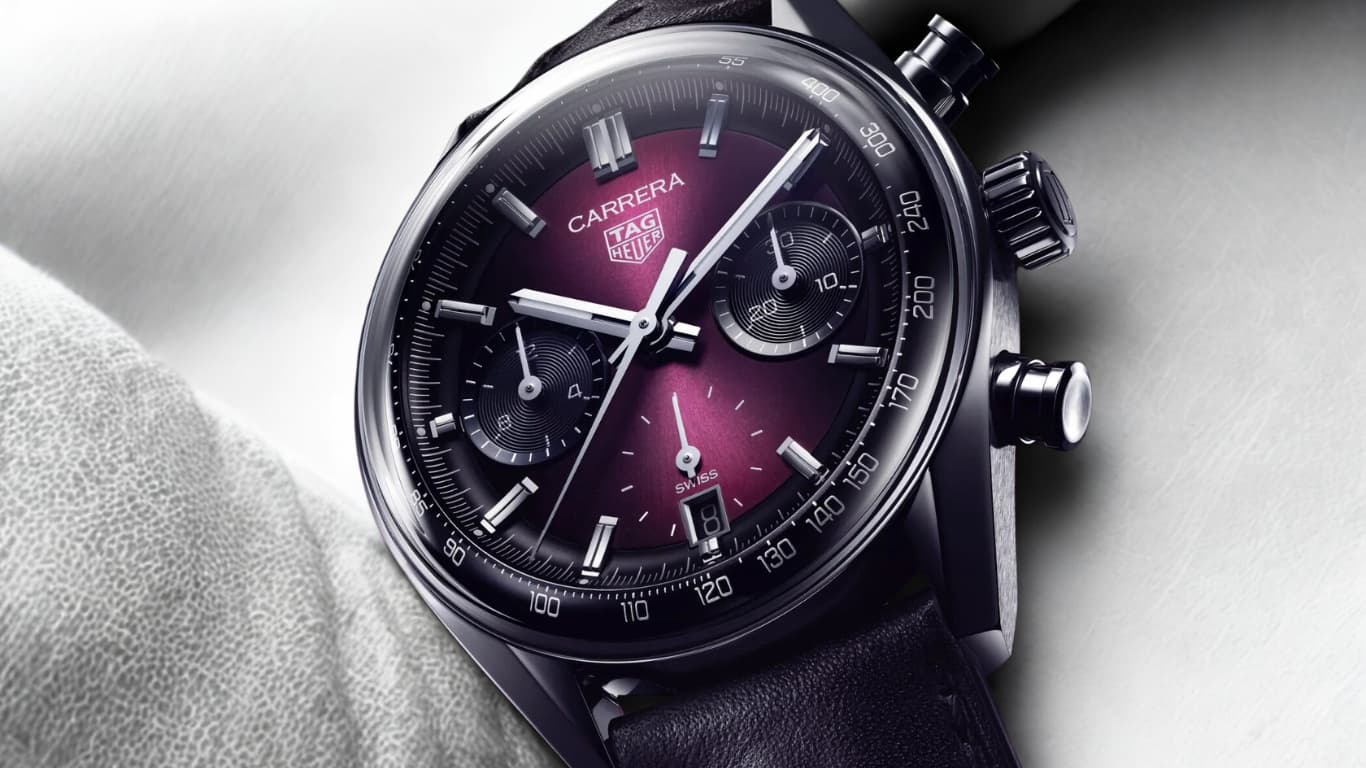
The TAG Heuer Carrera stays a reference in modern chronograph collecting because the original 1963 design remains one of the cleanest motorsport chronograph templates ever produced, and the contemporary line has finally returned to that disciplined register after a decade of drift.
- The TAG Heuer Carrera remains a reference chronograph in motorsport-anchored collecting, with Jack Heuer design lineage and racing heritage supporting decades of collector interest.
- Reference CBN2A1A and the modern Heuer 02 calibre versions anchor the current catalogue, with in-house calibre architecture closing the manufacturing gap with competitors.
- Vintage Carrera references from the 1960s and 1970s remain the strongest collector entries, with original conditions and 2447S dials commanding meaningful auction premiums.
- We see the modern Carrera Chronograph as the strongest single TAG Heuer purchase for motorsport-anchored collectors, at price points that respect the brand positioning.
- Limited Carrera editions tied to motorsport milestones, including the Jack Heuer commemorations, continue to outperform the broader TAG Heuer catalogue on the secondary market.
- The Carrera's clean dial architecture and three-register chronograph layout remain the design template that other manufacturers continue to reference.
- Who is this for?
- Motorsport-anchored collectors, TAG Heuer enthusiasts, and design-anchored buyers drawn to clean three-register chronograph references.
- What is happening?
- A grounded case for the TAG Heuer Carrera as a reference chronograph, covering Jack Heuer design lineage, in-house Heuer 02 calibre, and vintage collector entries.
- When did this emerge?
- The Carrera has anchored TAG Heuer's heritage marketing since the original 1963 release, with vintage references gaining auction visibility through the last decade.
- Where is this happening?
- Authorised TAG Heuer dealers globally stock the current catalogue, while Phillips, Christie's, and specialist auctions handle the vintage market.
- Why does it matter?
- The Carrera combines genuine motorsport heritage with clean three-register chronograph design, which makes it the reference TAG Heuer for racing-anchored collectors.
The original Carrera reference 2447 launched in 1963, designed by Jack Heuer with the clean dial geometry, the 36mm case, the manual-wind Valjoux 72 movement, and the inner tachymeter ring that defined the modern motorsport chronograph register for the next half-century.
Sixty-three years on, the Carrera continues to anchor TAG Heuer's most considered watchmaking. It provides the structural reference around which contemporary motorsport chronograph collecting still organises, and it remains a foundational reference in motorsport-inspired chronograph collecting.
Why the TAG Heuer Carrera stays a reference
The 1963 design is the starting point. Jack Heuer's brief was specific: a chronograph that worked under racing conditions, with the inner tachymeter ring legible at speed and the dial geometry clean enough to read at a glance. The reference 2447 delivered against that brief, and the design template has held up across six decades because it answered the original question cleanly.
The modern Carrera occasionally drifted away from the original discipline. The 2010s saw various design experiments and case-size escalations that pulled the line away from its structural identity. The 2023 60th anniversary references brought the line back to its original 1963 design language, with the clean dial and the period-correct case proportions, and collector reception has been substantially more positive than the broader contemporary Carrera catalogue had been across the prior decade.
That return to discipline is what keeps the Carrera structurally relevant. The watchmaking community reads the contemporary Carrera most clearly when the brand respects the line's own design history; the moments of departure tend to disappoint, and the moments of return tend to consolidate collector interest.
The original Carrera and the vintage tier
The vintage Carrera catalogue runs from the original 1963 reference 2447 through the various 1960s and 1970s Heuer Carrera references: the 2447SN, the 2547, the 7753, and the various dial-and-movement variants. Manual-wind references with the Valjoux 72 movement anchor the upper vintage tier.
The various automatic-chronograph references that came in with the Calibre 11 (the 1969 collaborative automatic chronograph movement Heuer co-developed with Breitling, Buren, and Hamilton-Büren) define the second-tier vintage Carrera collecting.
Clean vintage Carrera references with original dials and credible service history trade between $5,000 and $25,000 depending on reference, condition, and provenance. The rare dial variants (the Pasadena, the rare three-register configurations, the various coloured-dial limited production runs) command meaningful premiums when they surface at Phillips and the established specialist dealers.
Originality matters as much on vintage Carrera as on any other vintage Heuer reference. Refinished cases drop value meaningfully; replacement hands and service-dial swaps both compromise the considered collector premium. The dedicated Heuer specialist dealers in Europe and North America, notably OnTheDash and the Watchprosite Heuer Forum communities, handle the broader vintage market with the kind of dial-variant granularity the broader market doesn't really match.
The modern Carrera catalogue
The contemporary Carrera catalogue runs from the Carrera Three Hands references at around $3,000 retail, through the Carrera Calibre Heuer 02 references with the in-house chronograph movement at around $7,000, into the upper-tier Carrera Plasma and various special-edition references. The recent Carrera 60th Anniversary references brought the line back to its original 1963 design language with the clean dial and the period-correct case proportions.
Collector reception on the 60th anniversary references has been substantially more positive than on the broader contemporary Carrera catalogue across the prior decade. Hodinkee, Worn & Wound, and the established specialist watch press all covered the 2023 releases as a return to form, and the secondary trading on the cleaner anniversary configurations has held its retail-adjacent register cleanly.
The Calibre Heuer 02 movement, TAG Heuer's in-house chronograph caliber introduced in 2017, is the contemporary technical anchor of the upper Carrera catalogue. The integrated chronograph architecture (column wheel, vertical clutch) and the visible movement through display casebacks give the contemporary Carrera the kind of technical credentials the brand's 2010s production had drifted away from.
The Calibre Heuer 02 and what it changed
The in-house chronograph caliber matters for two reasons. The technical credentials sit structurally above the modular chronograph movements the broader sub-$10,000 Swiss chronograph category mostly relies on. And the in-house movement architecture gives TAG Heuer the kind of manufacture credentials that, two decades ago, the brand didn't have access to.
Column-wheel construction reads cleaner than cam-driven chronograph activation. The vertical clutch architecture eliminates the slight stutter on chronograph engagement that the lateral clutch produces. Both features are common in upper-tier chronograph production; their inclusion in the Carrera Calibre Heuer 02 references at the $7,000 retail tier is the technical headline that anchors the line's contemporary credibility.
What collectors look for in a Carrera
For modern Carrera, the references that come up most consistently in serious collector conversation are the 60th Anniversary 1963 reissue references (the cleanest contemporary execution that respects the original design language), the Carrera Calibre Heuer 02 in the various standard configurations, and the various special editions tied to motorsport partnerships. Box-and-papers documentation matters; service-network access through TAG Heuer's authorised facilities is the practical baseline.
For vintage, the original reference 2447 in clean condition with the original dial and the Valjoux 72 movement anchors the upper tier. The various 1960s and 1970s manual-wind references and the early Calibre 11 automatic chronographs extend the broader vintage Carrera collecting tier.
The vintage market rewards the considered collector who reads the dial variants carefully. The Pasadena dial configuration, the rare three-register variants, and the various coloured-subdial executions each carry their own following. The dealer relationships matter on the vintage tier in ways they don't on the broader contemporary catalogue.
What this means for collectors
The Carrera occupies a particular position in modern chronograph collecting. The brand's 2010s production drifted away from the line's original design discipline; the 2023 60th anniversary releases have signalled a return to the considered classical register that anchored the original Carrera's place in the catalogue. So far, on the evidence of how Phillips and the specialist dealers are giving the contemporary Carrera serious page space again, the discipline appears to be holding.
We'd argue the Carrera is the contemporary TAG Heuer reference most likely to read well a generation from now, provided the brand maintains the design discipline the anniversary releases signalled. The cultural anchor of the 1963 original isn't going anywhere, and the design language is distinctive enough to age well alongside the broader chronograph catalogue.
Further reading
- The Most Coveted TAG Heuer References of 2026
- Why the Rolex Daytona Stays the Most-Coveted Reference
We last reviewed this analysis in May 2026.

Frequently Asked Questions
- Which TAG Heuer Carrera models hold their value best?
- Carrera Chronographs with the Heuer 02 or TH20 movement, Porsche editions, and anniversary models typically retain value best and have the strongest resale demand.<br><br>
- How much does a TAG Heuer Carrera cost in 2025?
- Retail prices in 2025 range from $3,900 for standard three-hand models to $8,000 for chronographs, and up to $65,000+ for high-complication Carrera Plasma or Tourbillon variants.<br><br>
- What movement does the TAG Heuer Carrera use?
- Most modern chronograph models use the Heuer 02 or TH20 calibre—both in-house movements with an 80-hour power reserve, vertical clutch, and column wheel design.<br><br>
- Do Carrera watches appreciate over time?
- Select models do. Limited editions, Porsche collaborations, and references with unique dials or movements have seen resale prices rise 10–25% over their launch MSRP within 1–3 years.<br><br>
- Is the TAG Heuer Carrera a luxury watch?
- Yes. While priced below Rolex and Omega, the Carrera is a Swiss-made luxury chronograph with premium materials, in-house movements, and strong design heritage.<br>

Stefanos Moschopoulos
Stefanos Moschopoulos founded The Luxury Playbook in Athens and has spent the better part of a decade following the auction calendar, the en primeur releases, and the watchmakers, gallerists, and shipyards the magazine covers. He writes the field guides and listicles that anchor the Connoisseur section — pieces built on Phillips and Christie's results, Liv-ex movements, and conversations with collectors he has met across Geneva, Bordeaux, Basel, and Monaco. His own collecting habits sit closer to watches and wine than art, and it shows in the level of detail in the magazine's coverage of those categories. Under his direction, The Luxury Playbook now publishes long-form field guides, market-defining year-end listicles, and the Voices interview series with the founders behind the houses and the brands.