Why Los Angeles luxury property sales have hit a standstill is the most interesting structural question in the U.S. prime market right now. Only 11. 5 of every 1,000 homes in the LA metro area sold in the first nine months of 2025, the second-lowest turnover rate of any major U.S. city, trailing only the post-fire Pacific Palisades context.
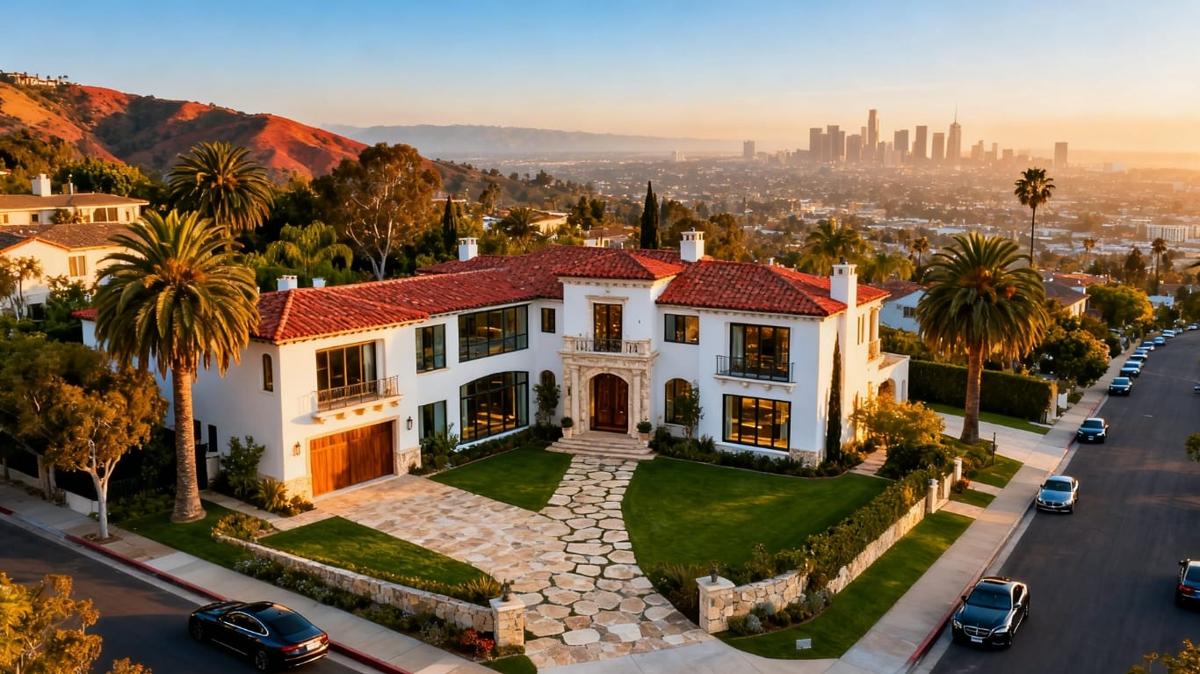
The more interesting picture sits at the trophy tier, where the Beverly Hills, Bel Air, Holmby Hills, Brentwood, and Pacific Palisades luxury inventory has produced the longest sales calendars and deepest price-discovery friction the city has seen in a decade.
Compass Los Angeles, Sotheby's International Realty Beverly Hills, and Hilton & Hyland (the three brokerage networks that handle the bulk of LA prime) describe the same underlying picture. Inventory has accumulated, the trophy listings have aged on market, and the pricing achieved on transactions, when transactions occur, has come in materially below original launch ask. Mansion Global's late 2025 LA dispatch put the median trophy-listing duration above 360 days, against a long-term average closer to 200.
- Los Angeles luxury property sales have hit a meaningful standstill in 2026, with transaction volumes above the Measure ULA mansion tax threshold dropping sharply from pre-tax levels.
- We see sellers and buyers each adjusting to the post-ULA reality, with the four to five and a half percent transfer tax on sales above five million reshaping the cost calculation.
- Inventory has built up materially in the prime hillside, Beverly Hills and Bel Air enclaves, with months-of-supply giving qualified buyers historically attractive negotiating positions.
- Some sellers have responded by structuring transactions to fall just below the ULA threshold, with price clustering becoming a visible feature of the market data.
- Wildfire risk and insurance availability concerns add further headwinds, with several luxury enclaves facing both the ULA effect and the climate diligence questions simultaneously.
- For most considered luxury buyers we view current LA conditions as offering historically attractive entry points, with patient capital well-positioned to navigate the post-ULA landscape.
- Who is this for?
- Luxury property buyers, investors and advisers tracking the LA market, alongside the family offices, lawyers and brokers structuring acquisitions in the post-ULA environment.
- What is happening?
- A market analysis of why Los Angeles luxury property sales have hit a standstill in 2026, covering the Measure ULA effects, inventory build-up and the climate diligence factors.
- When did this emerge?
- The article covers conditions through 2025 and 2026, with reference to the Measure ULA implementation since 2023 and the latest sales activity data.
- Where is this happening?
- The piece focuses on the Los Angeles luxury market, including the prime hillside, Beverly Hills, Bel Air and the broader Westside submarkets.
- Why does it matter?
- LA luxury market conditions in 2026 offer historically attractive entry points for patient capital, which is why understanding the ULA dynamics matters before any acquisition here.
Why the freeze concentrated in LA
Several forces have pressed in the same direction. The first is the post-2022 mansion-tax framework: Measure ULA added a 4 per cent transfer tax on properties above $5 million and a 5.5 per cent rate above $10 million.
The structural effect on prime trophy transactions has been larger than the headline rate suggests. The closing-cost stack on a $20 million Beverly Hills sale now adds approximately $1.1 million to the seller's friction layer, which has reshaped the pricing calculus for would-be sellers and effectively held inventory off-market.
The second is the post-2024 wildfire context. Pacific Palisades, Malibu, and parts of the broader Westside have been structurally affected by the 2024 fires, and the rebuilding-versus-selling decisions have produced a thinner active-market inventory than would otherwise be the case. The displaced households, the insurance-claim cycles, and the reconstruction permitting calendars all sit upstream of the transaction market.
The third is the broader rate environment and the buyer-affordability pressure. The LA market has historically run on a layered buyer profile (entertainment-industry wealth, Silicon Valley relocations, international buyers, the broader Westside professional cohort) and each of those segments has been affected by the rate environment in different ways. The result has been a coordinated softening across the demand stack rather than a single-segment slowdown.
The neighbourhoods at the centre of the freeze
Beverly Hills' trophy market across the Hillcrest, Trousdale, Mountain Drive, and the broader Beverly Hills Flats inventory has produced the longest sales calendars. Hilton & Hyland's late 2025 coverage describes the trophy Trousdale inventory at the highest active-listing count in over a decade, with the most-watched properties at original-ask anchors that are increasingly disconnected from the realised-sale pricing.
Bel Air's deeper inventory, including Stone Canyon, Roscomare Road, and the broader Bel Air Estates, has been more selective in what comes to market, with prime owners in many cases choosing to hold rather than face the friction layer. The trophy Bel Air market continues to clear at the upper tier when the right buyer-property match presents, but the absorption rate is meaningfully below the 2020 to 2022 pace.
Brentwood and the broader Westside, including Mandeville Canyon, Riviera, and the better Sullivan Canyon inventory, have produced a similar pattern. The mid-tier Westside inventory ($5 million to $20 million) has cleared more readily than the trophy tier, with the buyers who are active concentrating on properties that read as well-priced rather than aspirationally listed. Pacific Palisades and Malibu remain in the post-fire context with only selective transactions clearing.
What brokerages report buyers are doing
The buyer profile that is active is concentrated in three segments. The first is the relocation buyer with deep capital and a multi-year horizon, often coming from New York or international markets, who is willing to wait for the right property and to negotiate hard on price. This buyer cohort is patient and has been responsible for many of the trophy-tier transactions that have actually cleared in 2025.
The second is the redevelopment buyer, typically acquiring a tear-down or significant-renovation property at a price discount to its built-out potential. The Brentwood, Westwood, and Beverly Hills Flats markets have seen meaningful redevelopment-buyer activity through 2024 and 2025.
The third is the renovation-led buyer acquiring an established mid-prime property that has not been refreshed in a decade or more. Compass and Sotheby's IR both report this segment as the most active in 2025, with the renovation-led purchase often clearing 15 to 25 per cent below the original-launch pricing on the previously-listed property.
The international buyer dimension
International buyer activity has thinned. The 2010s LA prime market ran on a meaningful international-buyer share from Chinese, Russian, Middle Eastern, and Indian buyers that combined with the domestic demand to produce the absorption pace. The international flow into LA prime has weakened structurally since 2018, with the post-pandemic period further constraining particular national cohorts.
The Chinese buyer share, in particular, has been a fraction of its 2014 to 2017 peak. Knight Frank's International Buyers Index for 2025 ranked LA below New York, Miami, and several U.S. metropolitan areas in international-buyer flow share, a meaningful shift from the LA position a decade ago. Bloomberg's late 2025 coverage of LA prime corroborates the pattern.
Where the market reads heading into 2026
The LA prime market needs three things to find a clearing pace. The first is pricing realism from sellers anchored on 2022 peak values, and the brokerages describe an active pre-market conversation in which sellers are gradually accepting that the realised pricing will not return to the 2022 trajectory.
The second is some easing of the friction layer, whether through a ULA modification (which has been politically discussed but not implemented) or through buyer adaptation. The third is some renewal of the international-buyer flow, which is more dependent on macro and geopolitical conditions than on LA-specific factors.
The brokerages we follow are cautiously constructive on a more orderly 2026 market, with the freeze easing as sellers reprice and buyers re-engage. The trophy tier will likely lag the broader market in finding a new equilibrium, with the Trousdale and Beverly Hills trophy inventory continuing to face the longest sales calendars. The mid-tier Westside, the Brentwood and Palisades resilient pockets, and selective Bel Air inventory should clear more readily as 2026 progresses.
What this means for buyers
Further reading
For buyers thinking about LA prime, the freeze has produced a more interesting pricing conversation than the city has offered in over a decade. The patient buyer with deep capital and the willingness to negotiate has the upper hand at the trophy tier; the renovation-led buyer in the mid-prime range has access to inventory that would not have been priced reasonably in 2022.
The cycle's bottom likely will not be marked by a single dramatic event but by gradual repricing through the 2026 calendar, with the buyers who anchor on values rather than headline pricing finding the better outcomes. That is the position we would build.
We last reviewed this analysis in May 2026.