

The Philadelphia real estate market in 2026 is picking up real speed, giving investors and homebuyers a compelling mix of affordability, consistent rental demand, and long-term appreciation potential. Ranked among the top five hottest real estate markets in the country, Philadelphia punches above its weight thanks to its strategic location, vibrant economy, and rich architectural diversity, making it an increasingly attractive destination for both regional and out-of-state investors.
Unlike many coastal markets where sky-high prices and restrictive policies shut out opportunity, Philadelphia gives you more accessible entry points across a broad range of neighborhoods. The city’s blend of historic charm, expanding infrastructure, and relative affordability positions it as one of the most balanced and undervalued major markets in the U.S. If you’re looking for a city that rewards smart positioning, this is worth your attention.
Table of Contents
Overview of The Philadelphia Housing Market
As of Q1 2026, the Philadelphia housing market is stable, moderately competitive, and rich with opportunities for buyers and investors targeting both value and long-term growth. After several years of pandemic-driven volatility, the market has settled into a more sustainable pattern, defined by incremental price increases, improved inventory levels, and consistent demand in key neighborhoods.
The median sale price in Philadelphia currently sits at $250,000, reflecting a 3.4% increase year-over-year. The median listing price has risen to $269,000, signaling growing seller confidence and a resilient pricing floor across most submarkets. While the pace of growth has moderated compared to the 2021 to 2022 frenzy, appreciation stays steady, especially in neighborhoods undergoing revitalization or benefiting from infrastructure investment.
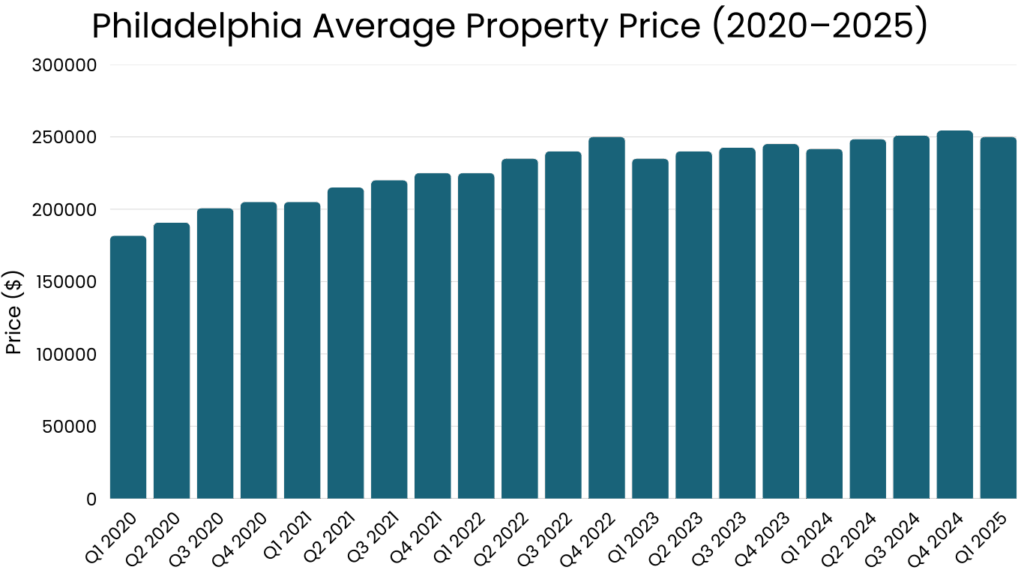
Homes in Philadelphia now spend an average of 67 days on the market, which tells you this is a balanced market where neither buyers nor sellers hold all the cards. The sale-to-list price ratio sits at approximately 98%, confirming that most homes are selling close to asking but with some room to negotiate if you play it right.
The city recorded over 4,500 active listings in early Q1 of 2026, alongside 1,127 new listings, suggesting healthier supply levels than during the tightest post-COVID periods. Inventory is still 46% lower than pre-pandemic norms, but it has improved 5.5% year-over-year, easing some pressure for buyers while continuing to support prices across the board.
Key market indicators worth keeping on your radar:
- Median sale price: $250,000; up 3.4% YoY
- Median listing price: $269,000
- Average days on market: 67
- Sale-to-list price ratio: 98%
- Inventory up 5.5% YoY but still 46% below pre-pandemic levels
Philadelphia’s real estate market in early 2026 is resilient and well-positioned for sustainable growth. For buyers and investors, current conditions offer a balanced environment for acquiring assets with real upside, especially in value-rich neighborhoods and mid-tier price ranges. If you’ve been sitting on the sidelines, this is the kind of market that rewards those who move with conviction.
Neighborhood Analysis
Philadelphia’s neighborhoods each carry their own character, investment appeal, and pricing dynamics. Getting to know these distinctions is what separates a good deal from a great one, and it’s essential for any buyer or investor serious about the Philadelphia housing market.
Center City
Center City is Philadelphia’s urban core, offering a blend of historic architecture, modern condominiums, and cultural landmarks. Despite its prominence, the neighborhood has seen a correction in home values, and for long-term investors, that correction is an opening worth exploring.
The median listing price runs at approximately $495,000, reflecting a 10.8% year-over-year decline. Properties here spend an average of 77 days on the market, which gives you more negotiating room than you’d find elsewhere in the city.
Price growth has slowed, but demand stays steady for well-located units near Rittenhouse Square, Logan Circle, and Society Hill. The area keeps drawing professionals and downsizers who want walkable city living with access to premier dining, retail, and transportation.
West Philadelphia
West Philadelphia offers affordability and consistent rental demand, bolstered by its proximity to universities, hospitals, and major infrastructure developments. The area is home to a growing student population and young professionals, particularly around University City, and that steady tenant base is hard to replicate in other parts of the city.
The median listing price runs around $210,000, with a price per square foot of $157. Homes average 73 days on the market, maintaining a relatively balanced pace. This neighborhood is a frequent target for investors seeking student rentals and small multifamily properties, and for good reason.
The combination of long-term appreciation potential and solid rental cash flow makes West Philadelphia one of the city’s more promising investment zones. If you’re building a portfolio, this is a neighborhood that deserves a serious look.
North Philadelphia
North Philadelphia is one of the city’s most actively redeveloping neighborhoods. Investors keep entering the market here, drawn in by low acquisition prices and rising tenant demand that shows no sign of slowing down.
The median sale price stands at $195,000, marking a 2.5% year-over-year decline. Homes typically sell after 64 days on market, indicating moderately active buyer interest and a window of opportunity for those willing to move decisively.
The neighborhood offers a high cash flow ceiling for experienced investors, especially in multifamily housing. As infrastructure improves and redevelopment accelerates, the long-term upside stays viable for those willing to manage risk and commit to property improvements.
Fishtown
Fishtown has transformed over the past decade into one of Philadelphia’s trendiest and most in-demand neighborhoods. With its art scene, nightlife, and proximity to downtown, it pulls in both owner-occupants and high-income renters who want to be at the center of the action.
The median listing price runs at approximately $424,900, with a price per square foot of $297. Properties in this area command premium pricing and often move quickly, so you need to be ready when the right unit comes up.
For investors, Fishtown opens the door to short-term rentals, luxury flips, and high-end buy-and-hold strategies. Demand stays strong, especially for modern units within walking distance to restaurants and transit.
Bustleton
Located in the Northeast, Bustleton gives you a suburban feel while still sitting within city limits. Known for its schools and low crime rate, it appeals to families and long-term renters who want stability without sacrificing city access.
The median listing price currently sits at $400,000. Homes here maintain steady value and consistent demand, making it a favored destination for those seeking portfolio stability without the volatility of trendier neighborhoods.
Bustleton’s rental market is particularly resilient, with low vacancy rates and dependable tenant retention. If you’re an investor who prioritizes occupancy and predictable income over flashy appreciation, this neighborhood belongs on your shortlist.
Somerton
Adjacent to Bustleton, Somerton offers a similarly quiet residential experience with strong demand among families and retirees. Its access to public transportation and major highways keeps commuter interest steady, and that demand isn’t going anywhere.
The median listing price runs at approximately $399,000, with price stability and gradual appreciation trends that make it a low-drama addition to any portfolio.
Somerton stands out for its low inventory, strong owner-occupancy rates, and suitability for conservative investors who want minimal volatility and a reliable tenant base year after year.
Neighborhood Median Prices and Price per SqFt
| Neighborhood | Median Listing Price | Price per SqFt |
|---|---|---|
| Center City | $495,000 | $380 |
| West Philadelphia | $210,000 | $157 |
| North Philadelphia | $195,000 | $145 |
| Fishtown | $424,900 | $297 |
| Bustleton | $400,000 | $265 |
| Somerton | $399,000 | $258 |
| Port Richmond | $295,000 | $215 |
| Brewerytown | $318,000 | $238 |
| Germantown | $269,000 | $205 |
| South Philadelphia | $360,000 | $275 |
Philadelphia Rental Market Overview
Philadelphia’s rental market has been on a steady upward trajectory, driven by rising home prices, interest rate pressures, and a large urban renter population. As homeownership moves further out of reach for many residents, rental demand has stayed high, keeping vacancy rates low and rent prices on the climb. You can see this dynamic playing out in real time across the city’s most active neighborhoods.
As of Q1 2026, the market continues to favor landlords, especially in neighborhoods near universities, job centers, and redevelopment corridors. If you own rental property in the right pockets of Philadelphia right now, the numbers are working in your favor.
As of early 2026, here is what average apartment rents look like across Philadelphia by unit type:
- Studio Apartments: Approximately $1,350 per month
- One-Bedroom Apartments: Around $1,575 per month
- Two-Bedroom Apartments: About $1,850 per month
- Three-Bedroom Apartments: Approximately $2,150 per month
These figures reflect a 3.9% increase compared to the previous year, showing consistent demand across all unit types. Despite this rise, Philadelphia still comes in below the national average rent of $1,980, which keeps it attractive as an affordable metro for both renters and real estate investors looking for better yield-to-cost ratios than gateway cities can offer.
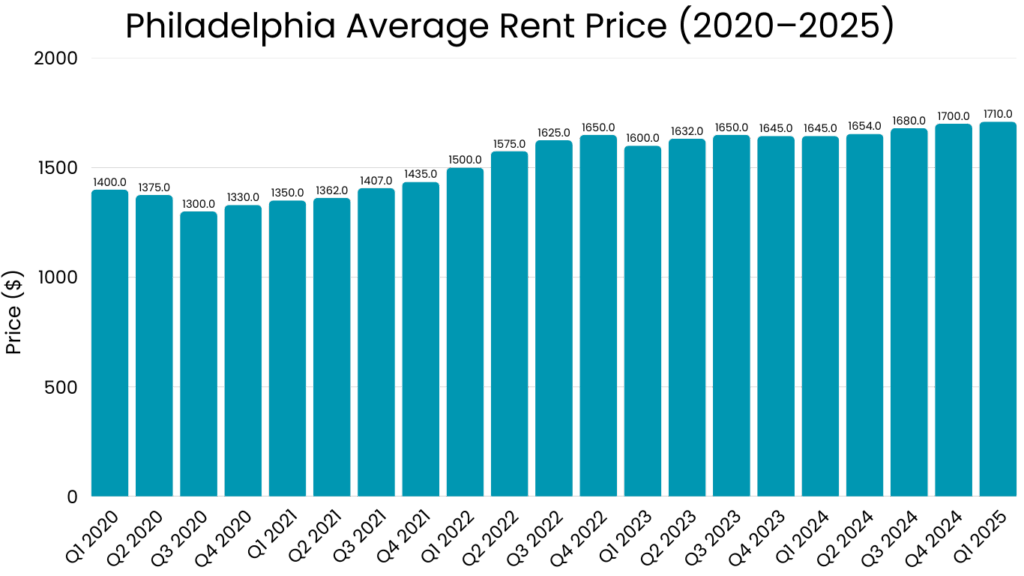
Rent levels can vary widely depending on the neighborhood, property quality, and proximity to transit or universities, so where you buy matters as much as what you buy.
High-demand areas like Center City and Fishtown see one-bedroom rents regularly exceeding $1,950 per month, while neighborhoods like West Philadelphia and Germantown offer more affordable options, typically ranging between $1,200 and $1,400 per month.
Center City one-bedroom apartments average about $1,950 per month, supported by demand from professionals, corporate tenants, and downsizers. Properties here command higher rents because of walkability and proximity to government, healthcare, and legal sectors.
Fishtown two-bedroom apartments rent for approximately $2,000 per month. The area’s lifestyle appeal, boutique development, and proximity to downtown all contribute to premium pricing and high renter turnover that keeps units consistently occupied.
In West Philadelphia, particularly near University City, one-bedroom units typically rent for $1,350 per month. Investor demand stays strong in this submarket thanks to consistent student and faculty occupancy and favorable rent-to-price ratios that are tough to find in most major U.S. cities.
Brewerytown offers a mix of affordability and upside potential. One-bedroom apartments average $1,300 per month, and the neighborhood keeps attracting young renters who want proximity to Fairmount Park and downtown without paying Center City prices.
Philadelphia’s rental vacancy rate currently sits at approximately 6.1%, a slight decline from the previous year. That modest reduction signals sustained renter demand, especially in neighborhoods near employment hubs, transit lines, and universities.
Low vacancy rates are supported by several key factors worth understanding before you make a move:
- Limited New Construction: Development activity has not kept pace with renter demand, particularly in mid-range and affordable housing segments.
- Affordability Pressures: Rising mortgage rates have delayed many renters from transitioning to ownership.
- Demographic Shifts: A growing base of young professionals, students, and in-migrants continues to fuel rental demand citywide.
The current supply-demand imbalance lets landlords raise rents and maintain high occupancy, especially in Class B and Class C rental properties. That’s where the strongest cash flow story is playing out right now.
Factors Influencing the Philadelphia Housing Market
The Philadelphia housing market in 2026 is shaped by a combination of economic, demographic, and regulatory drivers. Understanding these forces is what gives you an edge when timing purchases, evaluating investment risk, and spotting emerging opportunities across different submarkets.
1. High Mortgage Rates. Mortgage rates stay elevated, fluctuating between 6.5% and 7%, which keeps reducing purchasing power for first-time buyers. These higher borrowing costs have slowed buyer activity and pushed more demand into the rental market, as many prospective homeowners put their purchase plans on hold.
2. Inventory Shortages. Inventory has risen slightly year-over-year, but it still sits 46% below pre-pandemic levels. New construction has not kept pace with demand, especially in the $200K to $350K price range, leaving limited options for buyers and keeping competition fierce in affordable neighborhoods.
3. Population Growth and Affordability. Philadelphia keeps attracting residents from higher-cost metro areas like New York and D.C. Its relatively low home prices and lower cost of living make it a natural landing spot for remote workers, young professionals, and retirees who want urban amenities without the price tag to match.
4. Limited New Construction. Development stays constrained by rising construction costs, limited land availability, and zoning restrictions. New multifamily and townhouse developments are underway in areas like North Philadelphia and Brewerytown, but delivery remains well below the level needed to satisfy housing demand.
5. High Rental Demand. Rental demand stays elevated as higher mortgage rates and limited for-sale inventory keep more households in the rental market. Landlords continue to benefit from low vacancy rates and rising rents, especially in centrally located neighborhoods with good transit and job access.
6. Investor Activity. Investors and small-scale landlords stay active in neighborhoods offering strong rent-to-price ratios. Areas like West Philadelphia, Port Richmond, and Germantown keep drawing out-of-state buyers in search of stable cash flow and long-term appreciation potential.
7. Infrastructure and Neighborhood Revitalization. Public and private investment in transportation, parks, and streetscape improvements are accelerating interest in up-and-coming areas. Redevelopment zones like Kensington and Brewerytown are seeing increased buyer and renter interest thanks to new amenities and strong future growth prospects. You can track some of these trends through Bloomberg’s coverage of emerging U.S. real estate markets.
Philadelphia Housing Market Forecast for 2026
Looking ahead through 2026, the Philadelphia housing market is expected to maintain steady growth, supported by affordability, resilient rental demand, and long-term demographic trends that keep working in the city’s favor.
The market may not deliver explosive price appreciation. But what it does offer is stability and moderate gains that appeal to both investors and end-users who value consistency over speculation.
Home prices in Philadelphia are projected to rise between 2.5% and 4.5% over the next 12 months. With the current median home price at $250,000, that points to a potential increase to between $256,250 and $261,250 by early 2027, according to Zillow Research’s latest housing projections.
This growth is expected to be strongest in areas like West Philadelphia, Port Richmond, and South Kensington, where revitalization projects and increased buyer activity are pushing values higher. More established areas like Center City may see flatter growth as affordability caps put a ceiling on buyer budgets.
Mortgage rates stay a headwind, but the combination of pent-up buyer demand and ongoing in-migration is expected to support home values, especially in sub-$400K segments where competition stays fierce.
Inventory levels are expected to stay tight through 2026. Listings increased slightly in 2024, but the market is still operating with 46% fewer homes than pre-pandemic levels. That continued supply shortage, especially in affordable price brackets, is likely to keep competition elevated for well-priced listings.
Homes in the $200K to $350K range are expected to stay the most competitive, with average days on market holding steady around 60 to 70 days. If you’re targeting entry-level properties or value-add investments in that segment, you’ll need to act quickly and decisively.
If interest rates fall, buyer activity could increase sharply, putting additional strain on already limited supply and making today’s prices look like a bargain in hindsight.
Philadelphia’s rental market is forecast to stay strong through 2026, with rents expected to rise between 4% and 6%. With current average rents around $1,754 per month, that translates to potential increases to $1,824 to $1,859 per month by early 2027, as tracked by Apartment List’s national rent research.
The highest rental growth is projected in neighborhoods like Fishtown, Brewerytown, and South Philadelphia, where development has expanded housing options while strong tenant demand keeps pushing rents upward.
Vacancy rates are expected to stay low, between 5.5% and 6.2%, especially in Class B and Class C rental stock, which keeps outperforming thanks to affordability pressures in the ownership market.
Investors focusing on mid-tier multifamily properties will benefit from both rising rents and consistent occupancy, especially in neighborhoods with strong transit access and walkability. That combination is what drives durable returns over time.
Is It Worth Buying A Property In Philadelphia?
Yes. Buying a property in Philadelphia in 2026 is a compelling opportunity for both investors and end-users. The market benefits from a combination of relative affordability, strong rental demand, and long-term appreciation potential, making it one of the most strategically favorable major metros on the East Coast right now.
At a median home price of $250,000, Philadelphia gives you a significantly lower entry point compared to cities like New York, Boston, or Washington D.C. That pricing allows for stronger rent-to-price ratios, especially in neighborhoods like West Philadelphia, Port Richmond, and North Philly, where you can still find multifamily units or single-family rentals with positive cash flow potential. For a deeper look at how to structure these kinds of acquisitions, understanding asset allocation strategies can sharpen your decision-making.
For income-focused buyers, the city offers consistent demand from renters fueled by local universities, hospitals, and corporate employers. That tenant base doesn’t disappear when the economy softens, which is exactly the kind of durability you want in a long-term hold.
With rents rising 3.9% year-over-year and average gross yields ranging from 6% to 8%, you can achieve above-average cap rates while benefiting from future value growth. That’s a combination you don’t find easily in most major U.S. markets, as Forbes Real Estate has noted in its coverage of undervalued urban investment markets.
Buyers seeking long-term appreciation may want to target gentrifying areas like Brewerytown, South Kensington, or Germantown, where infrastructure projects and revitalization efforts are accelerating price appreciation and attracting a higher quality of tenant.
Philadelphia also stays relatively landlord-friendly, with no city-wide rent control and flexible zoning in certain districts that support value-add strategies like ADUs or multifamily conversions. That regulatory environment matters when you’re planning a long-term hold.
Mortgage rates may stay elevated in the short term. But buying now lets you lock in properties before further appreciation and refinance later if rates come down. Waiting could mean higher competition once affordability improves and more buyers flood back into the market.
Other Market Forecasts & Overviews
New York City Real Estate Market Overview & Forecast
Chicago Real Estate Market Overview & Forecast
Phoenix Real Estate Market Overview & Forecast
San Antonio Real Estate Market Overview & Forecast
Dallas Real Estate Market Overview & Forecast
Jacksonville Real Estate Market Overview & Forecast
Columbus Real Estate Market Overview & Forecast
Indianapolis Real Estate Market Overview & Forecast
Seattle Real Estate Market Overview & Forecast
Oklahoma Real Estate Market Overview & Forecast
Los Angeles Real Estate Market Overview & Forecast
Houston Real Estate Market Overview & Forecast
San Diego Real Estate Market Overview & Forecast
Austin Real Estate Market Overview & Forecast
San Jose Real Estate Market Overview & Forecast
Charlotte Real Estate Market Overview & Forecast
San Francisco Real Estate Market Overview & Forecast
Denver Real Estate Market Overview & Forecast
Nashville Real Estate Market Overview & Forecast
FAQ
Are home prices in Philadelphia expected to rise in 2026?
Yes. Home prices are projected to grow by 2.5% to 4.5%, driven by continued demand, affordability, and tight inventory levels.
Is Philadelphia a good market for real estate investment?
Absolutely. With strong rent-to-price ratios, rising rental demand, and consistent appreciation, Philadelphia offers solid opportunities for cash flow and long-term equity growth.
Which neighborhoods in Philadelphia offer the best investment potential?
High-opportunity areas include West Philadelphia, Brewerytown, Port Richmond, and Germantown—all offering affordability, tenant demand, and upside potential.
Is now a good time to buy property in Philadelphia?
Yes. Buyers can benefit from moderate pricing, strong rental yields, and long-term appreciation potential. Waiting may lead to higher competition and prices if interest rates decline in 2026.